
401(k) Calculators
401(k) Max Contribution Calculator
Find exactly how much to contribute per paycheck to hit the 2026 IRS limit, see the real paycheck impact, and how much a Traditional contribution actually saves you in taxes.

Calculate your max-out contribution
"Real take-home reduction" nets out the tax savings from a Traditional contribution — Roth contributions reduce your paycheck by the full amount, since there's no current-year deduction.
How to calculate 401(k) contribution to max out
Three numbers, one division.
Find your limit
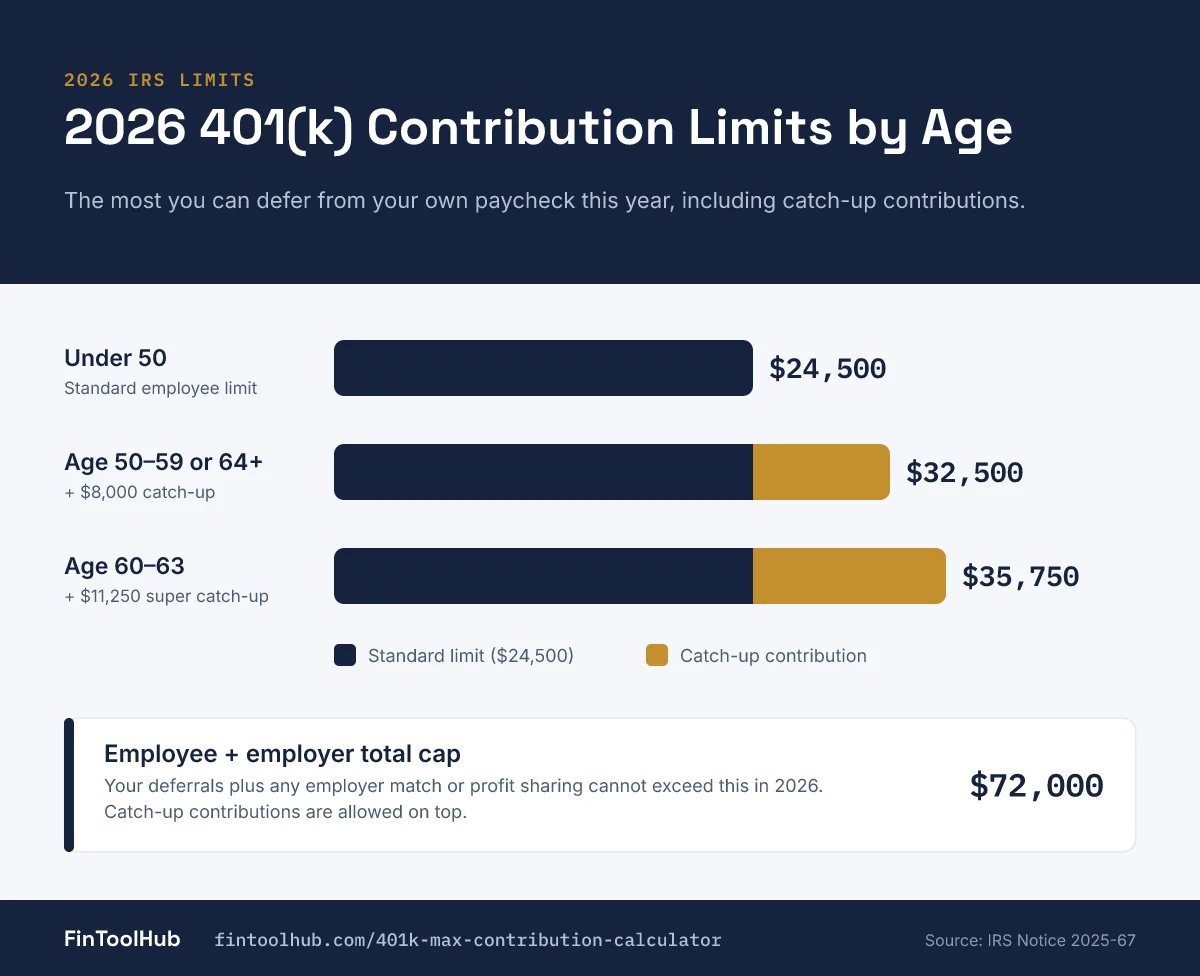
$24,500 for 2026, or $32,500/$35,750 with catch-up depending on your age.
Subtract what's already in
Limit minus your year-to-date contributions = remaining room.
Divide by paychecks left
Remaining room ÷ pay periods left in the year = what to set per paycheck.
2026 401(k) contribution limits
A 401k max contribution calculator, 401k contribution limit calculator, maximum 401k contribution calculator, or 401k limit calculator question starts with the IRS numbers for the year:
| Age | 2026 limit |
|---|---|
| Under 50 | $24,500 |
| 50–59 or 64+ | $32,500 |
| 60–63 | $35,750 |
These are elective deferral limits — your own contributions only. Employer match and other employer contributions are separate, capped instead by a much higher combined limit ($72,000 for 2026, per IRC Section 415(c)) that most employees never come close to.
How to max out your 401(k) by year-end
A max out 401k calculator, 401k contribution calculator to max out, 401k max out calculator, 401k calculator max out, calculate max 401k contribution, or calculate 401k contribution to max out search is asking the same practical question: how much per paycheck, starting now, gets me to the full annual limit by December 31? Take your limit, subtract what you've already contributed this year, and divide by the number of paychecks remaining — exactly what the calculator above does.
401(k) contribution and paycheck impact
A 401k contribution paycheck calculator, 401k contribution calculator paycheck, 401k paycheck contribution calculator, paycheck calculator with 401k contribution, paycheck calculator 401k contributions, or how to calculate 401k contribution on paycheck search wants to know one thing: how much smaller does my check get? For a Traditional contribution, the answer is less than the raw contribution amount, because that money was never taxed in the first place — your paycheck shrinks by the contribution minus the tax you would have paid on it. Our 401(k) Paycheck Calculator breaks this down line by line if you want the full pay-stub view.
How much does a 401(k) contribution reduce your taxes?
A how much does 401k contribution reduce taxes calculator needs to apply your actual marginal bracket to the contribution, not a flat guess. Because federal tax brackets are progressive, a Traditional contribution's tax savings depend on which bracket(s) it's actually sitting in relative to your other income — the calculator above computes this the correct way: tax on your income without the contribution, minus tax on your income with it deducted.
Roth 401(k) contributions on your paycheck
A roth 401k contribution calculator or how to calculate roth 401k contribution on paycheck search has a simpler answer: Roth contributions come out of your paycheck after tax, so there's no current-year tax reduction to calculate — your take-home pay drops by exactly the contribution amount, full stop. The tradeoff is qualified withdrawals in retirement are tax-free, which the Traditional side doesn't offer. If you're weighing which makes more sense for you, our Roth or 401(k) Calculator compares both paths side by side, and our 401(k) to Roth IRA Conversion Calculator covers the separate question of converting existing Traditional savings.
401(k) contribution percentage vs. dollar amount
A 401k contribution percentage calculator or 401k calculator contribution search is often just converting between the two: most payroll systems ask for a percentage of each paycheck, not a flat dollar figure, so the calculator above shows both — the dollar amount needed and what percentage of your paycheck that represents.
Individual (solo) 401(k) contribution limits are different
An individual 401k contribution calculator search usually means a Solo 401(k) for the self-employed — and the math genuinely differs from a standard employee plan. As a solo business owner, you can contribute as both "employee" (same $24,500/$32,500/$35,750 elective deferral limits above) and "employer" (up to 25% of net self-employment income), with both pieces combined capped at the same $72,000 (or $80,000/$83,250 with catch-up) 2026 combined limit. This calculator handles the employee-deferral side; the employer/profit-sharing side depends on your specific business income — see our 401(k) Profit Sharing Calculator for that half of the math.
Escalating your contribution over time
A 401k calculator with increasing contributions search is about auto-escalation — many plans automatically raise your contribution percentage by 1 point each year, often timed to coincide with annual raises so the paycheck impact feels smaller. If your plan offers this, it's a low-friction way to work toward maxing out gradually rather than all at once.
2026 contribution limits verified against IRS Notice 2025-67 and Fidelity's published limits summary. This is a planning estimate — your payroll provider's actual per-paycheck calculation is the authoritative figure. Official sources: IRS Notice 2025-67; IRS: 401(k) contribution limits.
Frequently asked questions
Before you change your contribution election.
What happens if I contribute more than the IRS limit?
Excess deferrals are taxed as income in the year contributed, and taxed again if not withdrawn by April 15 of the following year — effectively double-taxed. Most payroll systems cap contributions automatically to prevent this, but it can happen if you switch employers mid-year and each plan tracks your limit separately.
Does employer match count toward my personal contribution limit?
No. Your $24,500 (or higher, with catch-up) elective deferral limit covers only your own contributions. Employer match is separate and counts toward the much higher $72,000 combined limit instead.
Should I max out my 401(k) if it means missing part of the employer match?
Generally no — if maxing out early in the year means your contributions stop before the plan's match period ends, you can lose match dollars. Spreading contributions evenly across the full year is usually the safer way to capture both the full match and the full annual limit.
Can I change my contribution percentage mid-year?
Most plans allow this at any time through your payroll or benefits portal — useful if you're catching up to max out later in the year, or if your circumstances change.
Is it better to max out my 401(k) evenly or as early as possible?
Contributing as early as possible gets your money invested and compounding sooner, which is usually the better outcome for long-term growth — the tradeoff is a bigger paycheck impact in the months you're contributing more heavily, and the front-loading risk of missing match if your plan calculates match per pay period rather than annually.