
Tax Calculators
Reverse Sales Tax Calculator
Have a total price and need the pre-tax amount? This calculator works backward from a tax-inclusive total to show exactly what the item cost before tax — or forward, if you're starting from the pre-tax price instead.

Calculate
Enter your own local rate — combined state, county, city, and special-district sales tax rates vary widely and this tool doesn't assume one for you.
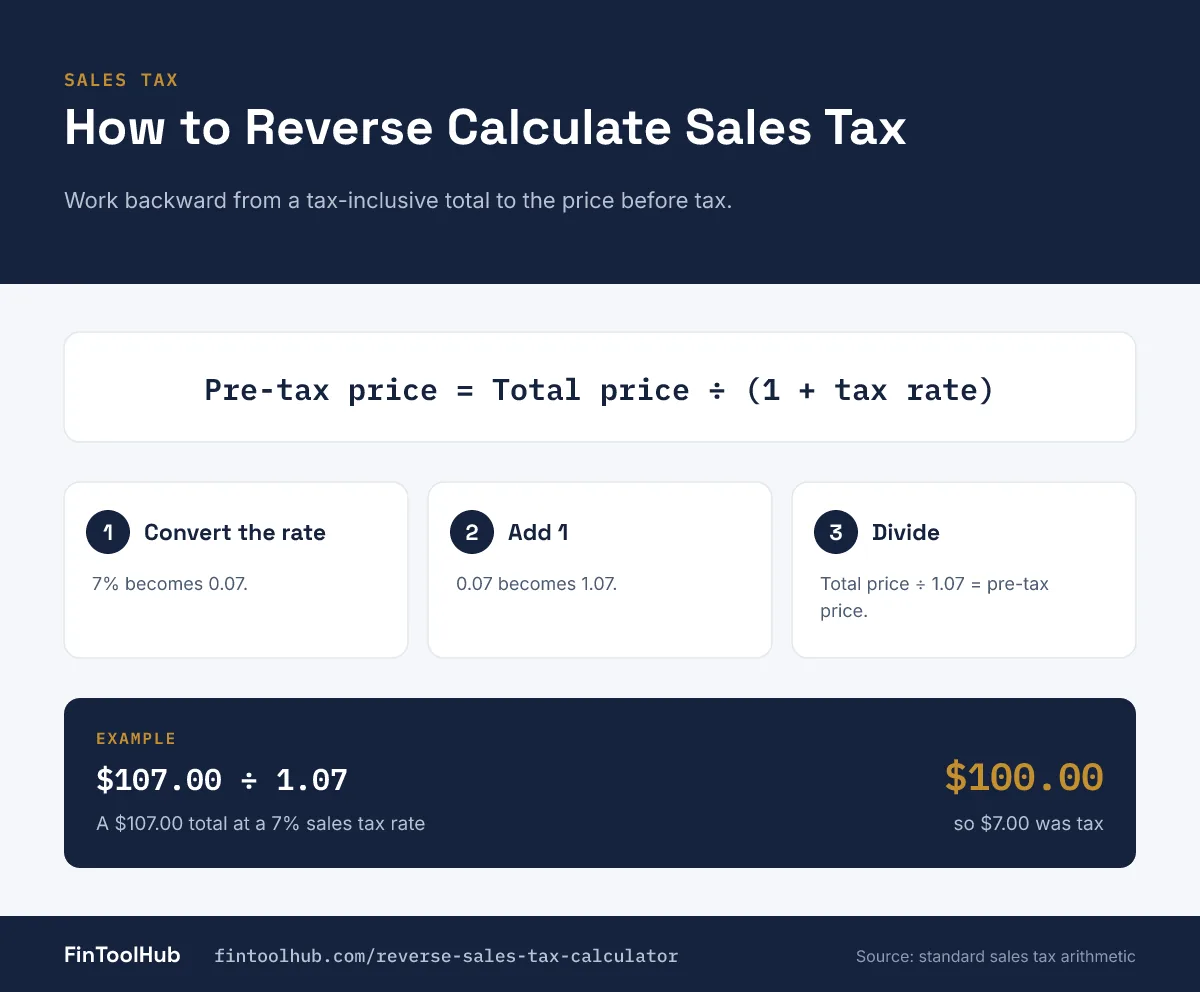
How to reverse calculate sales tax
One division, not a lookup table.
If you know the total you paid and the tax rate, divide the total by 1 plus the tax rate (as a decimal) to get the pre-tax price:
Pre-tax price = Total price ÷ (1 + tax rate)
Subtract the pre-tax price from the total to get the tax amount itself. Going the other direction — from a known pre-tax price to a total — is simpler: multiply the pre-tax price by the tax rate to get the tax amount, then add the two together.
Total price = Pre-tax price × (1 + tax rate)
When you need a reverse sales tax calculator
A reverse sales tax calculator is for exactly one situation: you have a receipt, invoice, or price tag showing the total amount, and you need to know what the item cost before tax was added — for bookkeeping, expense reports, comparing prices across states, or just curiosity. A sales tax reverse calculator or sales tax calculator reverse search is asking for the same thing, just phrased differently.
How to calculate reverse sales tax, step by step
To calculate reverse sales tax or reverse calculate sales tax by hand:
- Convert the tax rate to a decimal (7% becomes 0.07).
- Add 1 to that decimal (0.07 becomes 1.07).
- Divide the total price you paid by that number.
- The result is the pre-tax price. Subtract it from the total to find the tax amount.
Worked example, matching the how to reverse calculate sales tax question directly: a $107 total at a 7% tax rate gives a pre-tax price of $107 ÷ 1.07 = $100 exactly, meaning $7 of the total was tax.
Why there's no single "correct" rate to assume
Sales tax in the U.S. isn't just a state-level number — most states let counties, cities, and special taxing districts add their own rate on top, so the actual combined rate on a receipt can vary block to block within the same city. That's why this calculator asks for your rate directly rather than guessing one for you; check your actual receipt, or your state and local tax authority's published combined rate, for the number to enter.
This is a general-purpose math tool, not tax advice — always use the tax rate that actually applied to your transaction, and consult a tax professional for business filing purposes.
Frequently asked questions
Quick answers before you do the math.
How do I reverse calculate sales tax from a total?
Divide the total price by 1 plus the tax rate expressed as a decimal. A $50 total at 5% tax gives a pre-tax price of $50 ÷ 1.05 = $47.62.
Can I just subtract the tax percentage from the total?
No — that's a common but incorrect shortcut. The tax was calculated on the smaller pre-tax amount, not the larger total, so subtracting the percentage from the total gives a slightly wrong (too-low) answer. Dividing by (1 + rate) is the correct method.
What sales tax rate should I use?
Whatever rate actually applied to your purchase — check the receipt itself if it's shown, or your state and local tax authority's published combined rate for that specific location, since city and county add-ons vary.
Does this work for VAT or GST instead of U.S. sales tax?
The math is identical — value-added tax and goods-and-services tax are also calculated as a percentage added to a pre-tax price, so the same reverse formula applies regardless of what the tax is called.