
Tax Calculators
S Corp Tax Calculator
See how much self-employment tax an S-corp election could actually save you — based on the salary/distribution split you choose, not a generic percentage.

Compare S-corp vs. sole prop / default LLC
Adds the CA franchise tax (1.5% of net income, $800 minimum) on top.
This compares payroll/self-employment tax only — it doesn't include the added cost of running payroll or filing a separate S-corp return (Form 1120-S), which are real costs to weigh against the savings shown here.
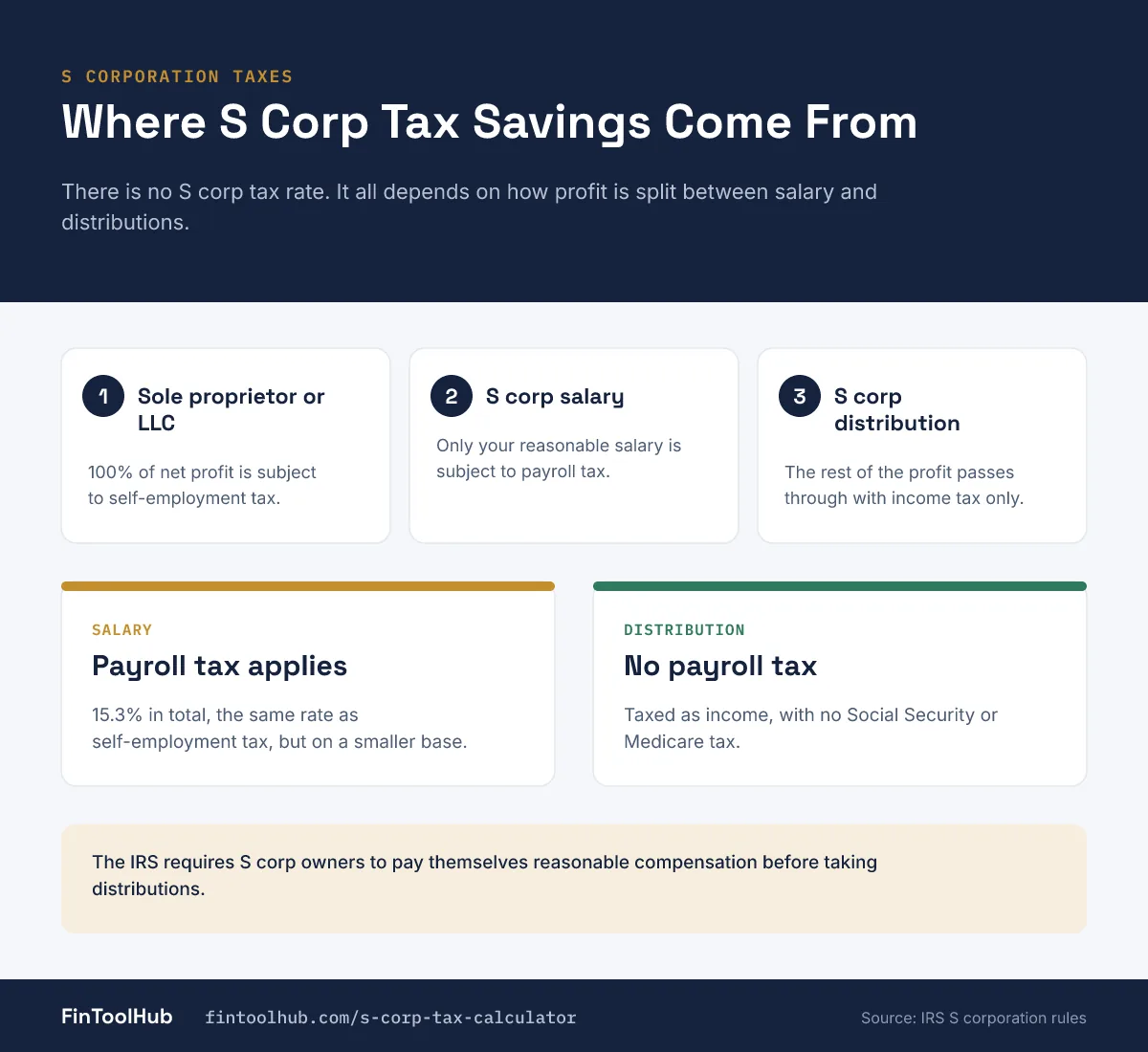
Where the S-corp tax savings actually come from
It's all about which part of your profit gets a payroll tax applied to it.
Sole prop / LLC
100% of net profit is subject to self-employment tax (15.3%-equivalent, on 92.35% of profit).
S-corp salary
Only your "reasonable compensation" salary is subject to payroll tax — same rate, smaller base.
S-corp distribution
The rest of the profit passes through with zero self-employment or payroll tax — only income tax.
How an S corp tax calculator works
A s corp tax calculator, s corp taxes calculator, s-corp tax calculator, s corp income tax calculator, tax calculator for s corp, or s corp tax rate calculator question is almost always really about one specific mechanism: the split between W-2 salary and shareholder distributions. There's no single "S-corp tax rate" the way there's a bracket for income tax — the entire tax picture depends on how you divide your profit between the two.
LLC vs. S corp: what actually changes
A llc vs s corp tax calculator, s corp vs llc tax calculator, llc s corp tax calculator, or s corp vs sole proprietorship tax calculator comparison comes down to this: a default single-member LLC or sole proprietorship pays self-employment tax on 100% of net profit. Electing S-corp tax treatment (which an LLC can do without changing its legal structure) lets you split that profit into salary — still subject to payroll tax — and distributions, which aren't. The calculator above runs exactly this comparison.
S corp distribution and payroll tax, explained
A s corp distribution tax calculator or s corp payroll tax calculator question is about the two halves of that split. Your salary is run through normal payroll, with Social Security and Medicare tax withheld exactly like any employee's paycheck (see our 401(k) Paycheck Calculator for how that FICA math works in detail). Your distribution isn't run through payroll at all — it's simply pass-through profit, taxed on your personal return as ordinary income, but with no 15.3%-equivalent tax attached to it.
Reasonable compensation: the number the IRS actually checks
The salary figure in the calculator above is the one number this tool can't compute for you — the IRS requires S-corp owner-employees to pay themselves "reasonable compensation" for the work they actually do, and there's no fixed formula for that number. It depends on your role, industry, hours, and what a similar employee would be paid in the open market. Setting your salary artificially low specifically to shift more profit into tax-free distributions is a well-known audit trigger, not a loophole.
California S corp tax
A california s corp tax calculator or s corp tax calculator california search reflects a genuine state-specific rule: unlike most states, which simply follow the federal pass-through treatment, California taxes S-corps at the entity level too — 1.5% of net income, or an $800 minimum, whichever is greater (waived in the corporation's first taxable year if there's no net income). This is on top of the personal income tax shareholders pay on their share of the profit, and on top of the federal payroll tax math above. The toggle in the calculator adds this in automatically.
Estimated tax payments for S corp owners
A s corp tax estimator, s corp estimated tax payments, estimated tax payments for s corp, estimated tax payments s corp, or s corp estimated tax payments dates question is about a different thing entirely from the salary/distribution split: since S-corp profit passes through to your personal return, you — not the S-corp itself — are generally responsible for quarterly estimated tax payments on it.
| Quarter | Federal deadline (individual, Form 1040-ES) |
|---|---|
| Q1 | April 15 |
| Q2 | June 15 |
| Q3 | September 15 |
| Q4 | January 15 (following year) |
California's entity-level franchise tax runs on its own schedule instead — quarterly FTB estimated payments due April 15, June 15, September 15, and December 15, one month earlier than the federal Q4 date.
Payroll software calculators
Tools like Gusto publish their own S-corp tax savings estimates (a gusto s corp tax savings calculator search) as part of payroll software aimed at businesses that have already made the election and need to actually run salary through payroll. The underlying math is the same salary-vs-distribution comparison this page walks through — the difference is mainly that a payroll provider's version is built to hand off directly into running your payroll, not just estimate the savings.
Self-employment tax mechanics reflect standard IRS rules (Schedule SE, the 92.35% net earnings factor); California franchise tax figures are verified against the California Franchise Tax Board. This is a planning estimate — treat it as a starting point for a broader s corp tax planning calculator conversation with a CPA before making an S-corp election or setting your salary figure. Official sources: IRS: S corporations; IRS: Schedule SE; California FTB: S corporations.
Frequently asked questions
Before you file Form 2553.
How much can an S-corp election actually save me?
It depends entirely on your profit level and how much of it can legitimately go to distributions instead of salary — there's no fixed percentage. The calculator above runs your specific numbers.
Is there a minimum profit level where S-corp election makes sense?
Many advisors point to somewhere around $60,000-$100,000 in net profit as the range where the payroll tax savings start to outweigh the added cost of running payroll and filing a separate S-corp return, though this varies by situation.
Can I pay myself $0 salary and take everything as a distribution?
No — the IRS requires reasonable compensation for work you actually perform, and a $0 or artificially low salary is one of the most common audit triggers for S-corps specifically.
Do S-corp shareholders pay self-employment tax on distributions?
No — that's the entire point of the structure. Distributions are taxed as ordinary pass-through income on your personal return, but they're not subject to Social Security or Medicare tax the way salary or sole-proprietor profit is.
Does every state tax S-corps the way California does?
No — California's entity-level 1.5%/$800-minimum tax is a state-specific rule, not a federal one. Most states follow the federal pass-through treatment with no separate entity-level S-corp tax, though a handful of others have their own variations.