
Tax Calculators
RSU Tax Calculator
See the real tax on your RSU vest — including the gap between the 22% your employer withholds and what you actually owe — plus what happens if you hold the shares and sell later.

At vesting
If you hold and sell later
Vest-date FMV becomes your cost basis. Only appreciation above that basis is a capital gain — the vest income itself is already taxed separately, above.
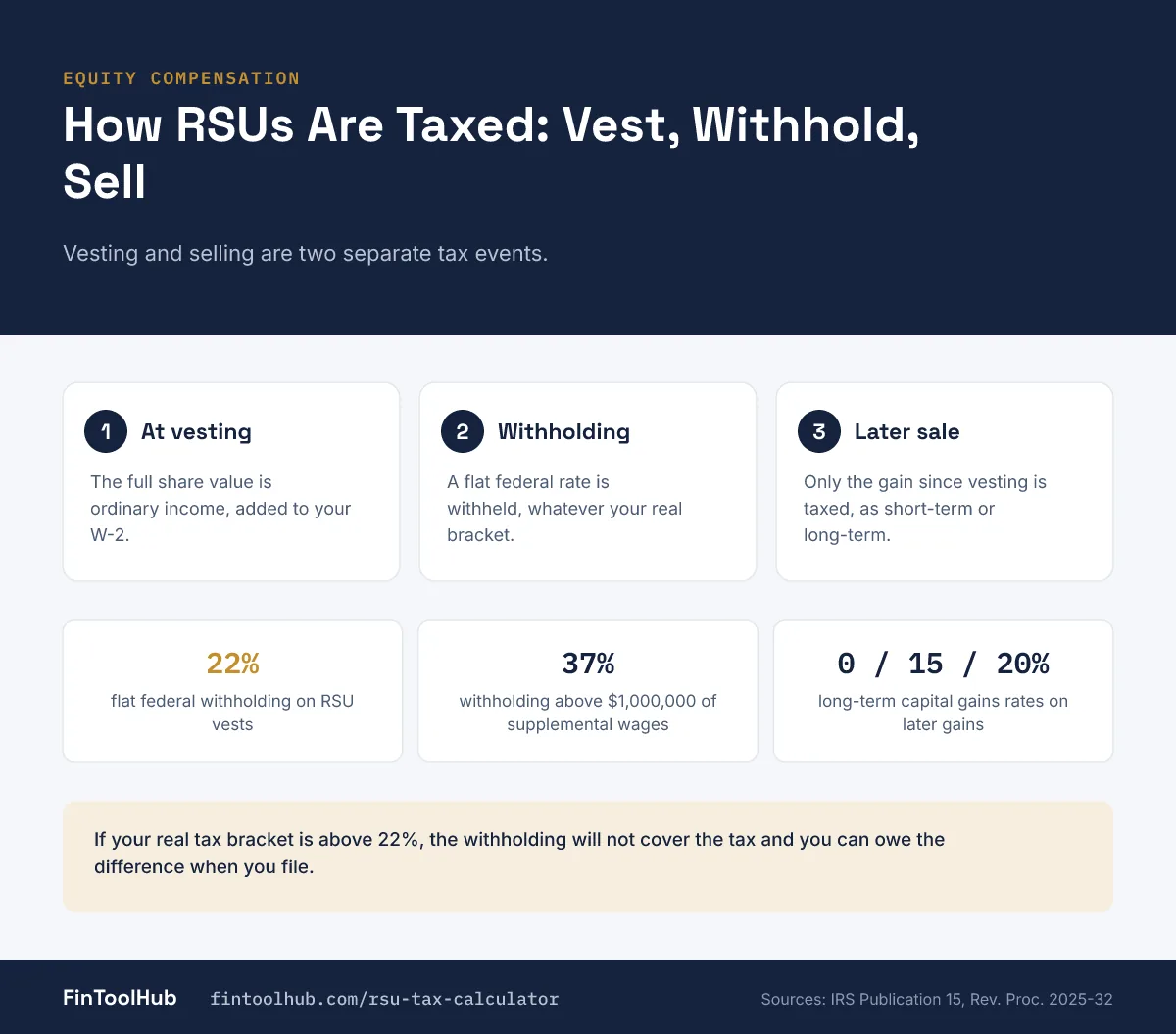
Two separate tax events, easy to conflate
Vesting and selling are taxed completely differently.
Vesting
100% ordinary income at the vest-date share price. No capital gains treatment, no 83(b) election available.
Withholding
A flat 22% (37% above $1M), regardless of your real bracket — routinely too low for equity-heavy earners.
Later sale
Only the gain since vesting is taxed — short-term at ordinary rates, long-term at 0/15/20%.
How an RSU tax calculator works
A rsu tax calculator, rsu stock tax calculator, or a search to calculate rsu tax is answering a question with two separate parts. First: when your RSUs vest, the full fair market value of the shares is treated as ordinary compensation income under IRC §83(a) — added straight to your W-2, taxed at your regular income tax rate, no different from a cash bonus. There's no special RSU tax rate and, unlike restricted stock or ISOs, no 83(b) election available, since RSUs are a contractual promise rather than transferred property until they actually vest.
The withholding gap: why RSUs cause surprise tax bills
Employers are required to withhold federal tax on RSU vests at the flat IRS supplemental wage rate — 22% on the first $1,000,000 of supplemental wages per employer per year, 37% above that. That flat rate was calibrated for the middle of the 22% bracket. If your salary alone already puts you above roughly $105,700 (single, 2026), every RSU dollar is actually taxed at 24%, 32%, 35%, or 37% — while only 22% gets withheld.
This is the exact rsu estimated tax problem: since withholding at vest routinely falls short for anyone earning above the low six figures, many RSU recipients need to make quarterly estimated payments (Form 1040-ES) to close the gap before it becomes a penalty.
What happens if you hold the shares
The fair market value on your vest date becomes your cost basis going forward. If you don't sell immediately, any further price movement is a separate capital gain or loss event — taxed only on the difference between your eventual sale price and that vest-date basis, not on the full share value again.
RSU long-term capital gains: the stacking rule
A rsu long term capital gains tax calculator question depends on your holding period after vesting, not from the original grant date. Sell within a year of vesting and any gain is short-term — taxed at your ordinary income rate, up to 37%. Hold more than a year past vesting and the gain qualifies for long-term rates instead: 0%, 15%, or 20%, based on where your total taxable income (including the gain) lands.
| Filing status | 0% rate up to | 15% rate up to | 20% rate above |
|---|---|---|---|
| Single | $49,450 | $545,500 | $545,500 |
| Married filing jointly | $98,900 | $613,700 | $613,700 |
| Head of household | $66,200 | $579,600 | $579,600 |
Long-term capital gains stack on top of your ordinary income for bracket purposes — your salary and vest income "fill up" the lower brackets first, and the capital gain is taxed at whatever rate applies to the space directly above that. The calculator above runs this stacking calculation exactly, rather than applying one flat rate to the whole gain.
Supplemental withholding rates (22%/37%) verified against IRS Publication 15 (Circular E); 2026 capital gains brackets verified against IRS Revenue Procedure 2025-32. This is a planning estimate — consult a tax professional for RSU-specific filing guidance. Official sources: IRS Publication 15; IRS Rev. Proc. 2025-32.
Frequently asked questions
Before your next vest date.
Why did I owe money at tax time even though RSU taxes were withheld?
Your employer withholds a flat 22% federal rate on RSU vests (37% above $1 million), which is often lower than your actual marginal tax bracket if you're a higher earner. The difference becomes a balance due when you file.
Can I avoid tax at vesting with an 83(b) election?
No — 83(b) elections aren't available for standard RSUs, only for actual restricted stock (property transferred at grant). RSUs are a promise to deliver shares later, so there's no property to elect against until they vest.
Is RSU income subject to Social Security and Medicare tax?
Yes — RSU vest income is treated as wages for FICA purposes too, subject to Social Security (up to the annual wage base) and Medicare, in addition to federal and state income tax.
What's my cost basis for RSU shares?
The fair market value per share on the vest date — that's the amount already taxed as ordinary income, so only appreciation above that basis is taxed again, as a capital gain, when you eventually sell.
Should I sell my RSU shares immediately at vest?
Many financial advisors recommend selling immediately to avoid concentration risk in a single stock, since the ordinary income tax is already owed regardless of whether you hold or sell. Holding longer only makes sense if you're comfortable with that concentration and expect further appreciation.