
Tax Calculators
Settlement Tax Calculator
Not all settlement money is taxed the same way. See what's excluded, what's taxable, and what you'll actually owe — whether it's a lawsuit settlement or a settled debt.

Lawsuit / legal settlement
Break your settlement into categories — each is taxed differently under IRC §104.
Doesn't include state tax, attorney fees, or FICA on wage components — see the content below for how those layer on.
Debt settlement (canceled debt)
A completely different tax question — is your forgiven debt taxable income?
Requires filing Form 982 to actually claim the insolvency exclusion — the exclusion doesn't apply automatically just because you qualify for it.
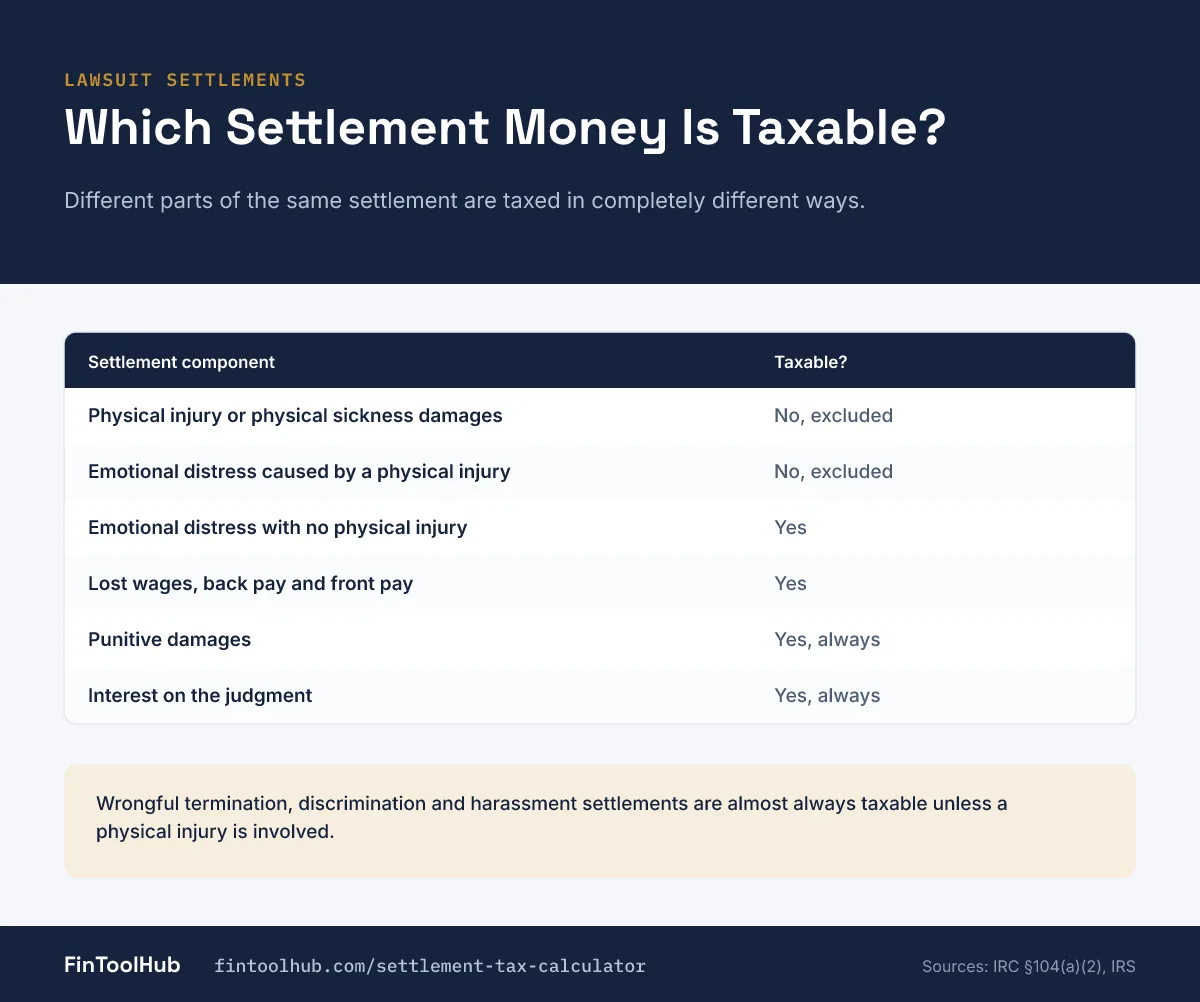
How a settlement tax calculator has to work
A settlement tax calculator, settlement taxes calculator, or tax settlement calculator can't apply one rate to a whole settlement — different pieces of the same settlement are taxed completely differently. The IRS rule (IRC §104(a)(2)) excludes damages received "on account of" personal physical injury or physical sickness from gross income. Everything else — punitive damages, lost wages, standalone emotional distress, interest — is generally taxable.
What's actually excluded, and what isn't
| Settlement component | Taxable? |
|---|---|
| Physical injury / physical sickness damages | No — excluded |
| Emotional distress caused by a physical injury | No — excluded |
| Emotional distress with no physical injury | Yes |
| Lost wages / back pay / front pay | Yes |
| Punitive damages | Yes, always |
| Pre- or post-judgment interest | Yes, always |
A lawsuit settlement tax calculator, tax calculator on lawsuit settlement, or a search to calculate tax on settlement agreement should walk through exactly these categories — which is why the calculator above asks for a breakdown rather than one lump sum.
Why wrongful termination settlements are (almost always) taxable
A wrongful termination settlement tax calculator question has a fairly clean answer: unless the underlying claim involves an actual physical injury, wrongful termination, discrimination, and harassment settlements are taxable as ordinary income — they replace wages and economic loss, not physical harm. Back pay and front pay are treated as wage substitutes and may be reported on a W-2 (subject to payroll tax withholding) rather than a 1099, depending on how the settlement is structured.
Common dollar-amount questions
Taxes on $10000 settlement calculator and taxes on $500 000 settlement calculator searches are really asking the same underlying question at different scales — the dollar amount doesn't change which category rules apply, only how much tax results from the taxable portion. Enter your actual settlement breakdown above regardless of the total size; a $10,000 settlement that's entirely physical-injury compensation owes nothing, while a $500,000 settlement that's entirely punitive damages is fully taxable.
Debt settlement tax: a completely different question
A debt settlement tax calculator search isn't about lawsuits at all — it's about negotiating down consumer debt (credit cards, personal loans) with a creditor. When a creditor forgives $600 or more of debt, they issue Form 1099-C, and the IRS generally treats the forgiven amount as taxable income under IRC §61(a)(12), because you received a benefit (debt relief) without paying for it.
IRS tax settlement (Offer in Compromise)
An irs tax settlement calculator search is asking about something different again — not tax on a settlement you received, but settling tax debt you owe directly with the IRS through its Offer in Compromise (OIC) program. This isn't a simple percentage calculation: the IRS evaluates your "reasonable collection potential" based on your income, assets, expenses, and future earning capacity using its own detailed financial forms. Because the outcome depends on a case-by-case IRS financial review rather than a fixed formula, this is a genuinely different kind of tool than a settlement tax calculator — the IRS's own Offer in Compromise pre-qualifier is the more appropriate starting point for that specific question.
California and state-level settlement tax
A settlement tax calculator california search reflects the fact that most states, including California, generally conform to the federal physical injury exclusion — if a settlement is excluded federally, it's typically excluded for state income tax too. This isn't universal across every state, so confirm your specific state's treatment for taxable settlement portions on top of the federal figures above.
Legal settlement tax treatment verified against IRS.gov's "Tax implications of settlements and judgments" guidance. Debt cancellation and insolvency figures verified against IRS Publication 4681, including its own worked examples. This is a planning estimate — settlement taxation depends heavily on exact agreement language, and a tax professional should review your specific settlement documents. Official sources: IRS: Tax implications of settlements and judgments; IRS Publication 4681.
Frequently asked questions
Before you sign, or before you file.
Is a personal injury settlement taxable?
Compensatory damages for an actual physical injury or physical sickness are generally excluded from federal income tax. Punitive damages within the same case are still taxable, even though the compensatory portion isn't.
Is a wrongful termination or discrimination settlement taxable?
Generally yes — these are economic/employment claims, not physical injury claims, so the settlement (including lost wages and emotional distress components) is taxable as ordinary income unless it stems from an underlying physical injury.
Do I owe tax on debt a creditor forgave?
Usually yes, unless an exception applies — most commonly the insolvency exclusion (your debts exceeded your assets right before cancellation) or a bankruptcy discharge. You'll need to file Form 982 to claim either exclusion.
Are attorney's fees taxable if they're paid out of my settlement?
Often yes — the full settlement amount, including the portion that goes directly to your attorney, is generally treated as your income first. For certain employment and civil rights claims, you may be able to deduct attorney's fees above the line, avoiding double taxation on that portion.
Is IRS tax settlement the same as a lawsuit settlement?
No — that phrase usually refers to the IRS's Offer in Compromise program, where you negotiate with the IRS to pay less than you owe in back taxes. It's a different process entirely from receiving and paying tax on a lawsuit settlement.