
Capital Gains
Does New Jersey Really Have an "Exit Tax"? What It Actually Is
It's one of the most googled — and most misunderstood — questions in New Jersey real estate. The short answer: there's no separate tax for leaving the state. Here's what's actually happening at closing.

Where the name comes from
"Exit tax" is a nickname, not an official term — you won't find it anywhere in New Jersey's actual tax code. It refers to a real requirement (formally, an estimated gross income tax payment under the Gross Income Tax Act) that applies when a nonresident sells New Jersey real estate. The name stuck because it sounds like the state is charging you extra for the act of leaving, which isn't quite what's happening.
What's actually being collected
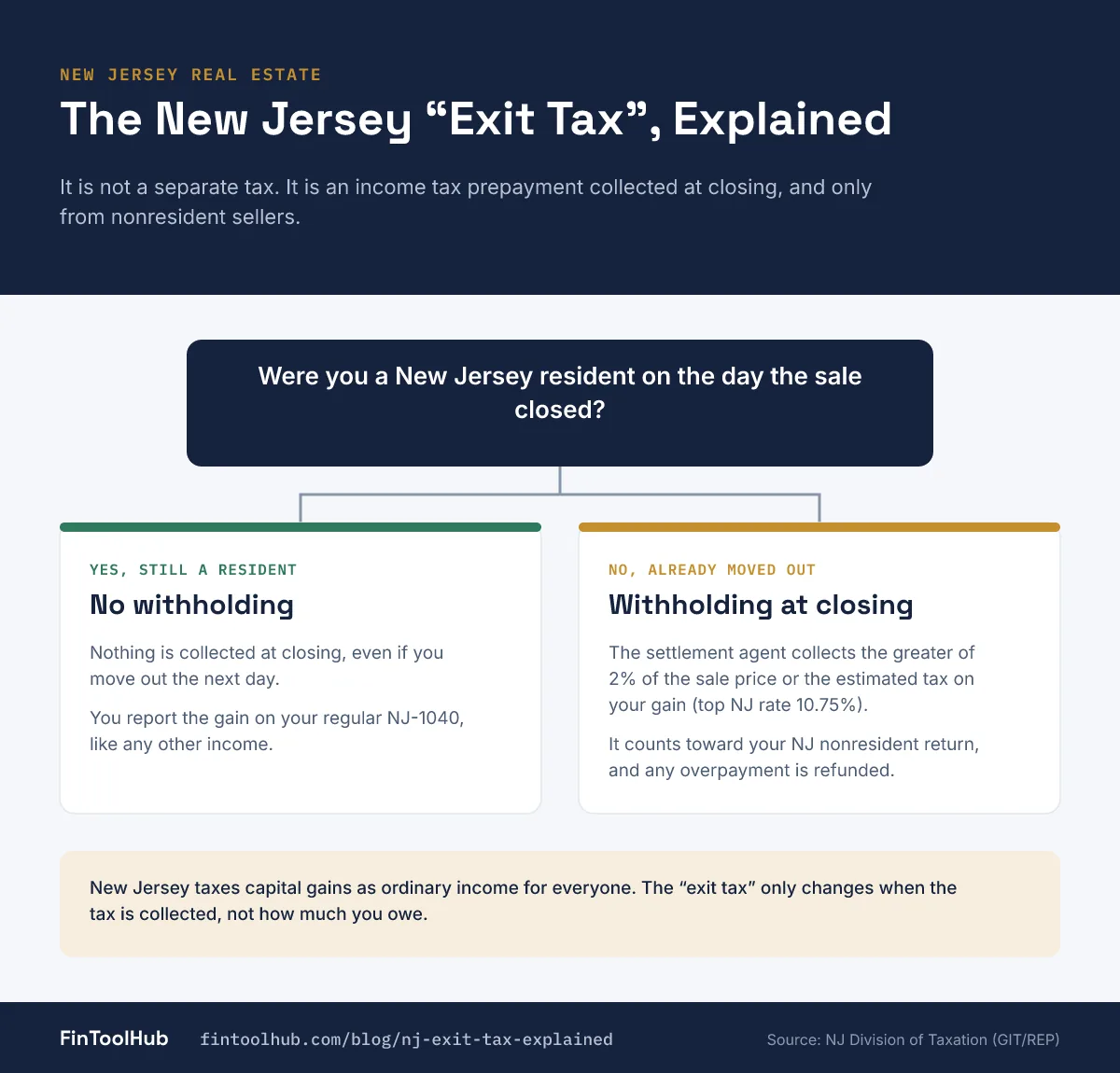
New Jersey taxes capital gains as ordinary income, at rates up to 10.75%, the same way it taxes wages. When a resident sells property, that tax gets calculated and paid on their regular annual return, the same as any other income. When a nonresident sells New Jersey property, the state can't count on a future tax return from someone who no longer lives there — so it collects an estimate of that tax directly at closing instead. That's the entire mechanism. It's a timing and collection method, not a different or additional tax.
The one question that decides everything
Whether this applies to you comes down to a single fact: were you a New Jersey resident on the day your property closed?
You're still a NJ resident when the property closes — even if you're planning to move out right after. You simply report and pay the gain on your regular NJ return, no different from any other year.
You already moved out of New Jersey before the closing date. The buyer's attorney or title company withholds an estimated payment at closing on your behalf.
This is the part that trips people up most: selling your house and then moving doesn't trigger anything. Moving and then selling the house you left behind does.
How much actually gets withheld
The withholding amount is the greater of two calculations:
| Method | Calculation |
|---|---|
| Estimated tax on the gain | Up to 10.75% of the taxable gain |
| 2% floor | 2% of the total sale price — regardless of gain size |
Getting the money back
If the amount withheld is more than your actual New Jersey tax liability on the sale — which it often is, especially for sellers with a modest gain — the difference is refundable. You recover it by filing Form A-3128 (the Claim for Refund of Estimated Gross Income Tax Payment) or by reporting the sale on your New Jersey nonresident income tax return. Either way, it isn't automatic; you have to file for it.
A number worth double-checking if you've seen it recently
Some older articles and calculators cite an "8.97% exit tax rate." That figure was accurate once — it was New Jersey's top income tax rate before 2018. The state added a higher bracket that year (its so-called "millionaire's tax"), and the current top rate is 10.75%. If a page you're reading still says 8.97%, it hasn't been updated in several years.
The bottom line
If you're selling New Jersey property while still living in the state, none of this applies to you — you'll pay tax on any gain normally, the same as always. If you've already relocated out of state before your closing date, expect a withholding at closing calculated as the greater of an estimated tax on your gain or 2% of the sale price, and plan to file for a refund if that amount turns out to be more than you actually owe.
New Jersey's withholding mechanics, the resident/nonresident distinction, and the 2018 rate change verified against multiple independent 2026 New Jersey tax guides and legal resources, cross-checked for consistency. This is general information, not tax advice — a New Jersey-licensed CPA can confirm your specific filing requirements. Official sources: NJ Division of Taxation: GIT/REP FAQs.
Frequently asked questions
Is New Jersey's "exit tax" a real, separate tax?
No. It's a withholding requirement — an estimated prepayment of the same New Jersey income tax owed on a capital gain, collected at closing specifically from sellers who are nonresidents at the time of the sale.
Do I have to pay it if I sell my house and then move?
No. If you're still a New Jersey resident on the day the property closes, no withholding applies at all — you pay any tax owed normally on your regular return, regardless of whether you move afterward.
How much is withheld from a nonresident sale?
The greater of an estimated tax on the gain (up to 10.75%) or 2% of the total sale price. The 2% floor applies even if your actual gain is small or zero.
Can I get the withheld money back?
Yes, if it exceeds your actual tax liability — which is common. File Form A-3128 or report the sale on your New Jersey nonresident return to claim the refund.
Is New Jersey's exit tax rate 8.97%?
No, that figure is outdated. 8.97% was New Jersey's top income tax rate before 2018. The current top rate, which the withholding calculation is based on, is 10.75%.