
Savings Calculators
Emergency Fund Calculator
Built on essential expenses, not your full income — a smaller, more accurate target than most calculators give you, plus a real timeline to reach it.

Calculate your emergency fund target
Based on the bills you'd still have to pay if your income stopped tomorrow.
This sets a suggested target below — feel free to override it.
Based on essential expenses only, per CFPB and Federal Reserve guidance — not your full income or total spending, which overstates what you actually need.
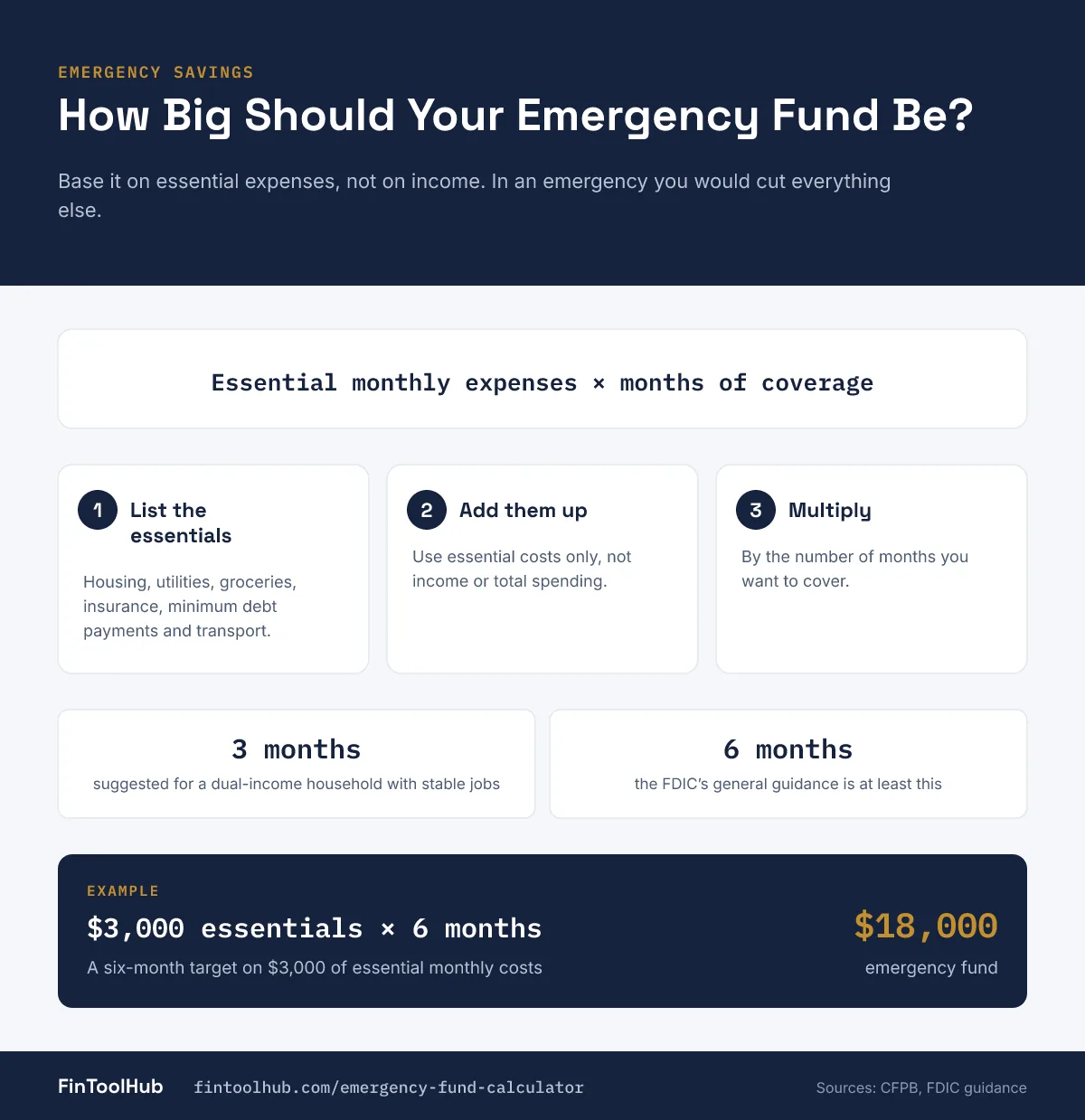
How to calculate an emergency fund the right way
Multiply your essential monthly expenses — not your income, not your total spending — by the number of months of coverage you're targeting. That's the real answer to how to calculate emergency fund or how to calculate an emergency fund amounts correctly. It's a smaller, more precise number than "6 months of income," because in a genuine emergency you'd cut discretionary spending immediately — you don't need to replace your full paycheck, just cover what actually has to get paid.
To calculate emergency fund targets by hand: list your rent or mortgage, utilities, groceries, insurance, minimum debt payments, and transportation costs, add them up, then multiply by your target number of months. That's the entire emergency fund calculation — the hard part is being honest about what's essential and what isn't.
3, 6, 8, or more months — how to pick
There's no single official number, but the guidance converges on a workable framework. The Consumer Financial Protection Bureau frames it around your own likely risks rather than a fixed rule, while the FDIC's general guidance points to at least six months. In practice, most financial planners break it down by situation:
| Situation | Suggested target |
|---|---|
| Dual-income household, stable jobs | 3 months |
| Single income, variable pay, freelance/commission | 6 months |
| Self-employed, major life transition, dependents, sole earner | 9–12 months |
A 6 month emergency fund calculator search and an 8 month emergency fund calculator search are both asking the same underlying question at different risk levels — pick whichever range best matches your own situation, since 8 months sits between the "variable income" and "high-risk" categories, a reasonable middle ground if you have some but not total income stability.
Why this matters more than it might seem
Per the St. Louis Fed's summary of the Federal Reserve's 2024 Survey of Household Economics and Decisionmaking (SHED), 30% of adults said they couldn't cover three months of expenses by any means, and even a $400 unexpected expense would require 37% of adults to borrow money or sell something to cover it. Kelley Blue Book pegs the average car repair cost at $838 in 2025 — a single ordinary mechanical failure is already more than many households have set aside.
Building your emergency fund while you're also carrying debt
If you're paying off debt at the same time you're trying to build this fund, sequencing matters more than most people realize — building the full target before touching high-interest debt isn't always the right order, and neither is the reverse. Our Emergency Fund vs. Debt Payoff Calculator walks through the actual sequence: a small starter fund first, then high-interest debt, then the rest of this target — based on your own numbers rather than a generic rule of thumb.
Where to actually keep this money
An emergency fund needs to be liquid — accessible within a few days, not locked in an investment account or subject to early-withdrawal penalties. A high-yield savings account is the standard recommendation: FDIC-insured up to $250,000 per depositor per bank, and separate enough from your everyday checking account that you won't accidentally spend it on something that isn't actually an emergency. Our Liquid Net Worth Calculator can show you how this fits into your broader picture of what you could access quickly if you needed to.
Guidance referenced against the Consumer Financial Protection Bureau's emergency savings research and the Federal Reserve Bank of St. Louis's summary of the 2024 SHED survey. This is a planning estimate — your actual essential expenses and risk factors are specific to your situation.
Frequently asked questions
Before you start (or restart) building your cushion.
How much should I have in my emergency fund?
Most guidance lands on 3 to 6 months of essential expenses, with self-employed or single-income households often targeting more. Multiply your essential monthly expenses (not your full income) by your target number of months.
Should I use my income or my expenses to calculate this?
Essential expenses, not income. In a real emergency, you'd cut discretionary spending first — your target only needs to cover what you'd still have to pay, which is meaningfully less than your full paycheck.
What counts as an "essential" expense?
Rent or mortgage, utilities, groceries, insurance premiums, minimum debt payments, and necessary transportation. It generally excludes subscriptions, dining out, entertainment, and other discretionary spending you could cut in a genuine emergency.
Is it okay to start with a smaller goal?
Yes — research from the CFPB found that even a modest amount of emergency savings correlates with meaningfully better financial outcomes than having none at all. A smaller first milestone (like $500–$1,000) is a reasonable starting point if the full 3–6 month target feels out of reach right now.
Where should I keep my emergency fund?
A high-yield savings account, separate from your everyday checking account — liquid enough to access within a few days, FDIC-insured up to $250,000, and not invested in the market where it could lose value right when you need it.