
Mortgage Calculators
Biweekly Mortgage Payoff Calculator
See what switching to true biweekly payments (every 2 weeks) actually saves — and how it's different from "semi-monthly," a mix-up that quietly cancels the whole benefit.

Compare biweekly vs. standard monthly
Half your monthly payment, sent every two weeks — 26 times a year, not 24.
Standard monthly
True biweekly
Assumes true biweekly (26 payments/year, one every two weeks) applied directly to principal, not a "semi-monthly" schedule (24 payments/year) — see below for why that distinction changes the entire result. Doesn't include any third-party biweekly program setup fee.
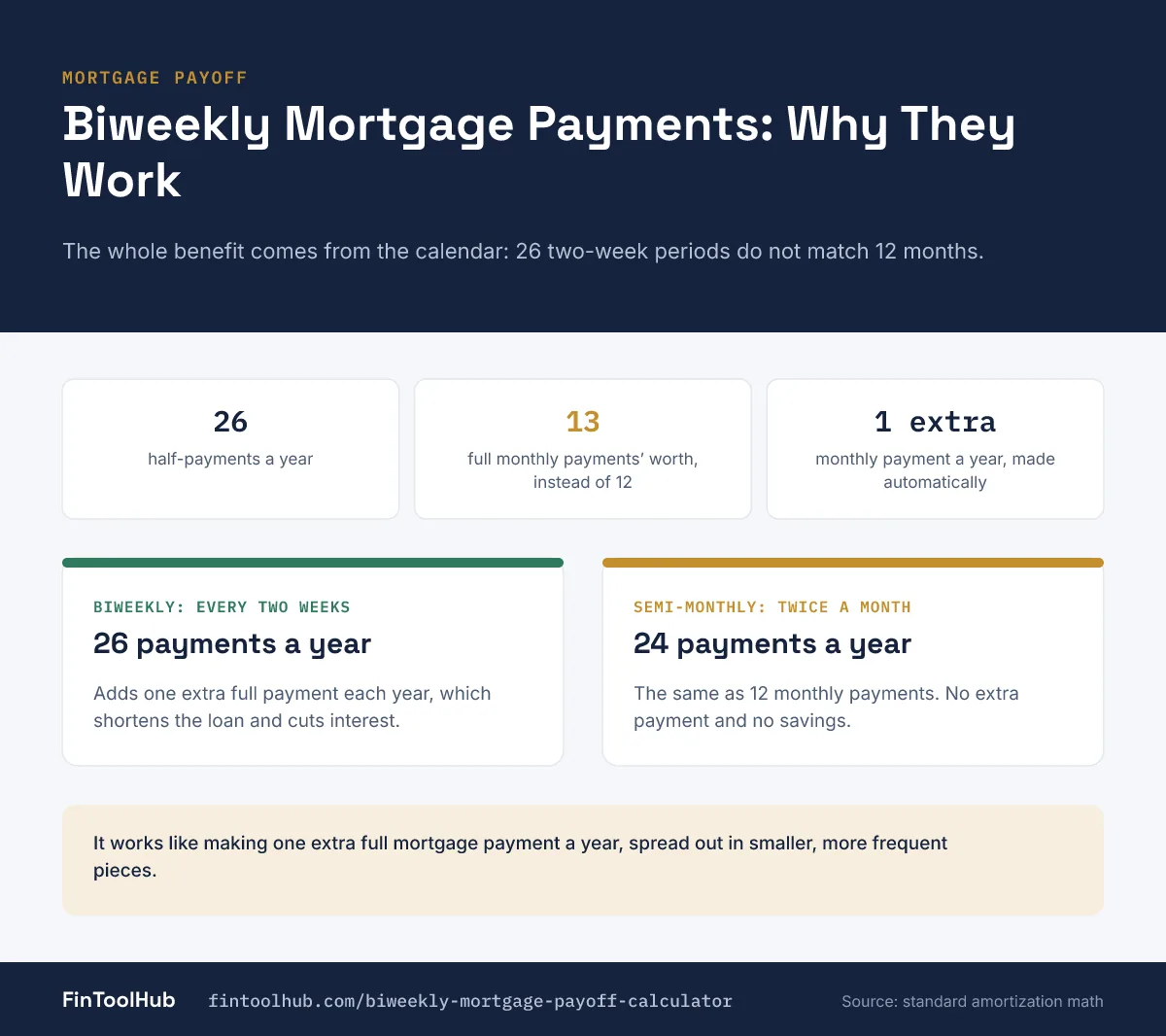
How a biweekly mortgage payoff calculator actually works
A true biweekly payment schedule sends half your normal monthly payment every two weeks — 26 payments a year, which equals 13 full monthly payments instead of 12. That extra 13th payment, made automatically without you having to think about it, is the entire mechanism behind a biweekly mortgage payoff calculator or mortgage payoff calculator biweekly search. It's mathematically similar to making one extra full mortgage payment a year, just spread out in smaller, more frequent pieces.
A mortgage payoff calculator biweekly payments or mortgage payoff calculator with biweekly payments tool needs to model payments on an actual biweekly schedule (every two weeks) rather than approximate it monthly, because the extra payment comes specifically from the calendar mismatch between 26 two-week periods and 12 months — approximating it as "one extra payment per year" gets close, but the real schedule compounds interest slightly differently along the way.
Biweekly vs. "semi-monthly" — the mix-up that erases the benefit
Watch out for third-party biweekly payment program fees
Some companies offer to set up automatic biweekly payments for a setup fee plus an ongoing per-transaction charge — despite the fact that you can capture the identical financial benefit for free. Two ways to do it yourself, at no cost:
- Make one extra full principal-only payment once a year, whenever you have the cash available — same total extra principal as biweekly, just delivered in one lump sum instead of 26 small increments.
- Add 1/12 of your payment as extra principal to every regular monthly payment. Over 12 months, that adds up to the same one extra payment's worth of principal reduction as the biweekly schedule — most loan servicers let you specify an additional principal amount with your regular payment at no charge. Our Mortgage Payoff with Multiple Extra Payments Calculator models exactly this kind of recurring extra-principal strategy, and lets you stack it with an annual lump sum too, if you have both available.
Both DIY approaches capture essentially the same result the biweekly schedule produces — our Online Mortgage Payoff Calculator can model either one directly as a monthly extra payment or lump sum, if you'd rather go that route than a strict biweekly schedule.
Why the impact is bigger than "one extra payment" sounds
Because that extra payment goes straight to principal, and mortgage interest is calculated on your remaining balance, the effect compounds every month for the rest of the loan — which is why biweekly payments on a fresh 30-year mortgage commonly cut roughly 4–6 years off the payoff timeline, not just 1/13th of a year. The earlier the extra principal hits the balance, the more total interest it prevents over the life of the loan.
Is biweekly right for you?
Biweekly works well if you're paid biweekly yourself, since it naturally matches your cash flow — two months a year you'll have three paychecks instead of two, and that's effectively where the "extra" payment comes from without feeling like a stretch. If you're paid monthly or semi-monthly, one of the free DIY alternatives above may fit your cash flow better than a strict every-two-weeks schedule.
Biweekly amortization uses the standard monthly payment amount split in half, applied every two weeks (26 payments/year) at a periodic rate of the annual rate divided by 26 — a widely used industry approximation for biweekly mortgage calculations. This is a planning estimate; confirm your loan servicer's exact biweekly program terms and whether any fees apply before enrolling.
Frequently asked questions
Before you sign up for a biweekly payment program.
How does biweekly mortgage payment saving actually work?
Paying half your monthly payment every two weeks results in 26 payments a year instead of 24 (twice a month) or 12 (once a month) — that's 13 full monthly-equivalent payments annually, one more than a standard schedule, which accelerates payoff and reduces total interest.
Is biweekly the same as paying twice a month?
No — that's semi-monthly, a common and costly mix-up. Semi-monthly is 24 payments a year (fixed calendar dates) and produces no extra payment or savings. Biweekly is 26 payments a year (every two weeks) and does produce an extra payment's worth of principal reduction annually.
Do I have to pay a company to set up biweekly payments?
No. You can achieve the same result for free by making one extra principal-only payment once a year, or by adding 1/12 of your payment as extra principal to each regular monthly payment — many third-party "biweekly programs" charge fees for something you can replicate yourself at no cost.
How much time does biweekly typically save on a 30-year mortgage?
Commonly around 4 to 6 years, along with tens of thousands of dollars in interest, though the exact figure depends on your balance, rate, and remaining term — run your own numbers above rather than relying on a generic average.
Can I switch to biweekly payments at any time?
Generally yes, though you'll need to confirm with your loan servicer how they administer it — some apply payments to principal as received, while others hold biweekly payments until they accumulate to a full monthly payment, which changes the timing (and the benefit) slightly.