
HSA Calculators
HSA Tax Savings Calculator
See your real HSA tax savings across all three layers — federal income tax, FICA, and state tax — not just a rough federal-only guess.

Calculate your HSA tax savings
How you contribute changes the answer — payroll vs. direct makes a real difference.
Federal figures use 2026 tax brackets. FICA uses the 2026 Social Security wage base ($184,500) and Additional Medicare Tax thresholds. This is a planning estimate — a tax professional should confirm your exact figures.
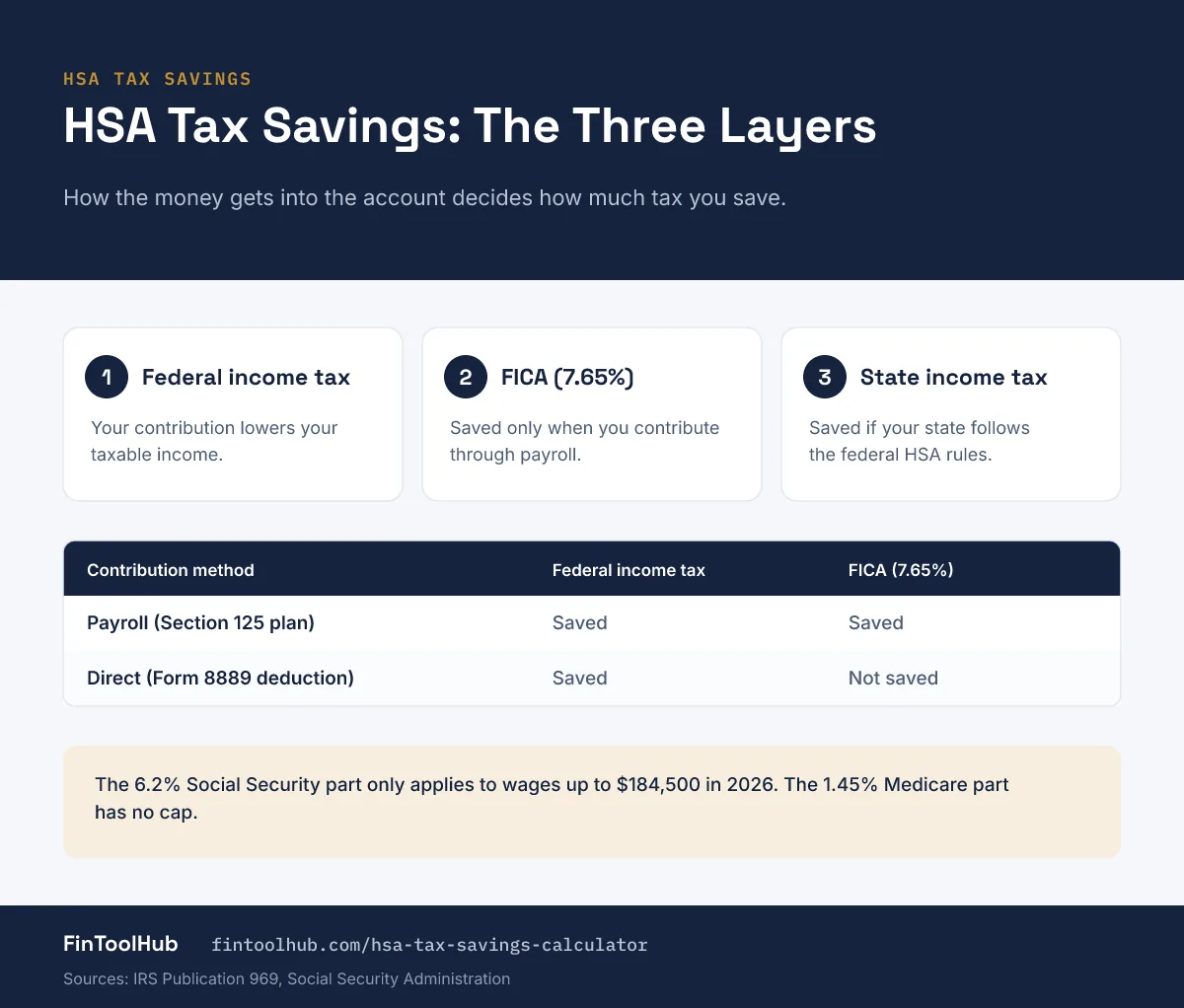
Why a real HSA tax savings calculator has three layers, not one
Your total HSA tax savings = federal income tax savings + FICA savings (if contributed by payroll) + state tax savings (if your state conforms). Most tools that call themselves an hsa tax savings calculator only compute the first piece — your contribution times your federal bracket — and stop there. That understates the real number for anyone contributing through payroll, and overstates it for anyone in a state that doesn't conform to federal HSA treatment.
To actually calculate hsa tax savings or answer how to calculate hsa tax savings correctly, you need to know one thing before anything else: how the money got into the account.
Payroll vs. direct contributions — the FICA difference
A contribution made through your employer's payroll (a Section 125 cafeteria plan) is excluded from your wages before any payroll tax applies — that means it skips the 6.2% Social Security tax and 1.45% Medicare tax too, not just federal income tax. A contribution you make directly to your HSA and deduct yourself on Form 8889 reduces your federal (and usually state) taxable income, but never touches FICA, because it was never treated as wages in the first place.
| Contribution method | Federal income tax | FICA (7.65%) |
|---|---|---|
| Payroll (Section 125) | Saved | Saved |
| Direct (Form 8889 deduction) | Saved | Not saved |
Per the Social Security Administration, the 2026 Social Security wage base is $184,500 — earnings above that are already exempt from the 6.2% portion, so a payroll HSA contribution only saves the Social Security piece if your income is under that cap. The 1.45% Medicare portion has no cap and always applies.
The Additional Medicare Tax — a nuance most calculators skip
Since 2013, earned income above $200,000 (single/HOH) or $250,000 (married filing jointly) is subject to an extra 0.9% Additional Medicare Tax — unchanged for 2026. If your income is above that threshold, a payroll HSA contribution that reduces your wages below it saves you 2.35% on that slice (1.45% regular + 0.9% additional), not just 1.45%. This calculator accounts for that automatically based on your income and filing status.
State tax: the part where "it depends" is the honest answer
Most states with an income tax conform to the federal HSA deduction — contribute pre-tax federally, and it's pre-tax at the state level too. California and New Jersey are the well-known exceptions: neither allows the HSA deduction at the state level, and both tax HSA investment earnings as ordinary income every year, not just at withdrawal. If you live in one of those two states, your real tax savings hsa calculator answer is federal (and FICA, if payroll) only — select that option above rather than assuming a state rate applies.
What this doesn't replace
This calculator answers the tax-savings question specifically. For your actual contribution limit and a balance-growth projection, use our HSA Calculator. For the different question of whether an HSA-eligible HDHP or a traditional PPO comes out ahead overall, that's a plan-comparison question — see our HSA vs. PPO Calculator for that separate comparison.
Federal tax figures use 2026 IRS brackets and standard deduction. FICA figures verified against the Social Security Administration's 2026 contribution and benefit base and the SSA 2026 COLA Fact Sheet (Additional Medicare Tax thresholds). State treatment reflects general rules; confirm your specific state and situation with a tax professional.
Frequently asked questions
Before you decide how to fund your HSA.
How do I calculate my HSA tax savings?
Add up three pieces: your contribution times your federal marginal tax rate, plus 7.65% FICA savings if contributed through payroll, plus your state tax rate if your state allows the deduction. Most simple calculators only account for the first piece.
Does it matter if I contribute through payroll or write a check myself?
Yes, significantly. Payroll (Section 125) contributions skip federal income tax, Social Security tax, and Medicare tax. Contributions you make directly and deduct on Form 8889 only reduce federal (and usually state) income tax — never FICA.
Do I save on Social Security tax if I already earn more than the wage base?
No — if your income already exceeds the Social Security wage base ($184,500 in 2026), you've already stopped paying the 6.2% Social Security tax on income above that level, so a payroll HSA contribution can't save you anything on a tax you're not paying anyway. You'd still save the uncapped 1.45% Medicare portion.
Do all states give an HSA tax deduction?
No. Most states conform to the federal treatment, but California and New Jersey don't — neither allows the state deduction, and both tax HSA earnings annually. States with no income tax have no state HSA tax question to begin with.
Is this the same as an HSA contribution limit calculator?
No — this calculates tax savings on a contribution amount you specify. For your actual maximum allowed contribution and a balance projection over time, use our HSA Calculator instead.