
HSA Calculators
HSA Withdrawal Penalty Calculator
See exactly what a non-qualified HSA withdrawal actually costs — income tax, plus a 20% penalty if you're under 65 and don't qualify for an exception.

Calculate your HSA withdrawal penalty
Qualified medical withdrawals are always tax-free — this is for everything else.
Income tax shown is a simplified federal estimate at your stated marginal rate — for the full federal/FICA/state picture on contributions (not withdrawals), see our HSA Tax Savings Calculator.
How the HSA withdrawal penalty actually works
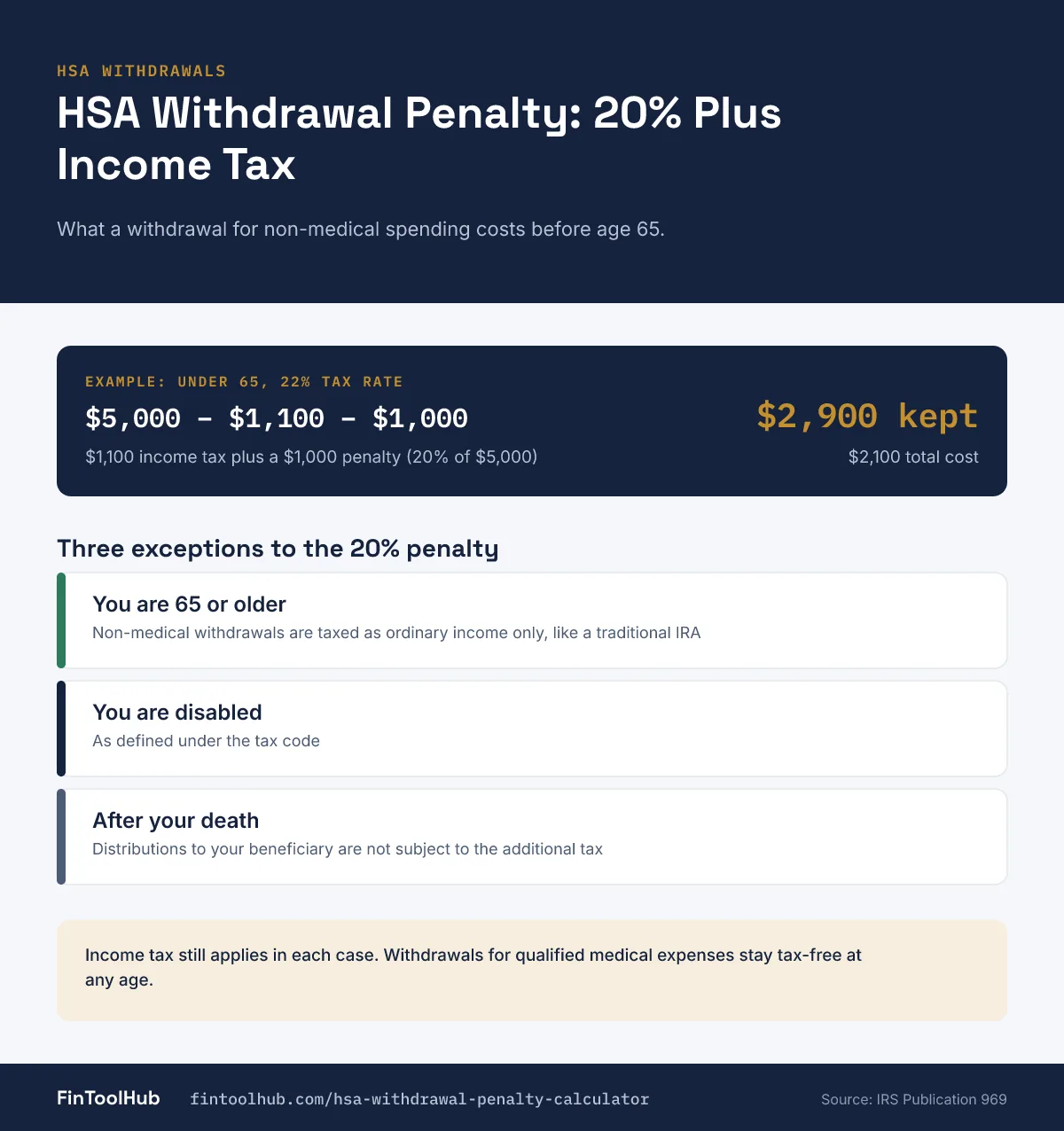
A non-qualified HSA withdrawal before age 65 costs you ordinary income tax plus a 20% additional tax on top — a combined hit that can easily exceed 40% of the amount withdrawn. Per IRS Publication 969, that's the exact rule behind every hsa withdrawal penalty calculator or hsa early withdrawal penalty calculator search: "There is a 20% additional tax on the part of your distributions not used for qualified medical expenses."
A hsa withdrawal tax penalty calculation is really two separate numbers added together — the IRS treats the non-qualified amount as ordinary income first, then tacks on the 20% penalty as a separate line item, calculated on the gross withdrawal, not on some after-tax figure.
The three exceptions that waive the 20% penalty
Even for a non-qualified withdrawal, the 20% penalty doesn't apply in three situations:
- You've reached age 65 — from that point on, non-medical withdrawals are taxed as ordinary income only, functioning like a traditional IRA.
- You're disabled, as defined under the tax code.
- You've died — distributions to your beneficiary aren't subject to the additional tax (though a non-spouse beneficiary generally loses the HSA's tax-advantaged status entirely on the full balance, a different and separate consequence worth knowing about).
None of these exceptions make a non-qualified withdrawal tax-free — ordinary income tax still applies in every case. They only remove the extra 20 percentage points.
Qualified medical expenses stay tax-free at any age
The 20% penalty (and income tax) only applies when the withdrawal isn't for a qualified medical expense. Two rules make qualified withdrawals more flexible than people expect: there's no deadline to reimburse yourself for a past expense, as long as it was incurred after your HSA was established and you kept documentation — some people intentionally let receipts accumulate for years while their HSA balance grows tax-free, then reimburse themselves later. And after 65, Medicare Part B, Part D, and Medicare Advantage premiums count as qualified medical expenses — but standard Medigap premiums specifically do not, a distinction that catches retirees off guard.
How this differs from other HSA penalties
This 20% additional tax is specific to non-qualified withdrawals. It's a different penalty from the 6% excise tax that applies annually to an uncorrected excess contribution — see our HSA Calculator for contribution limits and the excess-contribution earnings tool. Don't confuse the two; they're triggered by opposite ends of the account (putting too much in, vs. taking money out for the wrong reason).
Verified directly against IRS Publication 969 (2025), Health Savings Accounts and Other Tax-Favored Health Plans, and IRC §223. This is a planning estimate — a tax professional should confirm your specific situation, especially around disability status or estate/beneficiary distributions.
Frequently asked questions
Before you tap your HSA for something other than medical care.
How much is the HSA withdrawal penalty?
20% of the non-qualified amount, on top of ordinary income tax on that same amount — calculated as two separate charges, not one combined rate.
Does the penalty apply after age 65?
No. Once you turn 65, non-qualified withdrawals are taxed as ordinary income only — the 20% penalty no longer applies, similar to a traditional IRA withdrawal.
Are there other ways to avoid the 20% penalty?
Yes — becoming disabled (as defined by the tax code) or death also waive the 20% penalty, even before age 65. Ordinary income tax still applies in both cases.
Is a qualified medical expense ever subject to this penalty?
No. Withdrawals for qualified medical expenses are always tax-free and penalty-free, regardless of your age.
Is this the same as the penalty for contributing too much to my HSA?
No — that's a separate 6% excise tax on excess contributions, calculated differently and triggered by over-contributing rather than by a non-qualified withdrawal. See our HSA Calculator for that scenario.