
HSA Calculators
HSA vs PPO Calculator
Compare total annual cost — premium, expected medical spending, employer HSA contributions, and tax savings — not just the monthly premium difference.

Compare your HDHP+HSA and PPO options
Enter both plans' real numbers from open enrollment, plus what you actually expect to spend.
HDHP + HSA plan
PPO plan
Out-of-pocket estimate assumes standard deductible-then-coinsurance-then-covered-in-full structure; your actual plan's copay rules may differ slightly. Building this in a spreadsheet yourself? This is the same math, done live.
How to actually compare an HSA vs PPO plan
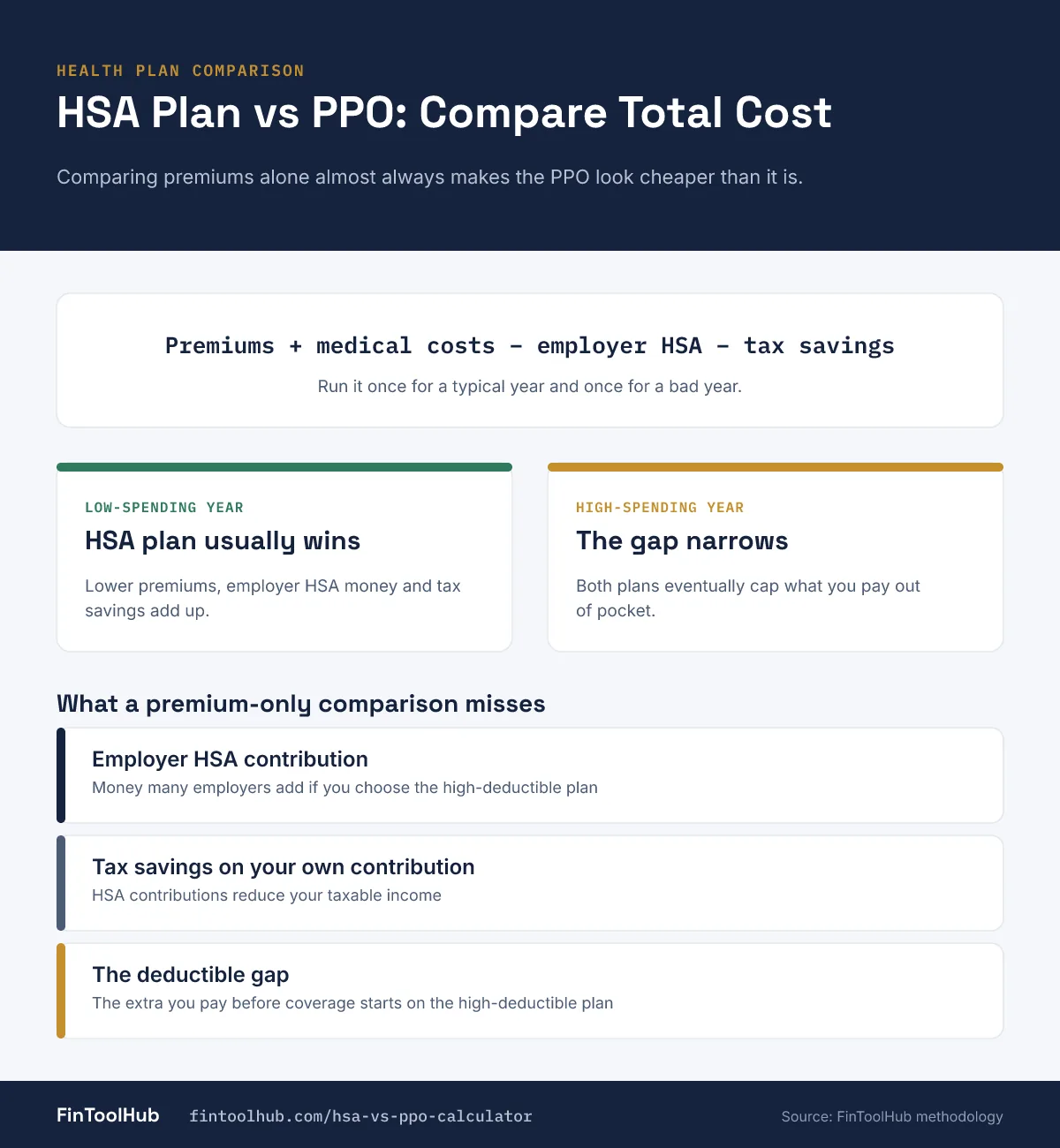
The right way to run an hsa vs ppo calculator comparison is total annual cost — premium plus expected out-of-pocket medical spending, minus any employer HSA contribution and tax savings — not just the sticker price on the premium. A hsa vs ppo comparison calculator that only compares monthly premiums will almost always make the PPO look artificially cheap, because it ignores the deductible gap and the free money an employer often adds to an HSA.
The same logic applies to a ppo vs hdhp with hsa calculator search — technically, "HSA" is the tax-advantaged account and "HDHP" (high-deductible health plan) is the insurance plan it's attached to; a PPO is usually a separate plan design with a lower deductible and richer coverage, and typically isn't HSA-eligible. What people are really comparing is total cost between the two plan structures, not the accounts themselves.
Why "expected spending," not "worst case," is the right input
The single input that changes this comparison the most is your expected medical spending — and the honest answer for most healthy people most years is: not much. Insurance exists to protect against the tail-risk years (a surgery, a diagnosis, an ER visit), not the typical year. Running this calculator once with your realistic typical-year spending and once with a bad-year estimate gives you a fuller picture than either number alone — a low-spending year usually favors the HDHP+HSA heavily, while a high-spending year narrows the gap since both plans cap out-of-pocket costs eventually.
The pieces a premium-only comparison misses
- Employer HSA seed money — many employers contribute directly to your HSA if you enroll in the HDHP, which is real money that offsets the deductible gap and doesn't exist on the PPO side.
- Tax savings on your own contribution — money you put into an HSA yourself reduces your taxable income (and FICA, if contributed by payroll); see our HSA Tax Savings Calculator for the full federal/FICA/state breakdown.
- What happens to unused HSA money — unlike an FSA, HSA balances roll over indefinitely and stay yours even if you change jobs or plans, which a pure annual cost comparison doesn't fully capture if you're building long-term savings, not just covering this year's bills.
What this calculator doesn't model
This uses a simplified deductible-then-coinsurance-then-out-of-pocket-max structure. Some plans have separate copays for office visits or prescriptions that apply before or alongside the deductible, family vs. individual deductible tiers, or network tiers with different cost-sharing — check your specific plan documents for those details, and treat this as a solid first-pass comparison rather than a guarantee.
Cost-sharing structure (deductible, coinsurance, out-of-pocket maximum) follows standard ACA-compliant plan design. This is a planning comparison based on the numbers you enter — actual plan costs depend on your specific employer's plan documents.
Frequently asked questions
Before open enrollment closes.
Is HSA or PPO better?
It depends on your expected medical spending, whether your employer contributes to the HSA, and your tax bracket. Lower-spending years and employer HSA contributions tend to favor the HDHP+HSA; consistently high, predictable medical costs can favor a richer PPO plan.
What's the difference between an HSA, an HDHP, and a PPO?
An HDHP (high-deductible health plan) is an insurance plan design; an HSA is the tax-advantaged savings account you're allowed to pair with an HSA-eligible HDHP. A PPO is a different, typically lower-deductible plan design that generally isn't HSA-eligible — they're not directly comparable as accounts, only as total-cost plan options.
Does an employer HSA contribution actually matter that much?
Yes — it's money added to your HSA regardless of your own contribution, directly offsetting your effective deductible. A $1,000 employer contribution is equivalent to a $1,000 discount on your out-of-pocket costs for the year.
What if I don't spend all my HSA money this year?
It rolls over indefinitely — unlike an FSA, an HSA has no "use it or lose it" rule, and the balance stays yours even if you change employers or health plans.
Should I run this with my average spending or a worst-case number?
Both, if you can. Run it once with a realistic typical-year estimate and once with a higher "bad year" estimate — the gap between the two plans usually narrows in a high-spending year since both plans cap out-of-pocket costs.