
Mortgage Calculators
Online Mortgage Payoff Calculator
See exactly how much sooner you'd be mortgage-free — and how much interest you'd save — with an extra monthly payment, a one-time lump sum, or both.

Calculate your mortgage payoff
Starts from your current balance, not the original loan amount.
Principal & interest only — doesn't include property tax, homeowners insurance, or PMI escrow, since those don't shrink with extra principal payments. Assumes extra payments go straight to principal, not held as a future-payment credit — confirm your servicer applies them that way.
How an online mortgage payoff calculator actually works
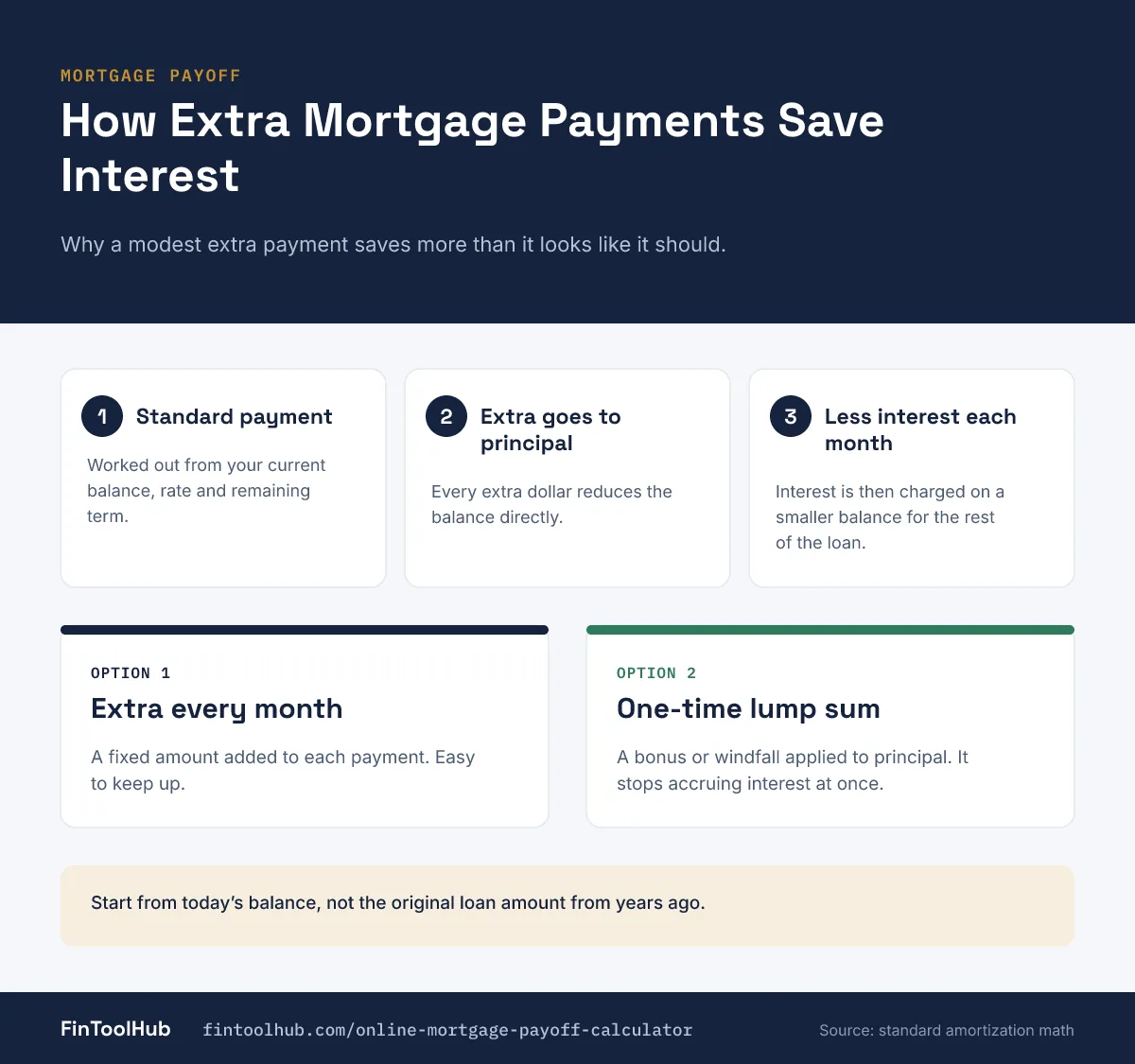
An online mortgage payoff calculator takes your current balance, rate, and remaining term to find your standard payment, then simulates extra payments month by month to show exactly how much sooner you'd finish and how much interest you'd avoid. That's the full mechanism behind this tool and any legitimate online mortgage payoff calculator — the math doesn't change because it's "online" rather than done by hand, but a working calculator saves you from running a 25-year amortization schedule yourself.
People searching for the best mortgage payoff calculator online or a free online mortgage payoff calculator are usually really asking for two things: does it start from where you actually are today (your current balance, not the original loan amount from years ago), and does it let you model extra payments realistically. This one does both.
Why extra payments save more than they look like they should
Mortgage interest is calculated on your remaining balance each month, and in the early-to-middle years of a loan, most of your standard payment goes toward interest, not principal. An extra payment applied directly to principal shrinks the balance interest gets calculated on for every remaining month of the loan — which is why a relatively modest extra monthly amount can eliminate years of payments and tens of thousands of dollars in interest, not just a proportional sliver of it.
Lump sum vs. ongoing extra payment
A one-time lump sum (an inheritance, a bonus, a tax refund) reduces your balance immediately and keeps saving you interest for the rest of the loan, even if you never add anything extra again. An ongoing monthly extra payment compounds that effect every single month. Both are modeled together above — enter either one alone, or combine them to see the full effect.
What this calculator doesn't include
- Property tax and insurance escrow — these don't shrink with extra principal payments, so they're excluded from the interest-savings math on purpose.
- PMI — if you're paying private mortgage insurance, paying down principal faster can help you cross the 20% equity threshold sooner and drop PMI, but that's a separate calculation from the interest savings shown here.
- Rate changes — this assumes a fixed rate for the remaining term; an ARM's future rate resets aren't modeled.
It also assumes your servicer applies extra payments directly to principal rather than holding them as a credit toward next month's payment — confirm that with your servicer, since some require you to specify "apply to principal" explicitly.
Standard mortgage amortization formula: M = P × [r(1+r)ⁿ] ÷ [(1+r)ⁿ − 1], the same formula used industry-wide for fixed-rate mortgage calculations. This is a planning estimate — your loan servicer's actual amortization schedule is the authoritative source for your specific loan.
Frequently asked questions
Before you send an extra payment.
How does an online mortgage payoff calculator work?
It calculates your standard monthly payment from your current balance, rate, and remaining term, then simulates your loan month by month with any extra payments applied to principal, tracking how much sooner the balance reaches zero and how much less interest accrues along the way.
Does a small extra payment really make a big difference?
Yes, often disproportionately so — because mortgage interest is calculated on your remaining balance each month, reducing that balance early saves interest on every future month of the loan, not just the month the extra payment was made.
Is a lump sum payment or a higher monthly payment better?
Both reduce your balance and save interest; a lump sum has an immediate one-time effect, while a higher monthly payment compounds that effect every month going forward. Combining both produces the largest combined effect.
Will extra payments lower my monthly payment amount?
Not automatically — most mortgages keep your required monthly payment the same and simply shorten the loan term unless you specifically request re-amortization (recasting) from your lender, which some but not all lenders offer.
Should I pay extra on my mortgage or invest the money instead?
That depends on your mortgage rate versus your expected investment return, your risk tolerance, and other financial priorities — a different comparison than this calculator makes, and worth running separately before deciding.