
Home Insurance Calculators
Home Insurance Replacement Cost Calculator
Estimate what it would actually cost to rebuild your home today, and check whether your current dwelling coverage would trigger a coinsurance penalty.

Estimate your replacement cost
Also called a replacement cost estimator — same calculation, different name.
This is a square-footage estimate, not an appraisal. Insurers use proprietary tools (like Marshall & Swift or Verisk 360Value) that factor in far more detail — treat this as a sanity check on your current coverage, not a binding number.
How to calculate replacement cost for home insurance
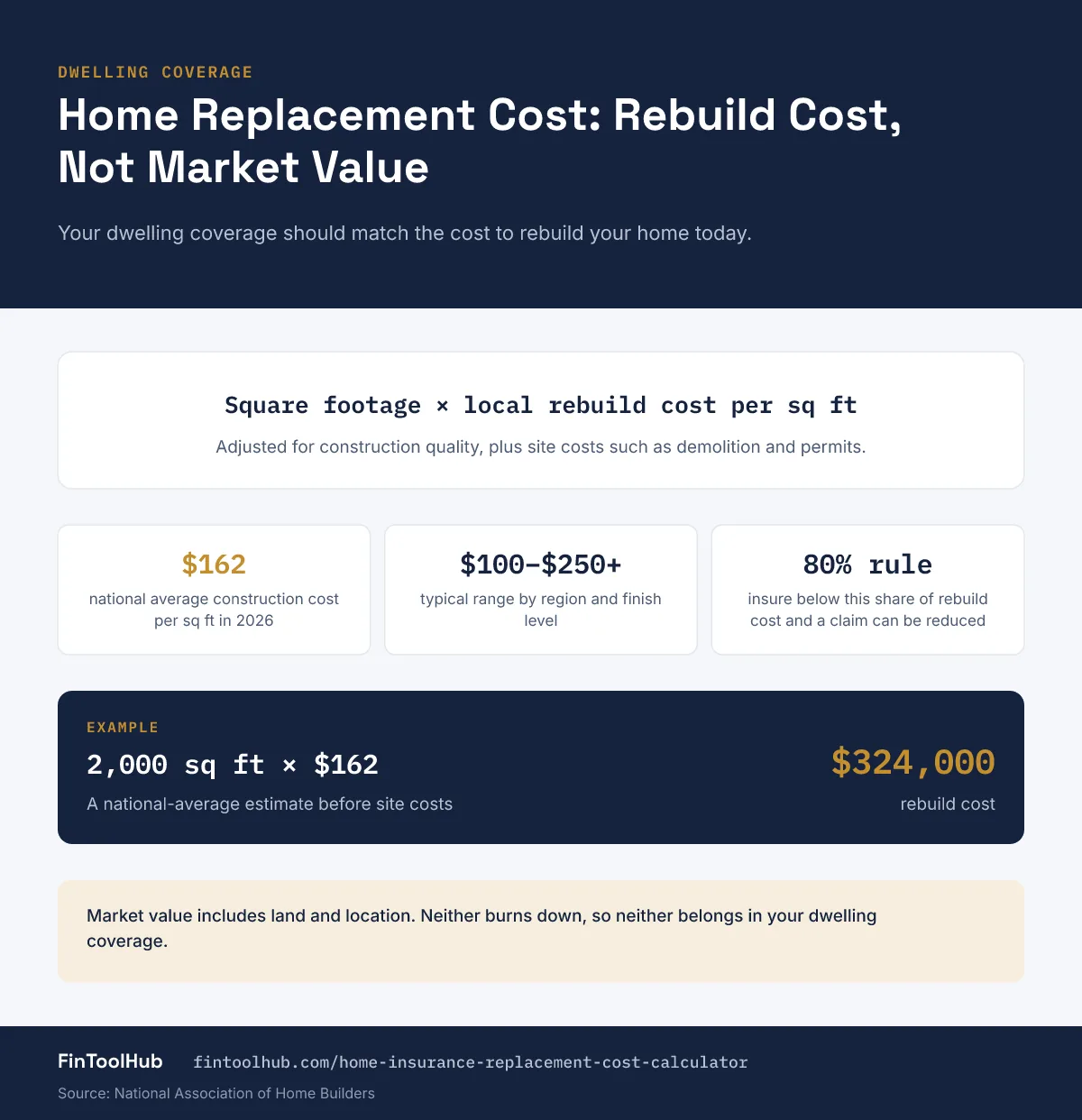
Replacement cost = your home's square footage × the local cost per square foot to rebuild, adjusted for construction quality and features, plus site costs like demolition and permits. That's the formula behind any real replacement cost calculator home insurance tool, whether it's called a replacement cost calculator for home insurance or a replacement cost estimator for home insurance — same math, different name. Per the National Association of Home Builders, the 2026 national average construction cost is about $162 per square foot, though the honest range runs from roughly $100 to $250+ depending on your region and finish level, with some high-cost states running well above $300.
To calculate the replacement cost of your home for insurance, you need your square footage and a realistic local cost per square foot — search recent local rebuild quotes or ask a contractor for a rough figure, since national averages can be off by 30% or more depending on where you live.
Replacement cost is not market value
This is the single most common point of confusion, and it matters because it can lead to the wrong coverage amount in either direction. Market value includes your land, your neighborhood, and whatever the local real estate market is doing — none of that burns down, floods, or blows away, so none of it belongs in your dwelling coverage. Replacement cost is purely the cost to rebuild the physical structure. A $600,000 home in a desirable neighborhood might only cost $350,000 to actually rebuild; insuring it for $600,000 means overpaying for coverage you'll never use.
The 80% rule and the coinsurance penalty
Most standard homeowners policies require you to insure your home to at least 80% of its full replacement cost. Fall below that threshold, and even a partial loss claim gets reduced proportionally — not just a total loss. The formula: Insurer payout = Claim amount × (Your coverage ÷ 80% of replacement cost), capped at 100%.
Real underinsurance is more common than most homeowners think
This isn't a theoretical risk. Researchers at the University of Colorado Boulder analyzed thousands of policyholders who filed claims after the 2021 Marshall Fire near Boulder and found 74% were underinsured — more than a third of those fell short by 25% or more of what they actually needed to rebuild. A separate analysis of California wildfire claims found average coverage of roughly $591,000 against an actual average rebuild cost of about $757,000, after post-disaster material and labor prices spiked well above pre-fire estimates.
Why rebuild costs spike right when you need coverage most
After a major regional disaster — wildfire, hurricane, hail event — rebuild costs in that area often jump well above the pre-disaster baseline, because everyone in the area needs the same contractors and the same materials at the same time. A replacement cost estimate from a normal year can understate what you'd actually pay to rebuild after the kind of event that would trigger the claim in the first place. This is exactly what "extended" or "guaranteed" replacement cost coverage — often 10–25% above your stated dwelling limit — is designed to protect against; ask your agent whether your policy includes it.
What this calculator can't replace
A square-footage estimate is a useful sanity check, not a substitute for a professional appraisal or your insurer's own detailed replacement cost calculation, which accounts for far more — foundation type, roof complexity, interior fixture quality, local permitting costs, and more. Update your estimate at every renewal, after any major remodel, and after any regional disaster that could have pushed local rebuild costs up.
National average construction cost sourced to the National Association of Home Builders (2026). Underinsurance research: University of Colorado Boulder's analysis of Marshall Fire claims data, as reported by NerdWallet. This is a planning estimate, not an appraisal or insurance advice — confirm your actual coverage needs with your insurer or a licensed appraiser.
Frequently asked questions
Before your policy renews.
How do I calculate the replacement cost of my home for insurance?
Multiply your home's square footage by the local cost per square foot to rebuild, adjusted for construction quality and any multi-story premium, then add site costs like demolition and permits. The 2026 national average is about $162/sq ft, but local costs vary significantly.
Is replacement cost the same as my home's market value?
No. Market value includes land and neighborhood factors; replacement cost only covers the physical structure. The two numbers can differ by tens or even hundreds of thousands of dollars in either direction.
What happens if I'm underinsured when I file a claim?
If your coverage falls below 80% of your home's full replacement cost, most policies apply a coinsurance penalty that proportionally reduces your payout — even on a partial loss, not just a total loss.
How often should I update my replacement cost estimate?
At every policy renewal, after any significant remodel or addition, and after any major regional disaster (wildfire, hurricane, hail) that could have driven up local labor and material costs.
Should I insure for more than 100% of the estimated replacement cost?
Many homeowners add a buffer — often through extended or guaranteed replacement cost coverage of 10–25% above the stated limit — specifically because rebuild costs tend to spike after the kind of regional disaster that triggers large claims in the first place.