
Capital Gains Calculators
1031 Exchange Capital Gains Calculator
See exactly how much gain a like-kind exchange defers vs. how much "boot" gets taxed now — plus your new basis in the replacement property.

Calculate your 1031 exchange capital gains
Compares an outright sale to a like-kind exchange, and flags any taxable boot.
Property you're selling (relinquished property)
Replacement property
Assumes a fully compliant exchange using a Qualified Intermediary, held for investment/business use, both properties real property. Doesn't replace Form 8824 — a QI and CPA should confirm the actual numbers before you file.
How a 1031 exchange capital gains calculator works
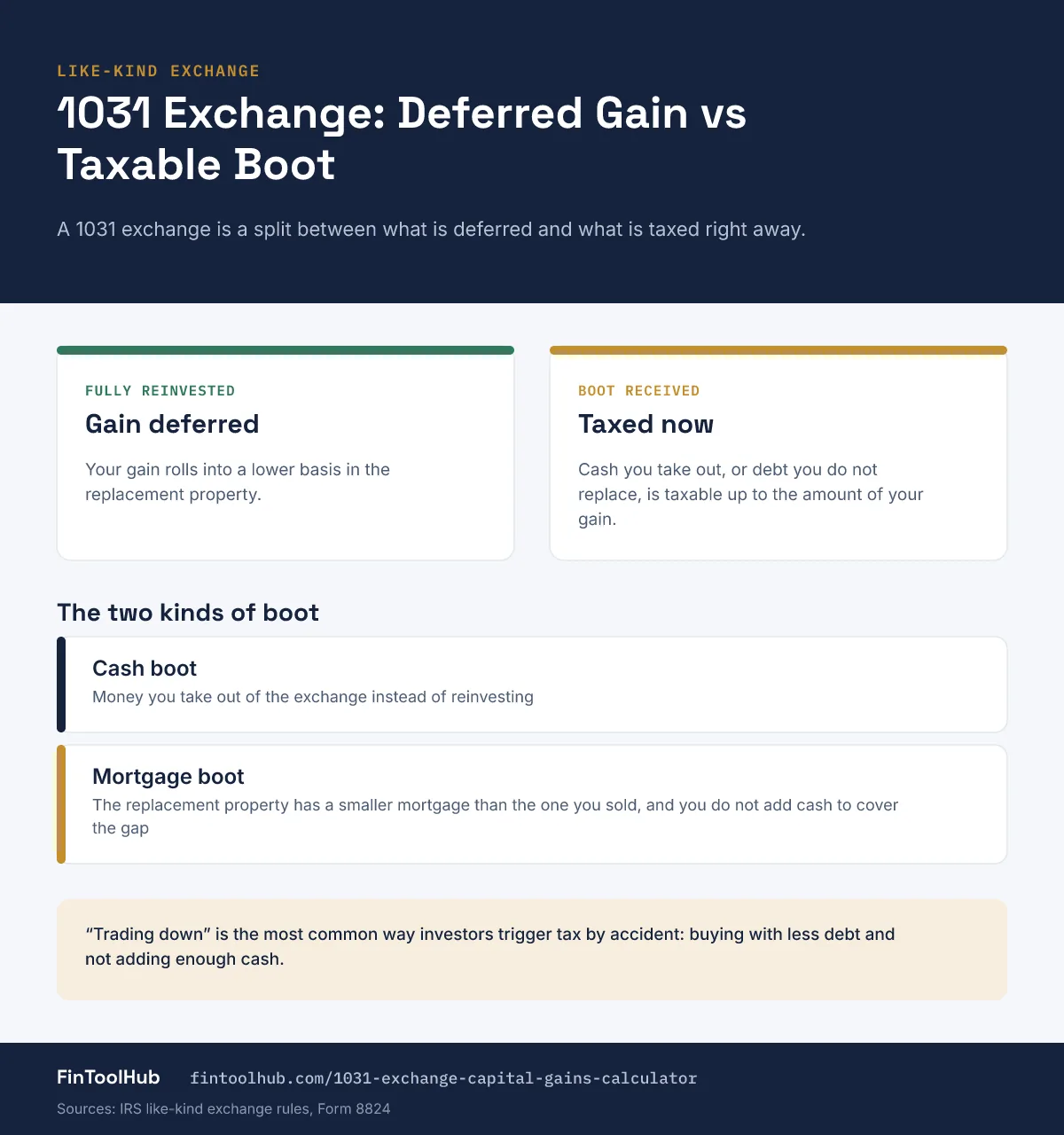
A 1031 exchange defers your capital gains tax by rolling your gain into a lower basis in a replacement property — but only the portion covered by full reinvestment. Any cash you take out, or debt you don't replace, becomes taxable "boot" right now. That's the core mechanic behind a 1031 capital gains calculator or 1031 exchange capital gains calculator: it's not one number, it's a split between what's deferred and what's recognized immediately.
To calculate my capital gains tax with 1031 exchange, or answer a broader capital gains tax calculator & real estate 1031 exchange question, you need both sides of the transaction — what you sold and what you bought — because the deferral only applies to the extent your money and debt stay in real estate.
What counts as "boot" (and gets taxed now)
Per IRS guidance on like-kind exchanges, if you receive cash or other non-like-kind property as part of the exchange, you must recognize gain to the extent of that boot — you can't recognize a loss, only gain. Boot comes in two forms:
- Cash boot — any money you actually take out of the exchange rather than reinvesting.
- Debt (mortgage) boot — if the mortgage you pay off on the property you're selling is larger than the mortgage you take on for the replacement property, that reduction in debt is treated as boot, even if you reinvest every dollar of cash. You can offset this by contributing additional outside cash to the deal equal to the debt shortfall.
Recognized gain, deferred gain, and your new basis
Recognized gain = the lesser of your realized gain or your total boot. Everything above that is deferred gain, which doesn't disappear — it reduces your basis in the replacement property, which is why the new property's basis is typically lower than its purchase price. When recognized gain does occur, depreciation recapture is treated as recognized first, up to the amount of boot, before any remaining gain — meaning a smaller boot amount can still trigger a real tax bill if your relinquished property carried significant depreciation.
| Outcome | Formula |
|---|---|
| Recognized gain (taxable now) | MIN(realized gain, total boot) |
| Deferred gain (rolled forward) | Realized gain − recognized gain |
| New basis in replacement property | Replacement purchase price − deferred gain |
The 45-day and 180-day deadlines
These deadlines run from the sale of your relinquished property, not the start of your search: you have 45 days to identify potential replacement properties in writing, and the entire exchange must close within 180 days (or your tax return due date for that year, if earlier). Both are hard deadlines with essentially no extensions, and you must use a Qualified Intermediary — you can never take actual or constructive receipt of the sale proceeds, or the exchange fails entirely and the full gain becomes taxable immediately.
What this calculator doesn't cover
This is a planning estimate, not a Form 8824 substitute. It doesn't model multiple relinquished or replacement properties, related-party exchange restrictions, reverse exchanges, or state-specific "clawback" rules that a few states (including California) apply to gains on property later sold outside that state. A Qualified Intermediary and CPA should structure and confirm any actual exchange.
Rules verified against IRS.gov: Like-kind exchanges, IRS Fact Sheet FS-2008-18, and the Form 8824 instructions. This is a planning estimate — actual reporting requires Form 8824 and a Qualified Intermediary; a CPA should confirm your specific transaction.
Frequently asked questions
Before you start your 45-day clock.
How do you calculate capital gains tax with a 1031 exchange?
Calculate your realized gain as if you'd sold outright, then determine your "boot" — any cash you took out plus any reduction in mortgage debt not offset by new cash. Your recognized (taxable) gain is the lesser of your realized gain or your total boot; everything else is deferred into your replacement property's basis.
Do I have to reinvest 100% of my sale proceeds to fully defer tax?
You need to reinvest all your equity and replace or exceed the debt you paid off (or offset any debt shortfall with new cash) to achieve full deferral. Falling short on either one creates boot, which is taxed even if you reinvested most of the proceeds.
What happens if I miss the 45-day or 180-day deadline?
The exchange generally fails entirely, and the full gain on the sale becomes taxable in that year, as if you'd simply sold the property. Both deadlines run from the closing date of the relinquished property sale and have essentially no extensions.
Does a 1031 exchange eliminate my tax, or just delay it?
It delays it. The deferred gain carries into your replacement property's lower basis, so it's generally recognized whenever you eventually sell without doing another exchange. Some investors defer indefinitely through successive exchanges; heirs can receive a stepped-up basis at death, which can eliminate the deferred gain entirely for them.
Can I do a 1031 exchange on my primary residence?
No. Section 1031 only applies to real property held for investment or business use. A primary residence uses the separate Section 121 exclusion instead.