
Loan & Finance Calculators
Lease vs Finance Calculator
A fair comparison has to account for what you own at the end, not just the monthly payment — leasing leaves you with $0 equity, financing leaves you with a car minus whatever's left on the loan.

Compare leasing vs. financing
Both paths are evaluated at the same point in time — the end of the lease term.
Lease terms
Finance terms
Lease
You return the car — $0 equity at the end
Finance
You own the car — equity minus remaining loan balance
Excludes sales tax, insurance, and maintenance, which can differ between leasing and owning. Assumes the financed vehicle's resale value at the comparison term follows the same estimated percentage you entered above.
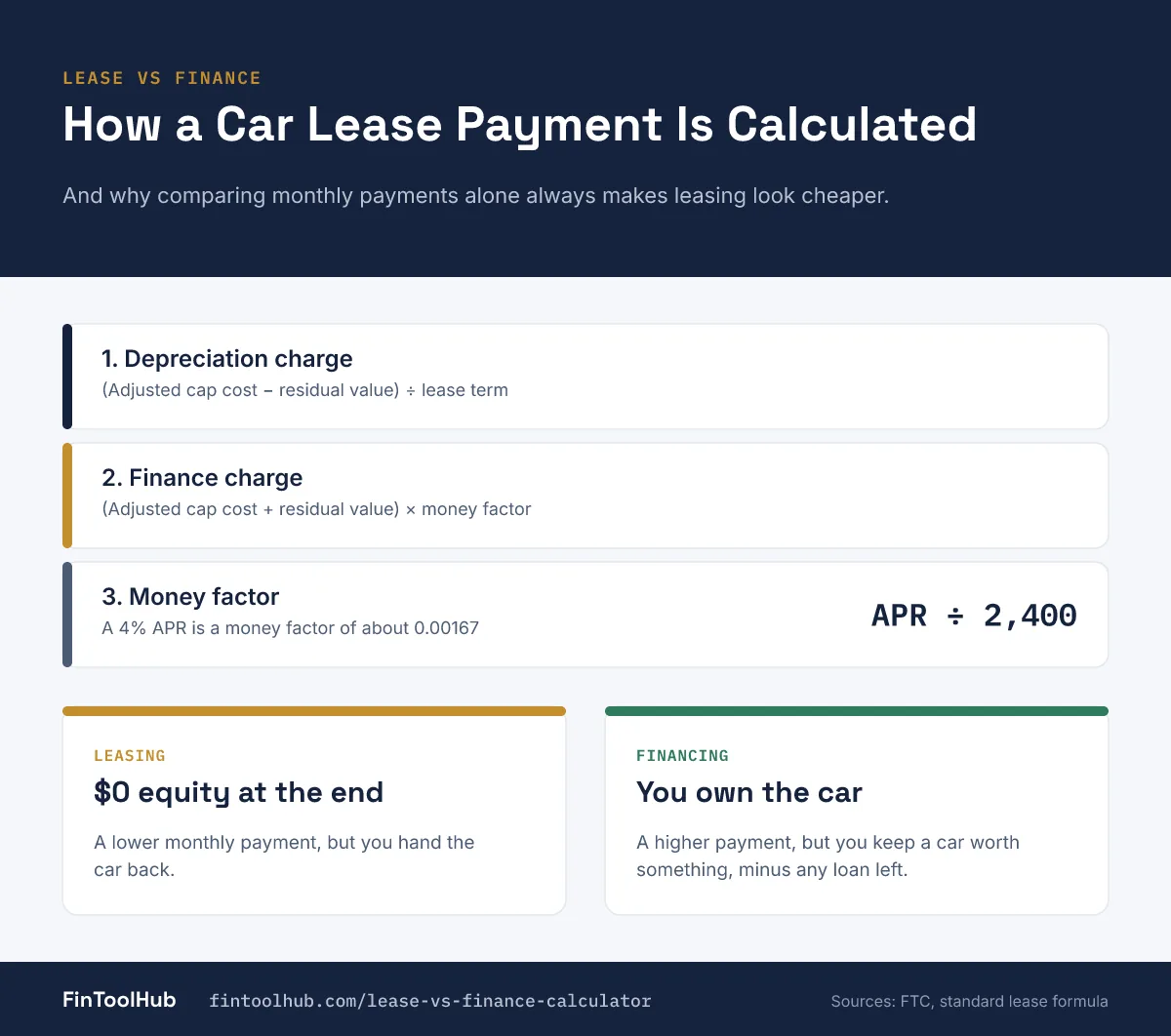
Why comparing monthly payments alone gets this wrong
A lease versus finance calculator that only compares monthly payments will always make leasing look cheaper — that's true by design, since a lease payment covers depreciation and interest on only the portion of the car's value you'll use, not the whole price. The comparison that actually matters is what each option leaves you with at the end: leasing hands the car back with $0 equity, while financing leaves you owning a car worth something, minus whatever's still left on the loan. This calculator evaluates both at the same point in time — the end of the lease term — and nets out that equity difference before declaring a winner.
How the lease payment is actually calculated
A lease payment has two components: a depreciation charge (the portion of the car's value you'll use up during the lease) and a finance charge (interest, expressed as a "money factor" rather than an APR). The formula:
Finance charge = (Adjusted Cap Cost + Residual Value) × Money Factor
Money factor = Lease APR ÷ 2,400
Dealers quote the money factor as a small decimal (like 0.00167) rather than an APR — the exact same 4% rate, just formatted to look smaller. This calculator takes your APR and converts it internally, so you don't need to track down the raw money factor to get an accurate estimate.
What residual value actually controls
The residual value — the car's estimated worth at the end of the lease — drives both your lease payment and, in this comparison, your equity if you'd financed instead. A car with a residual value of 55% of its original price after 36 months is a reasonable middle-of-the-road assumption; vehicles with strong resale value can run closer to 60%, while faster-depreciating models can fall closer to 45%.
When leasing tends to win, and when financing does
- Leasing tends to win when you value lower monthly payments, want a new car every few years, and don't drive enough miles to trigger overage charges — the calculator's "net cost" gap tends to be smaller than the raw monthly-payment gap suggests, though.
- Financing tends to win the longer you plan to keep driving the car past the comparison term — once the loan is paid off, your monthly cost drops to $0 while a lease payment continues indefinitely if you keep leasing new cars. Our Auto Loan Payoff Calculator can show you exactly when that happens for your specific loan.
Lease payment formula (depreciation charge + finance charge, money factor = APR ÷ 2,400) verified against Edmunds, Capital One Auto Navigator, and Calculator.net's published lease calculation methodology. This is a planning estimate — actual lease offers include additional fees, taxes, and mileage terms not modeled here. Official sources: FTC: Financing or leasing a car.
Frequently asked questions
Before you sign a lease or a loan.
Is leasing or financing cheaper?
It depends on how you measure it. Leasing almost always has a lower monthly payment, but financing usually wins on total net cost once you account for the equity you build in a financed vehicle — a fair comparison has to look at both.
What is a money factor, and how does it relate to APR?
The money factor is how lease interest is expressed, as a small decimal like 0.00167 instead of a percentage. Multiply an APR by that same relationship in reverse (APR ÷ 2,400) to get the money factor, or multiply the money factor by 2,400 to get the equivalent APR.
Why does the calculator show $0 equity for the lease option?
Because at the end of a standard lease, you return the vehicle to the leasing company — you don't own any part of it unless you separately exercise a purchase option at the residual value, which is a different decision from the lease itself.
Does this include sales tax?
No — sales tax treatment varies significantly by state (some tax only the monthly lease payment, others tax the full vehicle price upfront), so it's excluded to keep the comparison consistent. Add your state's estimated tax impact separately.
What residual value percentage should I use?
Around 55% is a reasonable default for a 36-month term. Vehicles known for strong resale value can run closer to 60%; faster-depreciating vehicles can fall closer to 45%. Check the specific residual value quoted for your vehicle and term if you have it.