
Savings Calculators
Sinking Fund Calculator
Find exactly how much to set aside each period to hit a savings goal by a target date — the same formula whether you're saving for a car, a bond payoff, or any known future expense.

Calculate your sinking fund contribution
Works for a personal savings goal or a formal sinking fund calculation.
Assumes contributions are made at the end of each period (an "ordinary annuity" — the standard convention for both personal savings goals and formal sinking fund calculations) and that your interest rate stays constant.
What a sinking fund is
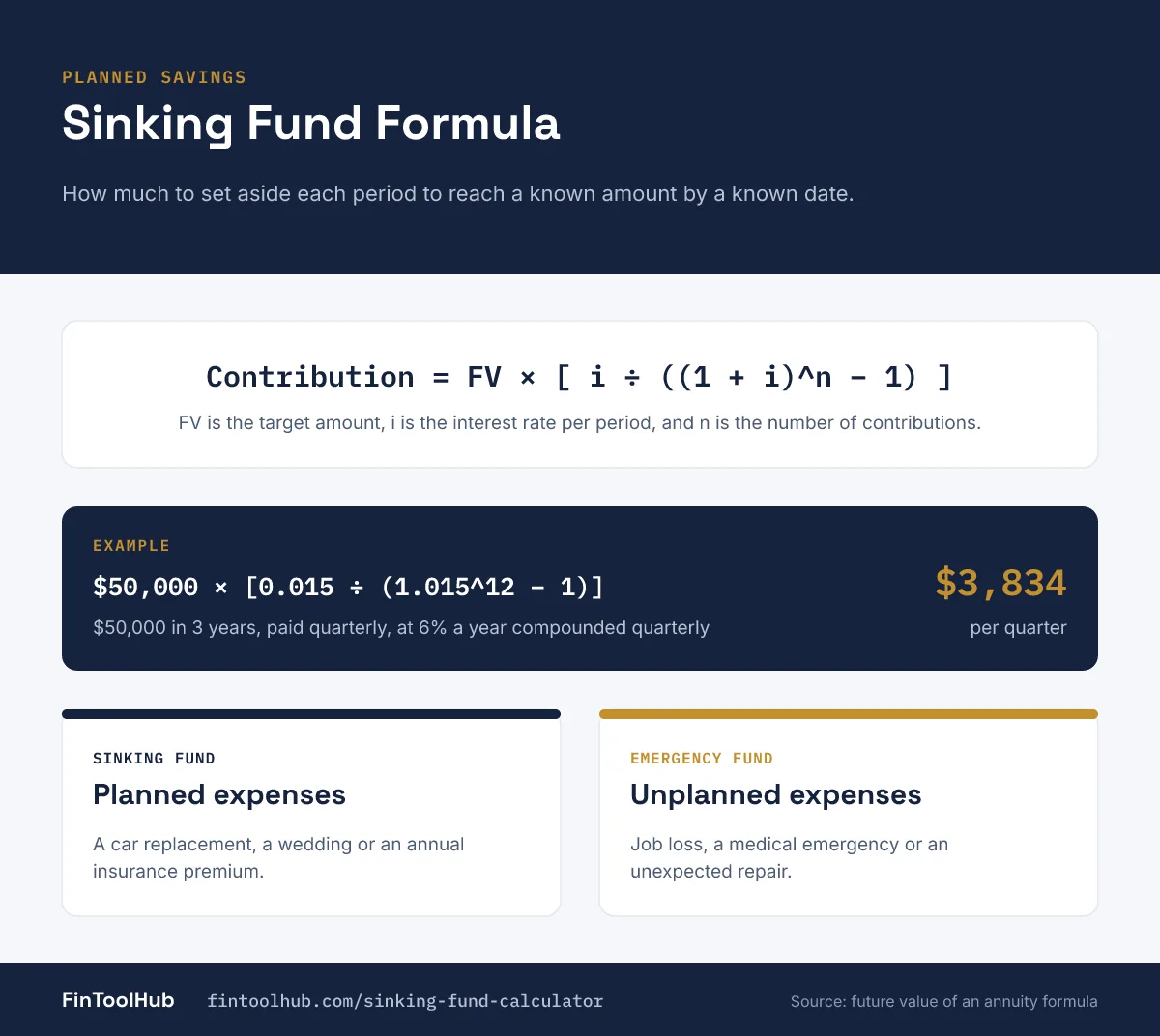
A sinking fund is money set aside gradually, in regular contributions, to reach a specific future amount by a specific date — as opposed to saving randomly or scrambling when the expense arrives. The term comes from corporate and municipal finance, where a company or government "sinks" money into a fund on a fixed schedule to retire a bond or loan at maturity, but the exact same math applies to a personal savings goal: a car replacement, a wedding, an annual insurance premium, or any known, planned future expense.
The sinking fund formula
The calculation of a sinking fund — how much you need to contribute each period — comes from the standard future-value-of-an-annuity formula, solved for the payment:
where i is the interest rate per period and n is the total number of contribution periods.
Worked example: a company needs to accumulate $50,000 in 3 years, contributing at the end of every quarter, earning 6% annual interest compounded quarterly. The periodic rate is 6% ÷ 4 = 1.5%, and there are 12 quarterly periods. Contribution = $50,000 × [0.015 ÷ ((1.015)¹² − 1)] = $3,834 per quarter.
Sinking fund vs. emergency fund
These get confused because both involve setting money aside, but they answer different questions. A sinking fund is for a known future expense with a rough target amount and timeline — you're not guessing whether you'll need the money, only precisely when and how much. An emergency fund covers unknown, unplanned expenses — job loss, a medical emergency, an unexpected repair — and doesn't have a fixed target date the way a sinking fund does. Most solid financial plans use both, for different purposes.
Common uses for a sinking fund
- Personal: a car replacement, home down payment, annual insurance premium, holiday or gift spending, a planned vacation, or a known upcoming repair.
- Business: equipment replacement, a planned facility upgrade, or building reserves ahead of a large predictable expense.
- Corporate/municipal finance: retiring a bond at maturity, where the bond's interest rate (what's owed to bondholders) and the sinking fund's interest rate (what the fund itself earns while accumulating) are two separate numbers, not the same rate.
Formula verified against a standard sinking fund worked example (quarterly contributions, 6% annual rate compounded quarterly, 3-year term) commonly used in finance and accounting coursework. This is a planning estimate — actual returns and fees on your specific savings account will affect the real result.
Frequently asked questions
Before you start (or restart) a savings goal.
How do you calculate a sinking fund contribution?
Multiply your savings goal by the interest rate per period, then divide by ((1 + rate)^periods − 1). This gives you the exact amount to contribute each period to reach your goal, accounting for the interest your contributions will earn along the way.
What's the difference between a sinking fund and just saving money?
A sinking fund specifically targets a known future amount by a known date, calculated precisely — rather than saving an arbitrary amount and hoping it's enough. The math accounts for compound interest, so you contribute less than you would with simple saving.
Is a sinking fund the same as an emergency fund?
No. A sinking fund is for a known, planned expense with a target date. An emergency fund covers unknown, unplanned expenses and isn't tied to a specific future purchase or deadline.
What interest rate should I use?
Use the actual rate you expect to earn on wherever you're keeping the money — a high-yield savings account APY is a reasonable choice for most personal sinking funds, since the money needs to stay liquid and safe for a known, relatively near-term goal.
Why do bond sinking funds use two different interest rates?
The bond itself has a coupon rate (what's owed to bondholders), which is separate from the rate the sinking fund earns while the money accumulates. They're often different numbers, since one reflects the cost of the debt and the other reflects the return on the fund's own investments.