
Loan & Finance Calculators
Invoice Finance Calculator
Two different tools, since "invoice finance" means two different things: getting cash advanced against unpaid invoices, or charging your own customers a fee for paying late.

Invoice factoring / invoice financing calculator
Selling or borrowing against your unpaid invoices for immediate cash.
Factor fees are often tiered (a higher fee if the invoice takes longer to collect) rather than flat — this models a flat fee for simplicity. The APR figure shows what that fee actually costs on an annualized basis, since a "small" fee over a short collection period compounds into a much higher effective rate.
Overdue invoice finance charge / late fee calculator
What to charge a customer for a late payment on an invoice you sent.
This late fee is only enforceable if it was disclosed in your invoice terms or contract before the work was done — it generally can't be added retroactively to an invoice with no prior agreement. Confirm your state's usury/interest-rate limits before setting a rate above 1%/month.
Two different questions, both called "invoice finance"
An invoice finance calculator or invoice financing calculator search is almost always about getting cash advanced against unpaid invoices you're owed — a cash-flow tool for the business waiting to get paid. A search to calculate finance charges on past due invoices or find a finance charge calculator for past due invoices is the opposite side of the transaction: what a business charges its own customers for paying late. Both tools live on this page because they share a name, not a mechanism.
How invoice factoring actually works
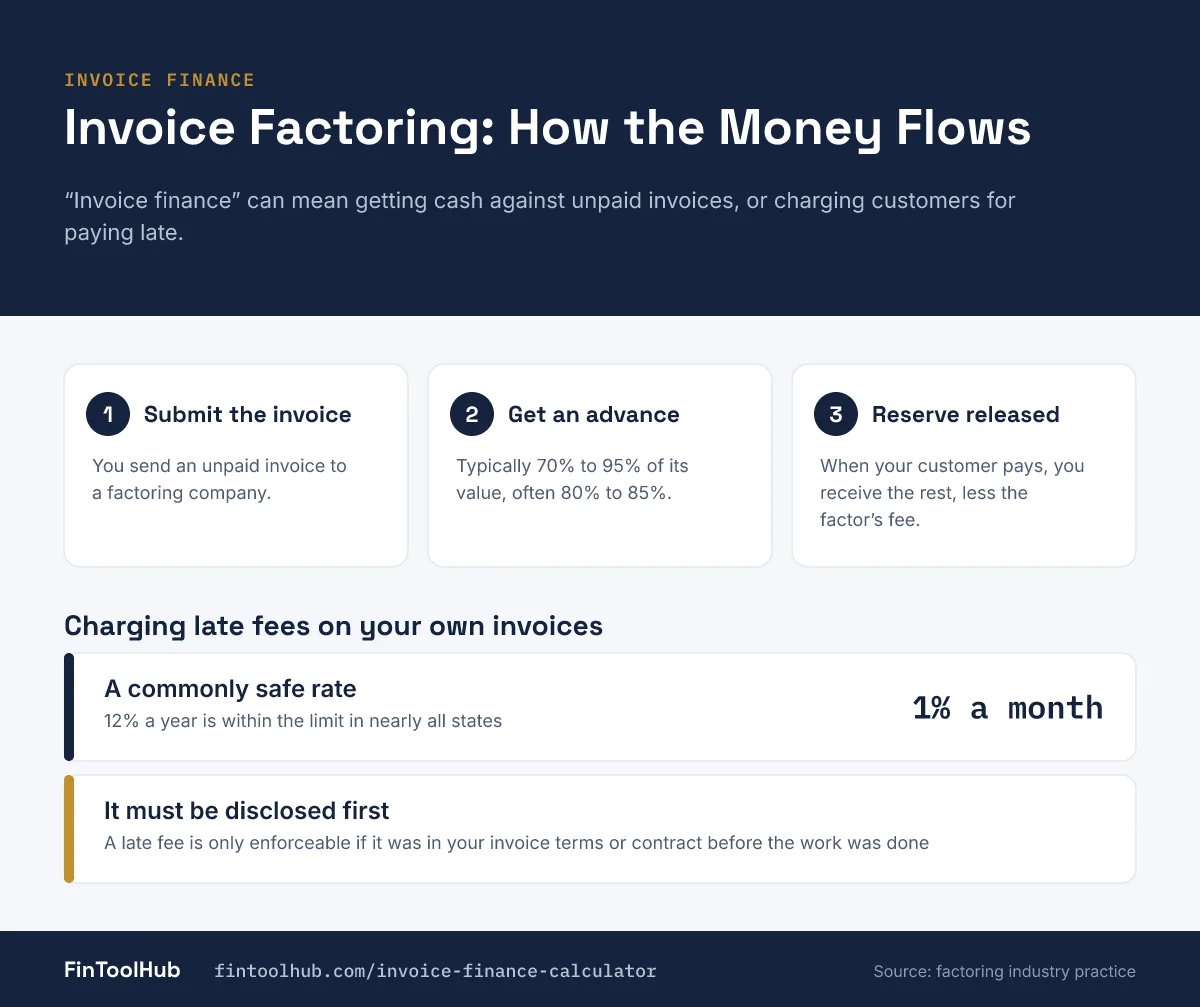
You submit an invoice to a factoring company, who advances you a percentage of its value immediately — the advance rate, typically 70–95%, commonly around 80–85%. The rest is held as a reserve. When your customer actually pays the invoice, the factor releases the reserve back to you, minus their factor fee — typically 1–5% of the total invoice value, sometimes charged as a flat rate, sometimes tiered upward the longer the invoice takes to collect.
Why the fee is a much bigger APR than it looks
A "4% fee" sounds modest next to a bank loan's interest rate — until you annualize it. Factoring fees are charged over a period of weeks, not a year, so a small-sounding percentage compounds into a genuinely high effective rate once you convert it to an annual basis. In the example above, a 4% fee collected over 28 days works out to roughly a 60%+ effective APR — a real cost that a flat "fee" framing tends to obscure. This is exactly why comparing the APR-equivalent, not just the sticker fee percentage, matters before choosing factoring over a traditional business loan or line of credit.
How to calculate a late fee on an overdue invoice
The standard, defensible method prorates an annual rate across the actual number of days overdue: Late Fee = Invoice Amount × (Annual Rate ÷ 365) × Days Overdue. This works cleanly regardless of exactly how many days late the payment is, rather than rounding to whole months.
| Structure | Typical rate | Best for |
|---|---|---|
| Percentage-based (most common) | 1–1.5% per month (12–18% annually) | B2B invoices, ongoing client relationships |
| Flat fee | $25–$50 | Smaller consumer-facing invoices |
| Tiered / graduated | Increases the longer it's unpaid | Repeat late payers |
Is there a legal limit on what you can charge?
Yes — most states have usury laws capping the interest rate you can charge, and they vary significantly. California, for example, caps non-exempt transactions at 10% annually, though exempt transactions (many standard B2B contracts) have no state cap. A rate of 1% per month (12% annually) is broadly cited as safe across nearly all US states, which is why it's the most common default for late fee policies. Whatever rate you choose, it needs to be disclosed in your original invoice terms or contract — a fee can't generally be added retroactively to an invoice with no prior agreement.
Invoice factoring mechanics verified against multiple independent factoring-industry calculators and guides. Late fee formula and legal limits cross-checked against several 2026 invoicing and small-business finance guides. This is a planning estimate, not legal or tax advice — confirm your specific state's usury limits and your contract terms before applying either calculation.
Frequently asked questions
Before you factor an invoice, or charge a late fee.
How much does invoice factoring actually cost?
Typically 1–5% of the invoice value as a factor fee, on top of receiving less than the full invoice amount upfront (the advance rate). When annualized, this can work out to a much higher effective rate than the fee percentage alone suggests — often 30–60%+ depending on how quickly your customer pays.
What's the difference between invoice factoring and invoice financing?
The terms are often used interchangeably. Technically, factoring involves selling the invoice (the factor collects payment directly from your customer), while financing/discounting uses the invoice as collateral for a loan while you retain collection responsibility. The cash-flow math works similarly either way.
How do I calculate a late fee on an overdue invoice?
Multiply the invoice amount by your annual late fee rate divided by 365, then by the number of days overdue. A common, broadly-safe default is 1% per month (12% annually).
Can I charge whatever late fee I want?
No — most states have usury laws capping interest rates, and the fee must be disclosed in your invoice terms or contract before the work was done. A rate can't generally be applied retroactively to an existing invoice without prior agreement.
Should I use a flat fee or a percentage-based late fee?
Percentage-based fees scale naturally with invoice size and are common for B2B work with variable invoice amounts. Flat fees are simpler to communicate and common for smaller, consumer-facing invoices.