
401(k) & Divorce
How a 401(k) Actually Gets Split in a Divorce (QDROs Explained)
Your divorce decree can say "split the 401(k) 50/50" all it wants — the plan administrator won't move a dollar without a separate document. Here's what that document is, and why how you take the money matters as much as how much.

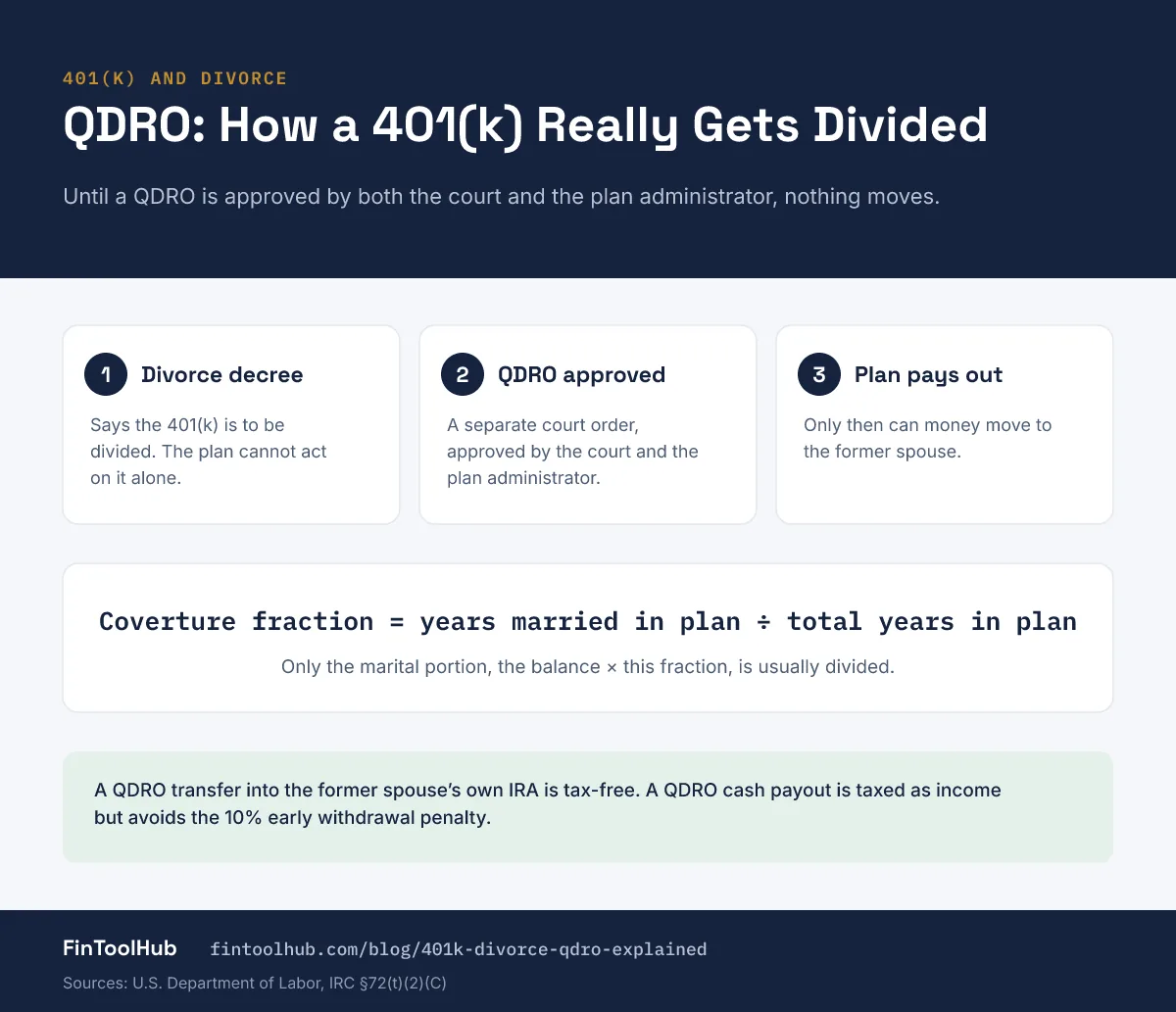
The decree says "split it." That's not enough.
A lot of people assume that once a divorce is finalized and the settlement says the 401(k) gets divided, the money just... moves. It doesn't. A 401(k) is governed by federal retirement law (ERISA), and plan administrators are legally barred from paying out any portion of an account to anyone other than the account holder — including an ex-spouse — without a specific, separately drafted court order.
That order is called a Qualified Domestic Relations Order, or QDRO. It's not automatic, it's not part of the standard divorce paperwork, and it usually requires its own attorney review, drafting, and approval process — sometimes taking weeks or months after the divorce itself is final. Until it's approved by both the court and the plan administrator, nothing moves.
It's rarely the whole balance
Courts generally don't award an ex-spouse a share of the entire 401(k) balance — only the portion that built up during the marriage. Money contributed before the wedding, and generally anything after separation, is typically treated as separate property. The formula used to isolate the marital share is called the coverture fraction:
Marital portion = Account balance × Coverture fraction
Spouse's share = Marital portion × Division percentage (commonly 50%)
A worked example: someone with an $180,000 balance, 18 years at the same employer, married for the last 14 of those years. The coverture fraction is 14 ÷ 18, or about 78% — meaning roughly $140,000 of the balance is considered marital property, not the full $180,000. Split 50/50, that's a $70,000 share for the ex-spouse, not $90,000.
The part that can cost — or save — thousands, after the QDRO is approved
Once a QDRO is in place, the ex-spouse (technically called the "alternate payee") has real choices about how to actually receive their share, and those choices have genuinely different tax consequences.
| Method | Tax owed at transfer | 10% early withdrawal penalty |
|---|---|---|
| Roll into your own IRA or retirement account | None | None |
| Take a cash distribution via the QDRO | Ordinary income tax | None — a specific QDRO exception applies |
| Skip the QDRO — owner withdraws and pays you directly | Owed by the account owner, not you | Also owed by the account owner |
On that same $70,000 share, choosing a full cash-out over a QDRO rollover — assuming a 22% tax bracket plus the standard 10% penalty a non-QDRO withdrawal would trigger — works out to roughly $22,400 in unnecessary cost. Same $70,000. Same divorce. A $22,400 difference based entirely on which button gets pressed.
What else counts as marital property in the account
- Employer matching contributions that vested during the marriage — these count the same as the employee's own contributions.
- Investment growth on the marital portion, tracked alongside the contributions that generated it.
- IRAs, notably, don't require a QDRO at all — they can transfer through a simple direct trustee-to-trustee transfer, as long as it's properly documented in the divorce decree itself.
Public pensions — state teacher retirement systems, government employee plans — generally aren't governed by ERISA at all, so a standard QDRO doesn't apply to them. Those typically require a different, state-specific order instead, with its own name and process depending on the state and plan.
The practical takeaway
If a 401(k) is part of your divorce settlement, budget real time for the QDRO process specifically — it's a separate legal step, not a formality that happens automatically once the divorce is final. And once it's approved, don't default to a cash-out just because it feels simpler. Rolling the funds into your own retirement account preserves the entire value; cashing out gives up a meaningful chunk of it to tax, even though the penalty itself is waived.
You can model your own marital portion and compare the payout methods directly with our 401(k) Divorce Calculator, using your actual account balance, years married, and division percentage.
The coverture fraction methodology and QDRO tax treatment (including the specific penalty exception under IRC §72(t)(2)(C)) verified against multiple independent 2026 family law and divorce finance resources. This is general information, not legal advice — a family law attorney and your plan administrator determine the actual division rules and required documentation for your situation. Official sources: US Department of Labor: QDROs; IRS: Exceptions to the early distribution tax.
Frequently asked questions
Does a divorce decree automatically split a 401(k)?
No. A separate legal order called a Qualified Domestic Relations Order (QDRO) is required before a plan administrator will divide the account, regardless of what the divorce decree itself says.
Do I get half of the entire 401(k) balance in a divorce?
Usually not the entire balance — only the portion built up during the marriage, calculated using the coverture fraction (years married while participating in the plan divided by total years of participation).
Does receiving money through a QDRO trigger the early withdrawal penalty?
Rolling the funds into your own retirement account is completely penalty-free and tax-free. Taking a cash distribution through the QDRO still avoids the 10% penalty, even under age 59½, though ordinary income tax applies to the distribution.
What happens if the account owner just withdraws the money and pays me directly, without a QDRO?
The account owner, not you, owes both income tax and the 10% early withdrawal penalty on that withdrawal. This is generally the most expensive and legally messiest way to handle a 401(k) division.
Do IRAs also require a QDRO in a divorce?
No. IRAs can be divided through a direct trustee-to-trustee transfer, properly documented in the divorce decree, without the separate QDRO process required for 401(k)s and other ERISA-governed plans.