
Debt Payoff
Debt Avalanche vs. Snowball: What the Research Actually Shows
The math says avalanche wins every time. The behavioral research says something more interesting: the method most likely to actually get finished isn't always the one that costs the least on paper.

Two methods, one shared assumption
Both approaches start the same way: pay the minimum on every debt, then throw every extra dollar at exactly one target. They only disagree on which target to pick.
Ignores balance size entirely. Targets whichever debt is costing you the most per dollar owed, regardless of how large or small it is.
Ignores interest rate entirely. Targets whichever debt will disappear soonest, then rolls that payment into the next-smallest.
The math isn't actually in dispute
Avalanche will never cost more in total interest than snowball, for the simple reason that it always attacks the debt accruing interest fastest. The size of the gap between them varies a lot depending on your specific mix of balances and rates — sometimes it's negligible, sometimes it's substantial.
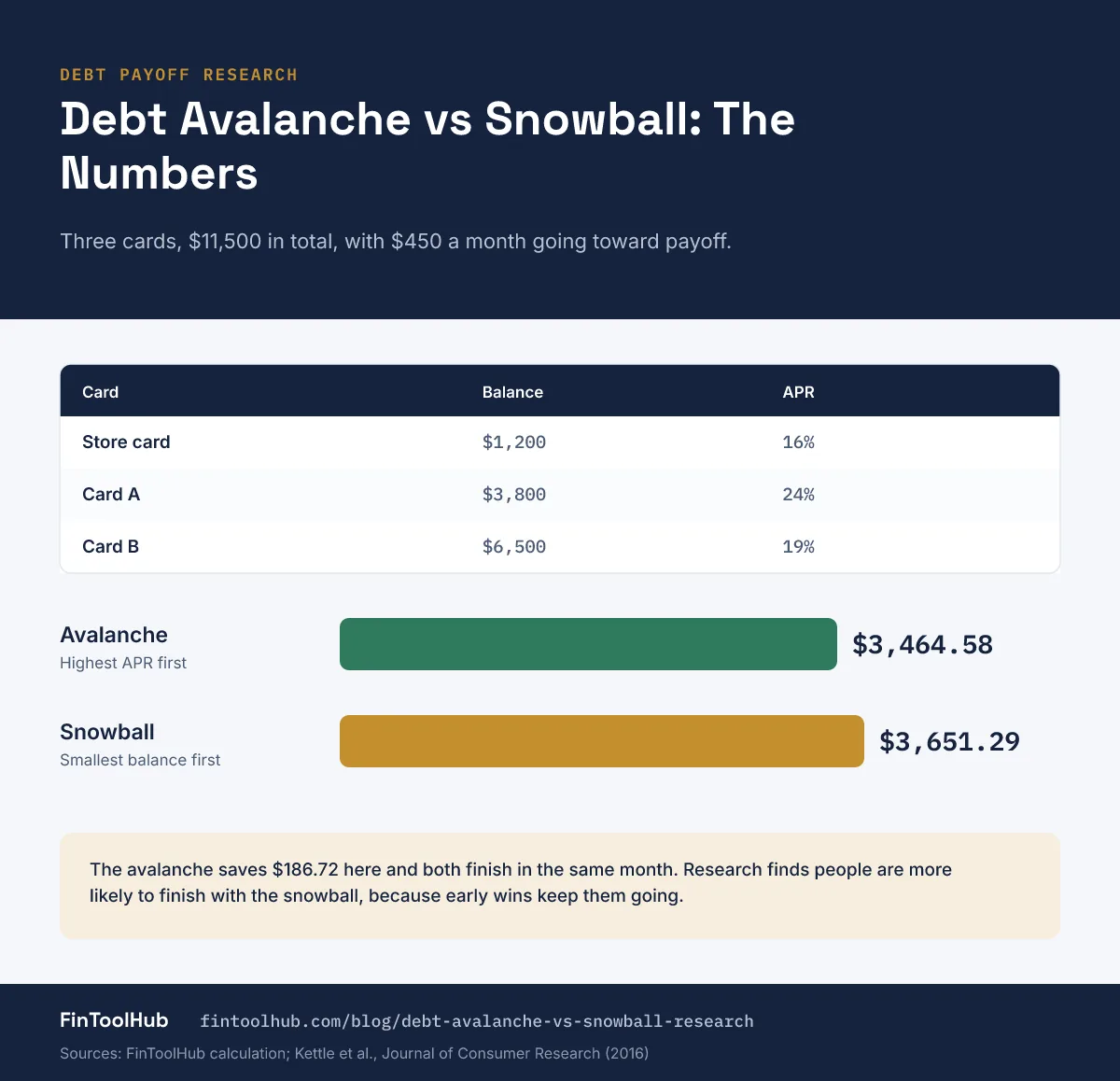
Here's a real comparison, calculated the same way our Credit Card Debt Payoff Calculator models both methods:
Card A: $3,800 at 24% APR
Card B: $6,500 at 19% APR
In this example, both methods finish in the same number of months — the gap shows up entirely in interest paid, not time. That's fairly typical: avalanche's advantage is usually measured in dollars saved more than months shaved, though both can move in avalanche's favor depending on the specific balances involved.
The research that complicates the "obvious" answer
If the only question were "which method costs less," this wouldn't be a debate. It's a debate because of what happens when a payoff plan meets real life. A 2016 study by Kettle, Trudel, Blanchard, and Häubl, published in the Journal of Consumer Research, examined how the way people structure debt repayment affects whether they actually see it through — and found that concentrating payments on paying off individual debts completely, rather than spreading payments proportionally, increased people's motivation to keep going. A related study by Gal and McShane, published in the Journal of Marketing Research in 2012, found that consumers who closed out small debt accounts first were more likely to eventually eliminate all of their debt than those following other strategies.
Neither study claims snowball beats avalanche on cost — it doesn't, and nothing suggests it does. What they point to instead is a completion problem: a mathematically optimal plan that gets abandoned in month six doesn't save anyone money. It just becomes an abandoned plan. The Consumer Financial Protection Bureau's own consumer education material makes a similar point in plainer language — behavioral factors meaningfully affect whether people actually finish paying down debt, and a plan you stick with generally beats a better plan you don't.
So which one should you actually use?
| Choose avalanche if | Choose snowball if |
|---|---|
| You're disciplined about sticking with a plan even without frequent visible progress | You've started and abandoned a debt payoff plan before |
| Your highest-rate debt isn't drastically larger than your other balances | Seeing an account hit zero is what keeps you motivated |
| You want the mathematically guaranteed lowest total cost | You have several small, easy-to-close accounts cluttering your list |
The hybrid most people actually end up using
In practice, a lot of people land somewhere in between: knock out one or two genuinely small debts first, purely for the early win and the reduced number of accounts to track, then switch to avalanche ordering for everything that's left. This isn't a compromise that sacrifices much — if the smallest debts are also relatively low-interest, you're giving up very little in total cost while still capturing most of the behavioral benefit that makes snowball work for people in the first place.
The honest bottom line: extra money going toward debt each month matters more than which method organizes it. Both approaches lose to inaction. Pick whichever one you're confident you'll actually finish, and use a payoff calculator to see your real numbers under either ordering before deciding.
Avalanche and snowball mechanics are standard, well-established debt payoff methodology. Behavioral findings are drawn from Kettle, Trudel, Blanchard, and Häubl (2016), Journal of Consumer Research, and Gal and McShane (2012), Journal of Marketing Research, as summarized in multiple independent 2026 secondary sources; readers wanting the underlying methodology should consult the original papers directly. The worked example above was independently calculated using standard amortization and payoff-priority simulation. This is general information, not personalized financial advice.
Frequently asked questions
Does the avalanche method always save more money than snowball?
Yes — avalanche always results in equal or lower total interest paid, since it always targets whichever debt is accruing interest fastest. The size of the savings varies depending on your specific balances and rates.
Why would anyone use snowball if avalanche saves more money?
Peer-reviewed behavioral research has found that people following the snowball method are more likely to actually complete their debt payoff plan, because eliminating individual accounts entirely sustains motivation better than a mathematically optimal but slower-feeling plan.
Can I combine avalanche and snowball?
Yes — a common hybrid approach is to pay off one or two genuinely small debts first for an early win, then switch to avalanche ordering (highest interest rate first) for the remaining debts.
Does the method I choose affect how long payoff takes, or just the interest paid?
Both are possible, but the difference usually shows up more in total interest paid than in total time to debt-free, especially when the same total monthly payment is applied under either method.
What matters more than choosing avalanche or snowball?
How much extra money you put toward debt each month. Both methods lose to inaction — the method you actually stick with and complete matters more than which one is theoretically optimal.