
Tax & Paycheck
State Income Tax by State: The Complete 2026 Guide
No two "no-tax" states get there the same way, and the states that do tax income range from a single flat rate to systems with county-level surcharges layered on top. Here's how every structure actually works, state by state.

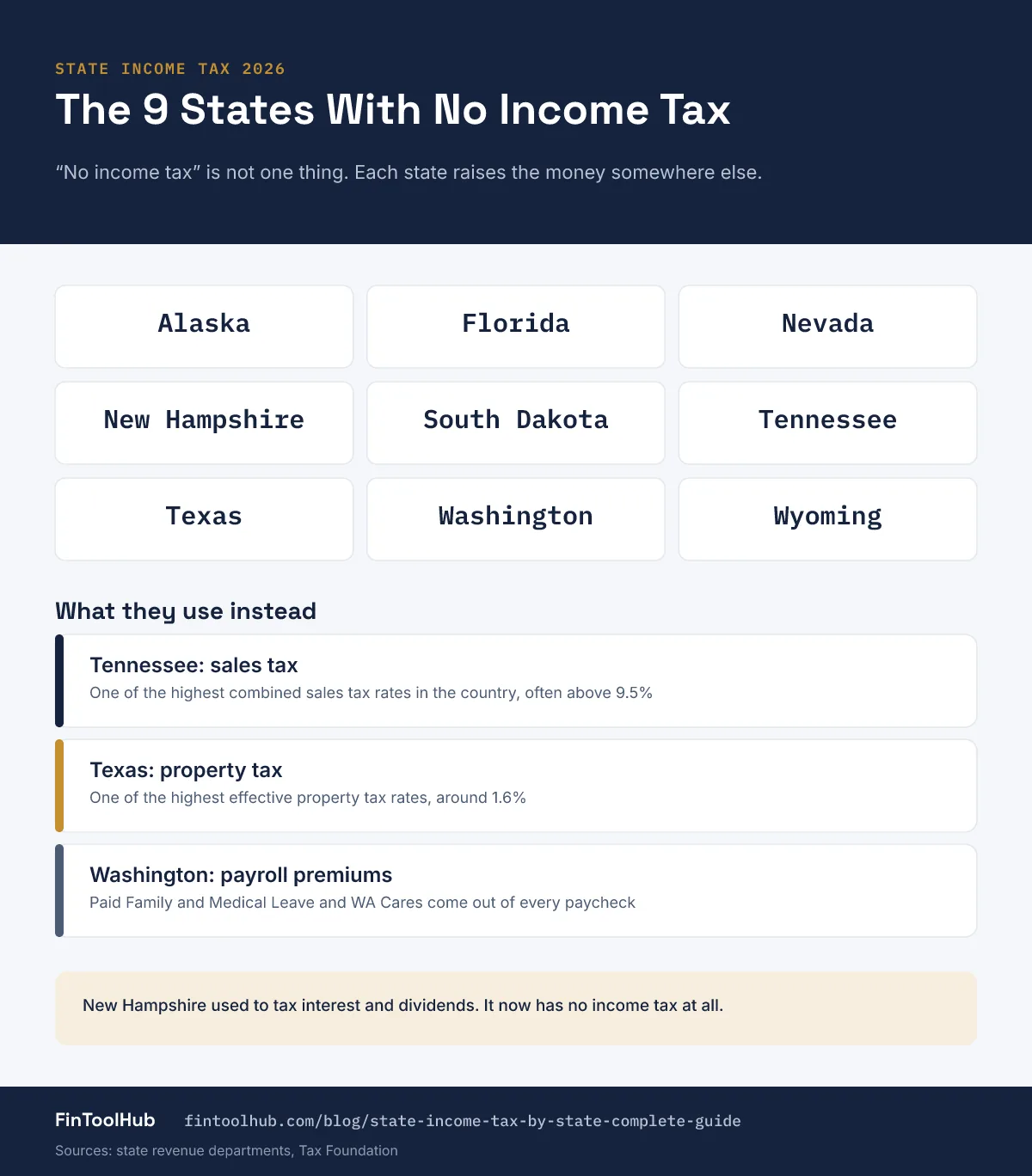
The 9 states with no income tax
"No income tax" sounds like one thing. It isn't. Every state in this group makes up the revenue somewhere else, and where that "somewhere else" lands — property, sales, tourism, payroll — varies enough to genuinely change what living there costs you.
Tennessee — the sales tax trade
Tennessee replaces income tax revenue with one of the highest combined sales tax rates in the country, frequently exceeding 9.5% combined. It's a tradeoff that lands most heavily on everyday spending rather than on any single asset class.
Texas — the property tax trade
Texas keeps sales tax comparatively moderate (up to 8.25% combined) and instead runs one of the highest effective property tax rates in the country, around 1.6%. The state's income tax ban is also unusually durable — reinforced by a 2019 constitutional amendment on top of an earlier voter-approval requirement.
Washington — payroll premiums instead
Washington layers two mandatory payroll deductions — Paid Family & Medical Leave and WA Cares long-term care — directly onto paychecks. They're not income tax, but they function similarly on a pay stub, and are easy to miss if you're only checking for a state tax line.
Nevada — tourists cover more of the bill
Nevada is the outlier of the group: both income tax and property tax stay low, funded substantially by gaming taxes on casinos and sales tax revenue drawn heavily from the roughly 40 million annual visitors to Las Vegas — a structure that lets residents avoid the sharpest tradeoffs the other no-tax states make.
New Hampshire — the most recent addition
New Hampshire never taxed wages, but it did tax interest and dividend income until a phased repeal — accelerated by 2023 legislation — eliminated it completely as of January 1, 2025. It now has zero state income taxation of any kind, funded overwhelmingly by property taxes that run among the highest in the country.
The remaining three — Florida, Alaska, South Dakota, and Wyoming — round out the group, each with its own revenue mix (tourism and corporate activity in Florida, oil revenue historically underpinning Alaska's budget, and generally lower overall tax burdens in South Dakota and Wyoming).
Flat-tax states
A smaller group of states tax all income at a single rate, regardless of how much you earn — genuinely simpler to estimate than a bracketed system, even when the rate itself isn't low.
Michigan — 4.25%, not 4.05%
Michigan's flat rate is 4.25% for 2026. A one-year reduction to 4.05% applied only to the 2023 tax year, triggered by a revenue formula that a court later determined wasn't a permanent change — the rate reverted the following year, but the lower figure still circulates in some outdated content.
Illinois — flat by constitutional mandate
Illinois taxes all income at 4.95%, a structure written directly into the state constitution rather than set by ordinary legislation — a genuine structural difference from most other flat-tax states, where the legislature could change the rate more easily. Illinois's personal exemption disappears entirely (not gradually) above $250,000 single/$500,000 joint income, a real cliff worth knowing about if you're near that threshold.
Progressive-tax states with real complexity
Most states use graduated brackets, but a handful layer on genuine additional complexity worth understanding before you estimate your paycheck by hand.
Maryland — state brackets plus a mandatory county tax
Every Maryland county (plus Baltimore City) adds its own local income tax on top of the state's graduated brackets, ranging roughly 2.25% to 3.2%, and it's residence-based rather than work-based — you pay your home county's rate regardless of where you're employed.
Ohio — a flat state rate, then 600+ possible municipal taxes
Ohio's state income tax is flat above a threshold, but the real complexity sits at the municipal level — over 600 cities and villages can each levy their own local income tax, with no statewide dropdown able to capture every possible rate.
Arkansas — two separate bracket schedules
Arkansas cut its top rate to 3.7% in a May 2026 special session, but the more unusual structural feature is that taxpayers above $94,700 don't just add more brackets on top — they switch to an entirely separate, simplified schedule for their whole calculation, creating a genuine notch right at that threshold.
South Carolina — a 2026 bracket collapse
South Carolina went from six brackets topping out at 6.4% down to just two — 1.99% and 5.21% — in a 2026 reform. If you've seen a higher top rate cited recently, it's describing the system this replaced.
Oklahoma — six brackets simplified to three
Oklahoma's 2026 reform consolidated six brackets into three and cut the top rate from 4.75% to 4.5% — in practice, most income above roughly $7,200 now falls into a single top bracket.
Utah — a rate that keeps moving
Utah has cut its flat rate several times in recent years, and different sources currently cite figures ranging from 4.45% to 4.55% depending on when they were last updated — genuinely worth double-checking the current figure directly rather than trusting any single cited number, including this one, without a date attached.
Full comparison, all 12 states
| State | Structure | Notable detail | Calculator |
|---|---|---|---|
| Tennessee | No income tax | Very high combined sales tax (~9.5%+) | Calculate → |
| Texas | No income tax | High property tax (~1.6%), constitutionally banned since 2019 | Calculate → |
| Washington | No income tax | PFML + WA Cares payroll premiums | Calculate → |
| Nevada | No income tax | Gaming tax + tourism-funded, low property tax too | Calculate → |
| Michigan | Flat 4.25% | Not 4.05% — that was a one-year-only 2023 reduction | Calculate → |
| Illinois | Flat 4.95% | Constitutionally mandated; exemption cliff above $250k/$500k | Calculate → |
| Maryland | Progressive + county | Mandatory county tax, 2.25%–3.2%, residence-based | Calculate → |
| Ohio | Flat + municipal | 600+ possible municipal income taxes | Calculate → |
| Arkansas | Progressive, dual schedule | Top rate 3.7% (2026 cut); notch at $94,700 | Calculate → |
| South Carolina | Progressive, 2 brackets | 2026 reform: 1.99% / 5.21%, down from 6 brackets | Calculate → |
| Oklahoma | Progressive, 3 brackets | 2026 reform: top rate 4.5%, down from 4.75% | Calculate → |
| Utah | Flat, ~4.5% | Rate has changed several times recently — verify current figure | Calculate → |
State tax structures verified against each state's department of revenue or treasury, cross-checked with Tax Foundation and independent legislative analysis. This is a summary guide — always confirm current figures with your specific state before filing, since several states covered here changed rates during 2026 itself. Official sources: Tax Foundation: State income tax rates.
Frequently asked questions
How many states have no income tax in 2026?
Nine: Alaska, Florida, Nevada, New Hampshire, South Dakota, Tennessee, Texas, Washington, and Wyoming. New Hampshire is the most recent addition, having fully repealed its Interest & Dividends Tax effective January 1, 2025.
Do all no-income-tax states have the same overall tax burden?
No. Each makes up the revenue differently — Tennessee through high sales tax, Texas through high property tax, Washington through payroll premiums, and Nevada through gaming and tourism revenue that shifts more of the burden onto visitors than residents.
What's the difference between a flat tax and a progressive tax?
A flat tax applies one rate to all income regardless of amount. A progressive tax applies increasing rates to higher income brackets, so different portions of your income can be taxed at different rates within the same return.
Which states have local or county income taxes on top of the state rate?
Maryland (mandatory county tax, residence-based) and Ohio (over 600 possible municipal taxes) are the most complex examples among commonly searched states, though other states have more limited local income tax systems as well.
Which states changed their income tax rates in 2026?
Arkansas (top rate cut to 3.7% via a May 2026 special session), South Carolina (six brackets collapsed into two), and Oklahoma (six brackets consolidated into three, top rate cut to 4.5%) all made structural changes effective for the 2026 tax year.