
Blog · Retirement
Dave Ramsey vs. Boldin vs. Fidelity: Which Retirement Calculator Should You Actually Use?
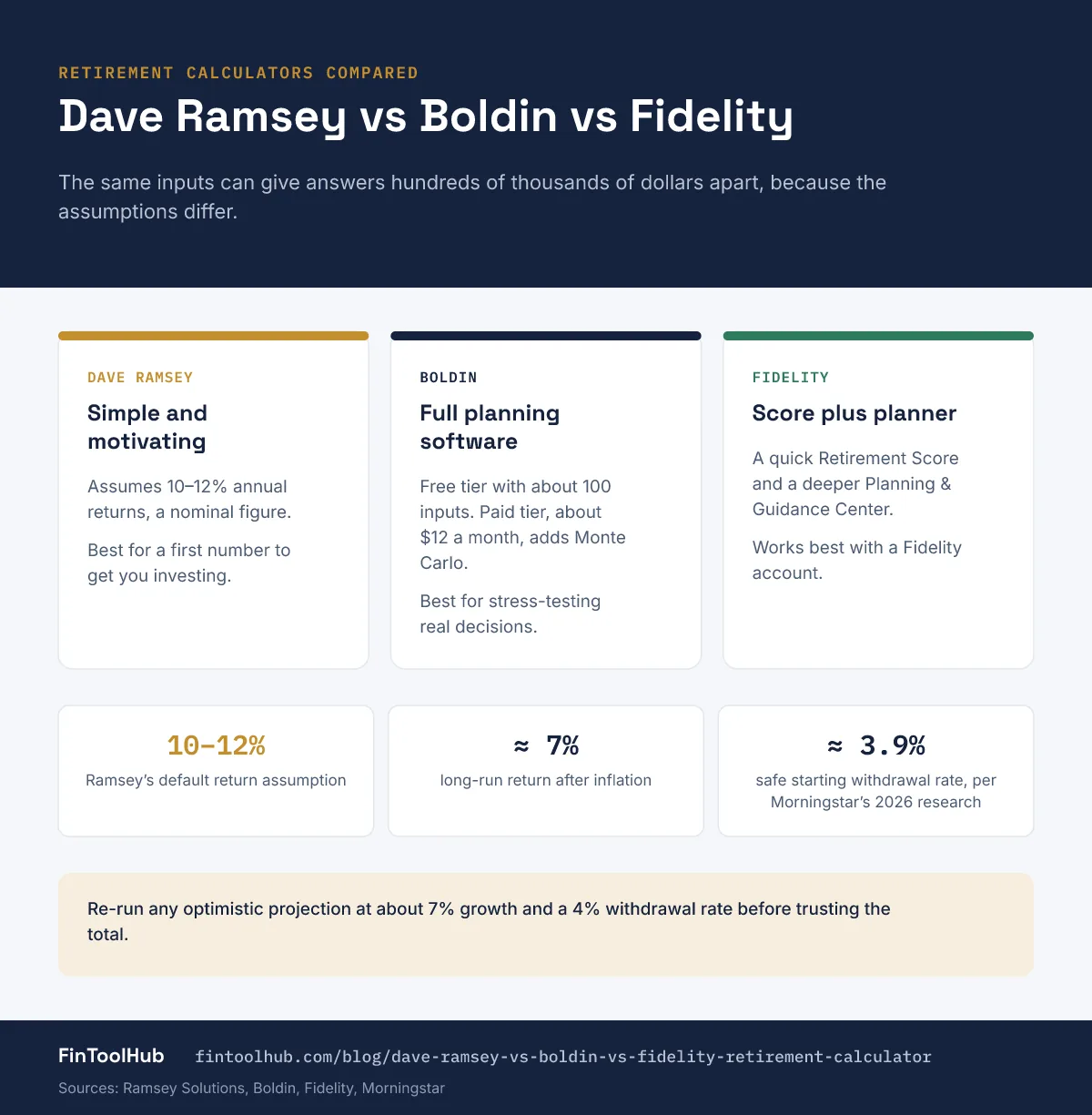
Three very different tools, three very different sets of assumptions baked in before you type a single number. Here's what each one actually does, what it gets right, and where it can quietly mislead you.
Why "which retirement calculator" isn't a simple question
Run the Dave Ramsey, Boldin and Fidelity retirement calculators and you'll get three numbers that can differ by hundreds of thousands of dollars, not because two of them are wrong, but because each tool is built around a different philosophy about risk, return, and what "planning" even means. Understanding the assumptions each one makes is more useful than the number itself.
Dave Ramsey's Investment Calculator
The retirement calculator dave ramsey fans use — officially Ramsey Solutions' Investment Calculator — is built around a specific philosophy: pay off all debt first (investing doesn't start until "Baby Step 4" of Ramsey's system), then invest 15% of household income, split evenly across four types of growth stock mutual funds, with no bond allocation.
The number that generates the most discussion is the calculator's default return assumption: 10–12% annually, drawn from the S&P 500's long-run nominal historical average. This is the single most litigated detail across every dave ramsey calculator retirement review you'll find. Financial researcher Michael Kitces, Morningstar, and outlets from Forbes to the Wall Street Journal have pointed out that 12% is a nominal, arithmetic-average figure — inflation-adjusted ("real") returns over the same long-run period are closer to 7%, and using the higher number can produce a projection more than triple what a more conservative assumption would show for the same monthly contribution.
Ramsey also advocates an 8% withdrawal rate in retirement, roughly double the traditional 4% guideline, a figure Morningstar's 2026 State of Retirement Income research puts closer to 3.9% as a safe baseline. Run Ramsey's calculator at its defaults and you are seeing a best-case scenario, not a plan built with margin for a bad decade.
People who need a simple, motivating first number to start investing at all. Re-run Ramsey's calculator at a 7% return and a 4% withdrawal rate before trusting the total.
Boldin (formerly NewRetirement)
Calling Boldin a retirement calculator undersells what the tool actually is. Boldin, rebranded from NewRetirement, is closer to full financial-planning software than a single calculator: it models income, expenses, home equity, Social Security timing, healthcare costs, and estate planning together, not retirement savings in isolation.
The free tier covers a real retirement projection and "chance of success" score with around 100 inputs. The paid PlannerPlus tier (about $12/month) adds Monte Carlo simulation — testing thousands of possible market sequences instead of one smooth average return — plus dedicated Roth-conversion and Social Security-timing "Explorer" tools and up to 250+ inputs. Independent reviewers consistently describe it as more flexible than brokerage-provided tools, at the cost of a steeper learning curve than a five-minute calculator.
DIY planners who want to stress-test real decisions — early retirement, Roth conversion timing, Social Security claiming age — rather than get a single ballpark number.
Fidelity's Retirement Score and Planning & Guidance Center
Fidelity offers two connected tools. The Fidelity Retirement Score is a quick, free readiness check — answer a handful of questions and get a color-coded score (on track, good, fair, or needs attention). The deeper Planning & Guidance Center — which folds in what used to be separate Retirement Income Planner and Portfolio Review tools — runs a fuller projection and, if you're a Fidelity customer, automatically pulls in your actual account balances.
The catch with Fidelity's tools: both work best, and in some cases only work at all, if you have or open a Fidelity account. Calling it a Monte Carlo tool is also a bit of a misnomer: the Planning & Guidance Center models a range of hypothetical market conditions, but independent reviewers describe it as a strong "high-level boundary" tool rather than a tactical one: it won't walk you through year-by-year withdrawal sequencing or Roth-conversion decisions the way Boldin's paid tier does.
Existing Fidelity customers who want a fast, free, account-linked readiness check without comparing multiple institutions.
Side by side
| Dave Ramsey | Boldin | Fidelity | |
|---|---|---|---|
| Cost | Free | Free, or ~$12/mo for PlannerPlus | Free (Fidelity account often required) |
| Default return assumption | 10–12% (widely contested) | User-set, Monte Carlo range | Model-based hypothetical range |
| Withdrawal rate assumption | 8% (contested) | User-modeled, no fixed default | Model-based, not a fixed rule |
| Scope | Investment growth only | Whole financial life | Retirement-focused, account-linked |
| Account required? | No | No (free tier) | Effectively yes |
The wider field: SmartAsset, Clark Howard, Suze Orman, and the rest
The three above get the most search volume, but they're really representative of four different categories, and most other named tools fall into the same buckets:
- Personality-driven tools: calculators from personal finance hosts such as Clark Howard, Suze Orman, the Money Guy Show and Ramit Sethi each reflect that host's specific philosophy, the same way Ramsey's reflects his. None of these are neutral, so check what assumptions are baked in before trusting the output.
- Brokerage- and bank-provided tools: calculators from SoFi, USAA, Voya, Nationwide, American Funds, Citizens Bank and KeyBank all work similarly to Fidelity's. They are free, often better with an account at that institution, and generally better at "are we roughly on track" than tactical tax or withdrawal-order planning.
- Insurance/advisory lead-generation tools: calculators from Northwestern Mutual, Ameriprise and Mutual of Omaha typically lead to a short questionnaire designed to connect you with that company's own advisor or agent. Useful as a starting conversation, less useful as an independent second opinion.
- Power-user planning software — pralana retirement calculator and maxifi retirement calculator are both known in detail-oriented planning communities (especially FIRE) as more granular, spreadsheet-like alternatives to Boldin — more powerful, generally less intuitive, and aimed at people who already know exactly what they want to model.
- Plain calculator utilities: Moneychimp, Dinkytown, Fisher Investments, Morningstar, Root and SmartAsset offer straightforward, formula-based calculators with no account, no personality and no sales funnel, just a formula.
What none of these tools are built for
Every tool above is a generalist — built to handle a 401(k)-and-IRA retirement, roughly. None of them are purpose-built for the specific federal and niche retirement systems that a large share of readers actually have:
- Federal employees under FERS need the actual OPM annuity formula, not a generic pension estimate — see our FERS Retirement Calculator.
- Anyone with a TSP account is leaving money on the table if a generic 401(k) calculator doesn't model the government's specific match tiers — see our TSP Retirement Calculator.
- Military retirees need Legacy High-3, BRS, Reserve points, or Chapter 61 disability math — none of which a civilian brokerage tool attempts — see our Military Retirement Calculator.
- Railroad employees have a two-tier system none of the tools above even reference — see our Railroad Retirement Calculator.
- None of the three headline tools show you, in one place, exactly how many years your specific balance and spending will last — that's the single question our How Long Will My Retirement Savings Last calculator answers directly.
- If you want the real tax bill on your withdrawals — not just a savings projection — see our Retirement Tax Calculator.
- If you're chasing a FIRE number or want to know when you can stop contributing entirely, see our FIRE & Coast FIRE Calculator.
- For an exact countdown to your target date, see our Days to Retirement Calculator.
- And if crypto is part of your plan, none of the tools above touch it — see our Bitcoin Retirement Calculator.
None of our calculators require an account, and none of them default to a return or withdrawal assumption we picked for you — you set your own, and we show you the math plainly. If you'd rather see the exact formulas laid out yourself before trusting any calculator's output, including ours, read Retirement Planning in a Spreadsheet: Free Excel & Google Sheets Templates You Can Steal next.
Return-assumption criticism referenced above reflects reporting and analysis from Michael Kitces (kitces.com), Morningstar's 2026 State of Retirement Income research, and Moneywise; product details for Ramsey Solutions, Boldin, and Fidelity are drawn from each company's own published materials as of 2026. This article isn't sponsored by, and has no affiliation with, any tool mentioned.
Frequently asked questions
Quick answers before you pick a tool.
Is Dave Ramsey's 12% return assumption realistic?
It's a real historical nominal average for the S&P 500, but most financial researchers consider it optimistic for planning purposes because it doesn't account for inflation — real (inflation-adjusted) long-run returns are closer to 7%. Running the calculator at both figures gives a more honest range.
Do I need a Fidelity account to use Fidelity's retirement calculator?
The basic Retirement Score doesn't strictly require one, but the fuller Planning & Guidance Center experience — including auto-populated account balances — works best, and in practice mostly assumes, that you have a Fidelity account.
Is Boldin worth paying for?
The free tier covers a genuine retirement projection and score. The paid PlannerPlus tier is worth it specifically if you want Monte Carlo simulation, detailed Roth-conversion modeling, or Social Security claiming-age analysis — features the free tier and most brokerage tools don't offer.
Why do these calculators give such different answers for the same inputs?
Because the inputs are rarely actually the same — each tool defaults to a different assumed rate of return, a different withdrawal rate, and a different scope (some model your whole financial life, others just investment growth). The assumption matters more than which brand's logo is on the page.