
401(k) · Self-Employed
Solo 401(k) for the Self-Employed: Contribution Limits, Profit Sharing, and Fees Explained
If you're self-employed, a Solo 401(k) can let you save far more than a SEP IRA at the same income — but only if you understand the two-bucket contribution structure and the deadlines that come with it.
What a Solo 401(k) actually is
A Solo 401(k) — also called a one-participant 401(k) or individual 401(k) — is a standard 401(k) plan for a business with no employees other than the owner and, if applicable, their spouse. Because there's no one else in the plan, there's no non-discrimination testing to worry about, which is the same compliance burden that makes regular company 401(k)s expensive and complicated to administer. You get the full 401(k) rulebook — Roth option, catch-up contributions, participant loans in many plans — with almost none of the overhead.
It's available to sole proprietors, single-member LLCs, partnerships, and S-corp or C-corp owners, as long as the business genuinely has no non-spouse employees eligible to participate. The moment you hire someone who qualifies for the plan, one-participant status ends and you're into full 401(k) territory — testing, eligibility rules, and all.
The two contribution buckets, and why they matter
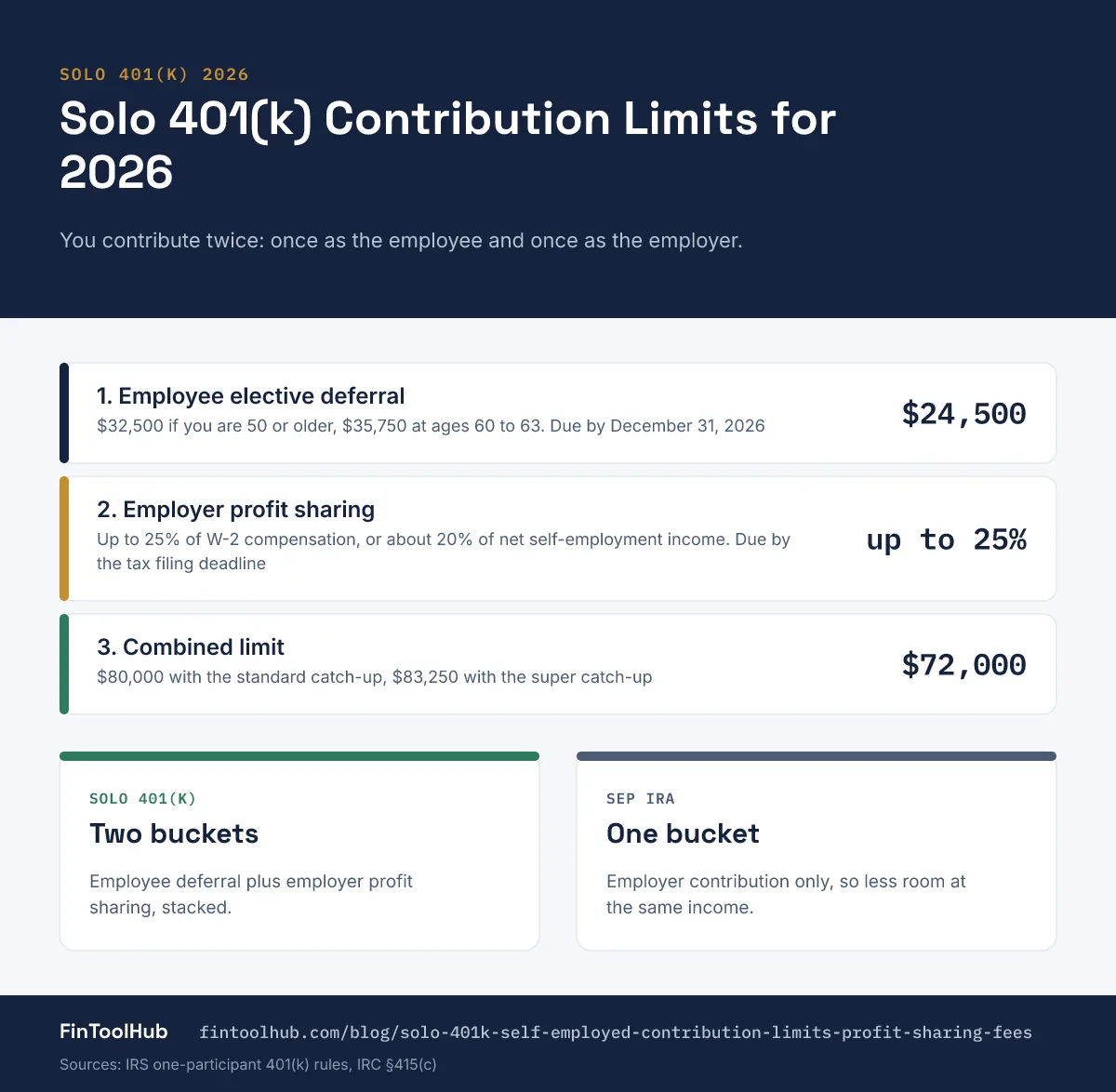
This is the entire reason a Solo 401(k) usually beats a SEP IRA for self-employed savers: you get to contribute in two separate capacities — as the employee, and as the employer — and both buckets stack on top of each other.
| Bucket | 2026 limit | Deadline |
|---|---|---|
| Employee elective deferral | $24,500 ($32,500 if 50+, $35,750 if 60–63) | Dec 31, 2026 |
| Employer profit-sharing | Up to 25% of compensation (W-2) or ~20% of net SE income (Schedule C) | Tax filing deadline, incl. extensions |
| Combined total (IRC §415(c)) | $72,000 ($80,000 with standard catch-up, $83,250 with super catch-up) | — |
A SEP IRA only gives you the employer bucket — there's no separate employee deferral option. At lower and moderate self-employment income levels, that missing bucket is a big deal, because the employee deferral doesn't depend on a percentage of income the way the employer contribution does.
Worked example: Solo 401(k) vs. SEP IRA at $50,000 net self-employment income
Take a sole proprietor under 50 with $50,000 in net self-employment income. A SEP IRA caps out around 20% of that, roughly $9,300 — the employer contribution is the whole story. A Solo 401(k) lets the same person defer up to the full $24,500 employee limit (well within their compensation), plus the same roughly $9,300 employer piece — potentially over $33,000 total, more than triple the SEP IRA figure, from identical income.
Why the employer contribution isn't simply "25% of income"
This is where people trip up. The 25% figure applies cleanly to W-2 wages from an S-corp or C-corp — 25% of your W-2 salary, full stop. For a sole proprietor or single-member LLC filing Schedule C, the calculation runs through an IRS adjustment first: you subtract half of your self-employment tax from net profit before applying the percentage, which nets out to an effective rate of roughly 20% of net self-employment income, not 25%. Most guides use "about 20%" as the practical shorthand for exactly this reason — it's close enough for planning purposes, even though the precise IRS worksheet (in Publication 560) gets you the exact number.
If you run your business as an S-corp, this distinction also changes your strategy: your employer contribution is based on your W-2 salary, not your business's total profit — a reason S-corp owners often deliberately manage their salary-vs-distribution split partly around retirement contribution capacity. Our S Corp Tax Calculator can help you see how that salary/distribution split plays out on the tax side before you decide how to structure it.
Deadlines: the part that actually trips people up
Solo 401(k) deadlines aren't one date — there are three separate ones, and mixing them up is the single most common mistake:
- Plan adoption (establishing the plan): Generally by December 31 of the tax year. Sole proprietors get a SECURE 2.0 exception allowing adoption up to their tax filing deadline without extensions (April 15 the following year) — but not the extended deadline.
- Employee elective deferral: Must be designated and deposited by December 31 of the tax year. There's no going back after year-end to claim an employee deferral for the prior year, regardless of when you file.
- Employer profit-sharing contribution: The most flexible of the three — due by your business's tax filing deadline, including extensions. This is deliberate: it lets you finalize your books, know your exact net income, and decide the contribution amount afterward.
Roth option and the 2026 catch-up change
Most current Solo 401(k) providers let you split your employee deferral between traditional (pre-tax) and Roth (after-tax), and under SECURE 2.0, employer profit-sharing contributions can now be made on a Roth basis too — a real change from the old rule that forced all employer money to be pre-tax. One important 2026 update: if your prior-year FICA wages (Box 3 on your W-2) were $150,000 or more, your catch-up contributions must be made as Roth, not pre-tax, starting in 2026. If your plan doesn't support Roth contributions and you're subject to this rule, you could be blocked from making catch-up contributions at all until the plan is updated — worth confirming with your provider before year-end if this applies to you. Our Roth or 401k Calculator can help you compare the traditional-vs-Roth trade-off for your own tax situation.
Fees: what "free" actually gets you
Major discount brokers — Fidelity, Schwab, and similar — offer no-annual-fee "prototype" Solo 401(k) plans, and for a straightforward pre-tax-only plan with no loan feature and no interest in alternative investments, that's often genuinely enough. Where the free plans fall short is flexibility: some don't support a loan provision, some have more limited Roth handling, and none of them let you hold real estate, private equity, or other self-directed assets inside the plan.
Specialized Solo 401(k) providers charge a setup fee plus an annual fee — commonly a few hundred dollars a year — in exchange for a fuller plan document that supports loans, Roth for both buckets, and self-directed/alternative investments, plus more hands-on help with the profit-sharing calculation and required tax filings. Which one makes sense depends entirely on whether you actually need those features; paying for flexibility you'll never use is just a drag on returns.
The $250,000 filing requirement
Once your Solo 401(k)'s total assets reach $250,000 or more at the end of the year, the IRS requires an annual Form 5500-EZ filing. Below that threshold, no annual filing is required at all — one more reason the Solo 401(k) stays low-maintenance for most solo business owners in the plan's early years.
Contribution limits and adjustments verified against the IRS: One-Participant 401(k) Plans and IRS Notice 2025-70 (2026 cost-of-living adjustments). This is educational information, not tax or legal advice — a CPA or Solo 401(k) provider should confirm your specific plan design, entity type, and contribution calculation before you file.
Frequently asked questions
Before you open a plan or file your return.
How much can I contribute to a Solo 401(k) in 2026?
Up to $24,500 as an employee elective deferral ($32,500 if 50+, $35,750 if 60–63), plus up to 25% of W-2 compensation (or roughly 20% of net self-employment income for sole proprietors) as an employer profit-sharing contribution — combined, up to $72,000 total ($80,000–$83,250 with catch-up), or 100% of compensation, whichever is less.
Is a Solo 401(k) better than a SEP IRA?
For most self-employed people earning under roughly $150,000–$200,000, yes — a Solo 401(k) adds the employee deferral bucket a SEP IRA doesn't have, often allowing two to three times more total contribution room at the same income level.
When does a Solo 401(k) need to be set up?
Generally by December 31 of the tax year. Sole proprietors get a SECURE 2.0 exception allowing plan adoption up to their tax filing deadline (without extensions), though the employee deferral itself must still be designated by December 31 regardless.
Do I have to file anything for my Solo 401(k)?
Only once your plan's total assets reach $250,000 or more at year-end — at that point, an annual Form 5500-EZ filing is required. Below that threshold, no annual filing is needed.
What happens if I hire an employee?
Hiring a non-spouse employee who's eligible for the plan generally ends one-participant status. Your plan then becomes subject to standard 401(k) eligibility and non-discrimination testing rules, and you may need to include the new employee in the plan.