
Capital Gains
Capital Gains Tax by State: The Complete 2026 Guide
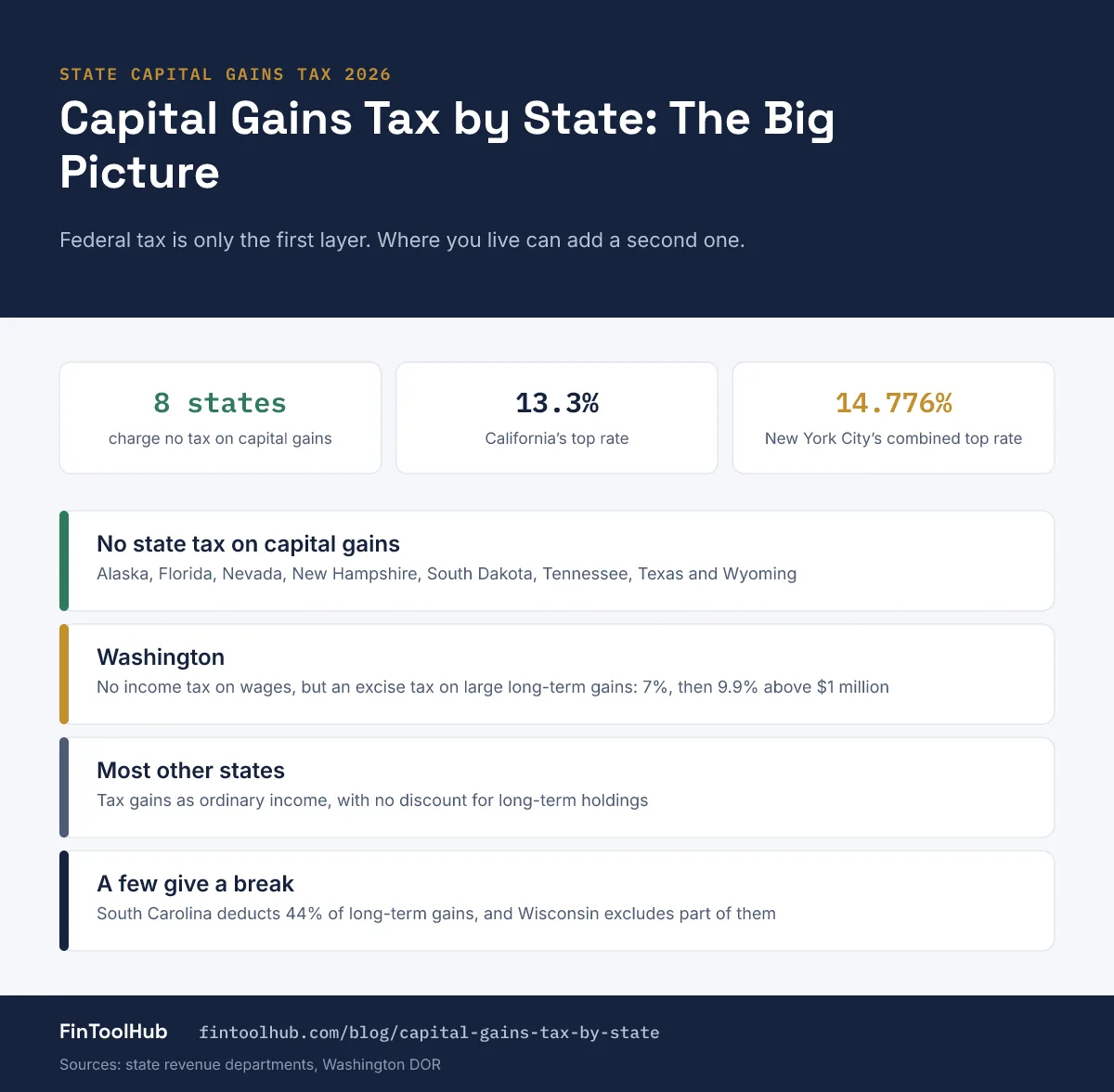
Eight states charge nothing. One state that charges nothing on income still taxes big capital gains specifically. And the highest combined rate in the country isn't in California — it's in New York City.
Federal capital gains tax gets most of the attention, but where you live can add a meaningful second layer on top — sometimes a small one, sometimes larger than the federal tax itself. Here's the full national picture, plus links to our detailed calculators for every state we cover.
Start with the federal baseline
Long-term capital gains (assets held more than a year) are taxed federally at 0%, 15%, or 20% depending on income, before any state tax applies. For 2026, the 0% bracket covers taxable income up to $47,025 single / $94,050 married filing jointly; the 15% bracket runs up to $518,900 single / $583,750 joint; income above that is taxed at 20%. High earners also face an additional 3.8% Net Investment Income Tax once modified adjusted gross income exceeds $200,000 single / $250,000 joint — thresholds that haven't been inflation-adjusted since 2013, meaning more taxpayers get pulled in every year even without a raise.
Eight states charge nothing at all
Alaska, Florida, Nevada, New Hampshire, South Dakota, Tennessee, Texas, and Wyoming have no individual income tax, meaning capital gains are completely untaxed at the state level. For an investor with a large gain and genuine flexibility about residency, this is where the biggest, cleanest savings exist.
Washington is the exception that trips people up
There's also a genuinely significant, still-unsettled development worth knowing about if you have Washington residency and a major liquidity event on the horizon: in March 2026, the state signed its first broad-based income tax in nearly a century — a 9.9% tax on all income (not just capital gains) above $1 million, layered on top of the existing capital gains excise tax, scheduled to take effect January 1, 2028. Its fate is genuinely uncertain as of mid-2026: a repeal initiative gathered enough signatures to reach the November 2026 ballot, and a separate constitutional challenge is pending in court. If you're planning around Washington's 2028 tax landscape, treat it as a real possibility to watch closely, not yet a locked-in certainty.
Most other states tax capital gains as ordinary income
The majority of states with an income tax don't distinguish between capital gains and wages at all — a stock sale is taxed at the same rate as your paycheck. This is genuinely important to understand, since it means these states offer none of the federal system's preferential long-term rate; a patient long-term investor pays the same state rate as someone flipping an asset in a month.
| State | Top rate | Combined with federal (20% + 3.8% NIIT) |
|---|---|---|
| California | 13.3% | ~37.1% |
| New York (statewide) | 10.9% | ~34.7% |
| New York City (NYC residents, state + city) | up to 14.776% | ~38.6%+ |
| New Jersey | 10.75% | ~34.55% |
| Oregon | 9.9% | ~33.7% |
New York City residents face a genuinely unusual situation: layering the city's own income tax (up to 3.876%) on top of New York State's rate produces a combined state-plus-city burden that can exceed California's — making NYC, not California, the highest all-in combined rate in the country for high earners.
A handful of states offer real preferential treatment
Most states don't distinguish long-term gains at all — but a genuine minority carve out partial exclusions, an important exception worth knowing if you live in one of them:
- South Carolina — 44% deduction on net long-term capital gains specifically (short-term gains don't qualify).
- Wisconsin — a long-term capital gains exclusion exists, though the exact percentage varies by source and asset type.
- Arizona — a 25% subtraction for qualifying long-term capital gains.
- Arkansas — taxes only 50% of net long-term capital gains at the flat 3.9% rate, for an effective rate around 1.95%.
- North Dakota — excludes roughly 40% of capital gains from taxable income, producing an effective rate in the 0-2.5% range.
- New Mexico — a 40% exclusion on long-term gains.
- Vermont — a 40% exclusion, but only after a 3-year holding period.
Retirement accounts can be a genuine escape hatch
Illinois is a notable example: while the state taxes capital gains as ordinary income at a flat 4.95% generally, it fully exempts retirement income — including gains realized inside 401(k)s, IRAs, and pensions. Gains that stay inside a qualifying retirement account structure effectively face $0 Illinois tax, even though the same gain realized in a taxable brokerage account would be fully taxed at the standard rate.
Our detailed state guides
We've built dedicated calculators covering the specific rules, exceptions, and quirks for these states:
For assets you didn't buy yourself, our Inherited Property and Gifted Property calculators cover the different basis rules that apply.
State capital gains tax rates, the eight no-tax states, and the combined federal+state+NIIT rate examples verified across multiple independent 2026 sources. Washington's two-tier 7%/9.9% capital gains structure and the 2028 income tax's current legal and ballot-initiative status were independently verified against multiple specialized 2026 sources (including citations to RCW 82.87 and Quinn v. State) after an initial version of this guide understated the top-tier rate. Individual state preferential treatment rules verified against each state's specific dedicated guide on this site. This is general information — tax situations vary by individual circumstances, and a tax professional can confirm your specific figures, especially for Washington's evolving tax landscape. Official sources: Washington DOR: Capital gains tax; IRS Topic 409: Capital gains and losses.
Frequently asked questions
Which states have no capital gains tax?
Alaska, Florida, Nevada, New Hampshire, South Dakota, Tennessee, Texas, and Wyoming have no individual income tax, meaning capital gains are completely untaxed at the state level.
Does Washington State tax capital gains?
Yes, despite having no general income tax on wages - Washington levies a tiered excise tax on long-term capital gains: 7% on the first $1 million above the annual deduction, then 9.9% above that, with real estate and retirement accounts excluded.
What state has the highest capital gains tax?
California has the highest state-level rate at 13.3%, but New York City residents can face a higher all-in combined rate once the city's own income tax is layered on top of the state rate.
Do any states give a lower rate for long-term capital gains specifically?
Most states tax capital gains the same as ordinary income with no distinction, but a handful - including South Carolina, Wisconsin, Arizona, Arkansas, and North Dakota - offer partial exclusions or deductions specifically for long-term gains.
Are capital gains inside a retirement account taxed the same as a regular brokerage account?
Not always - some states, like Illinois, fully exempt retirement income including gains realized inside qualifying retirement accounts, even while taxing the same type of gain in a taxable account at the standard rate.