
Tax & Paycheck
The Real Tax Rate on Gig Work: DoorDash, Lyft, Instacart & More
Gig income isn't taxed at some special, higher rate. You just don't have an employer quietly covering half your payroll tax anymore — and that difference is bigger than most gig workers realize until the first tax bill arrives.
Ask a first-year DoorDash driver or Instacart shopper what they'll owe in taxes, and most guess somewhere around what a W-2 job would cost them. Then the actual bill shows up meaningfully higher, and it feels like gig work is being punished by the tax code. It isn't. The real explanation is simpler and worth understanding clearly, because it changes how you should budget from your very first payout.
The myth: gig income is taxed at a higher rate
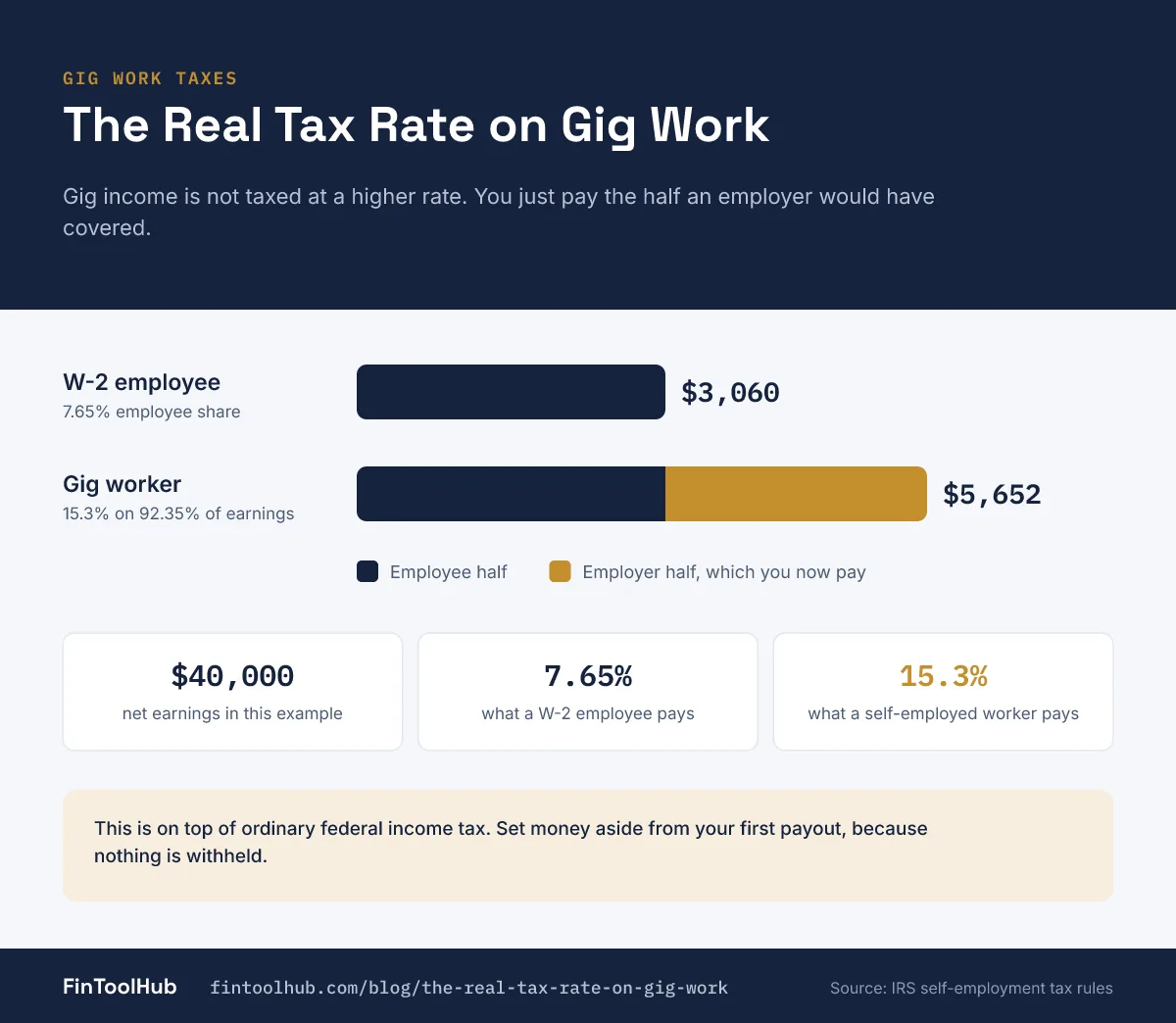
It isn't. Every W-2 employee already pays 7.65% of their paycheck toward Social Security and Medicare — it's just deducted automatically, so most people barely notice it. What they also don't see is that their employer matches that 7.65% out of its own pocket, bringing the total contribution to 15.3%, split evenly between employee and employer. As a gig worker, you're both the employee and the employer for tax purposes. Nobody else is covering that other half — so the full 15.3% self-employment tax comes out of your own earnings, on top of ordinary federal income tax.
What that actually costs, in real dollars
Take $40,000 in net gig earnings after expenses — a realistic full-time DoorDash or Instacart year. Here's how the two layers stack:
| Layer | Amount |
|---|---|
| Self-employment tax (15.3%, on 92.35% of net earnings) | $5,652 |
| Federal income tax (after standard deduction and the QBI deduction) | $1,330 |
| Total federal tax | $6,982 — an effective rate of about 17.5% |
The confusion your 1099 actually causes
For rideshare and delivery drivers specifically, the 1099 form you receive typically reports your gross payments — the full fare or order value before the platform's commission is taken out. That is not your real income, and it's not what you owe tax on. The platform's cut is a deductible business expense you subtract on Schedule C to arrive at your actual net earnings. Skipping this step and paying tax on the gross number is one of the most common, and most expensive, mistakes new gig workers make.
You owe tax on gig income even without a form at all
The deduction that does the most work
Mileage is almost always the single largest deduction available to rideshare and delivery drivers, and it directly reduces both layers of tax — self-employment tax and income tax alike, since it lowers your net earnings before either is calculated. For 2026, the standard mileage rate is 72.5¢ per mile for the first half of the year, rising to 76¢ for the second half. A driver logging 10,000 business miles in the first half of the year alone is looking at a $7,250 deduction — a substantial reduction in taxable income before anything else is even considered.
Beyond mileage, a newer, more specific benefit is worth knowing: a federal deduction on tip income of up to $25,000, available for tax years 2025 through 2028 — directly relevant to rideshare and delivery workers who rely on tips as a meaningful share of their earnings.
Quarterly payments aren't optional once you owe enough
If you expect to owe $1,000 or more in federal tax for the year from gig income, you're generally required to make quarterly estimated payments — due in mid-April, June, September, and the following January — rather than settling everything at once when you file. Missing this isn't just inconvenient; the IRS can charge an underpayment penalty on top of the tax itself. Setting aside a consistent percentage of each payout as it comes in, rather than treating quarterly deadlines as a surprise, is the difference between a manageable bill and a stressful one.
Platform-specific quirks worth knowing
The core math above applies across every gig platform, but each has its own specific wrinkles worth understanding in detail — our dedicated guides below cover DoorDash's mileage-rate mechanics, Lyft's 1099-K-versus-real-income gap, Instacart's genuinely different full-service-versus-in-store employee classification, and OnlyFans' 20% platform fee deduction.
The self-employment tax mechanics, the 1099-K gross-reporting issue, the current $20,000/200-transaction threshold, the 2026 mileage rates, and the 2025-2028 tips deduction were verified across multiple independent 2026 gig-economy tax guides showing consistent detail. The worked example above was independently validated using standard IRS self-employment tax and federal bracket formulas. This is general information, not tax advice — a tax professional can confirm your specific numbers and deduction eligibility.
Frequently asked questions
Is gig income taxed at a higher rate than a regular job?
No - the tax rates themselves are the same. Gig workers just pay both the employee and employer share of payroll tax (15.3% total), since there's no employer to cover the other half.
Do I owe taxes on gig income if I didn't receive a 1099?
Yes - the 1099 threshold only determines when a platform is required to report to the IRS. You're required to report all gig income regardless of whether you receive a form.
Does my 1099 show my actual take-home pay?
Not for rideshare and delivery drivers - it typically shows gross payments before the platform's commission, which you deduct separately as a business expense to reach your real taxable income.
What's the biggest tax deduction for gig workers?
Mileage, in most cases - the 2026 standard rate is 72.5 cents per mile for the first half of the year, rising to 76 cents for the second half, and it reduces both self-employment tax and income tax.
Do gig workers need to make quarterly tax payments?
Generally yes, if you expect to owe $1,000 or more for the year - missing quarterly deadlines can result in an underpayment penalty on top of the tax itself.