
Loan & Finance
Seller Financing: What Buyers Actually Need to Know
Federal law splits sellers who carry financing into three distinct categories — and which one your seller falls into determines whether you get real buyer protections or none at all.
Seller financing — sometimes called owner financing or a seller carryback — means the person selling a property acts as your lender instead of a bank. You make payments directly to them under a promissory note, secured by a deed of trust or mortgage on the property. It's a real, legitimate path to buying property, particularly useful if you're self-employed, recently changed careers, had a past credit event, or simply want a faster close without a bank's underwriting timeline. It's also more heavily regulated than most buyers realize, and understanding that regulation is genuinely protective for you.
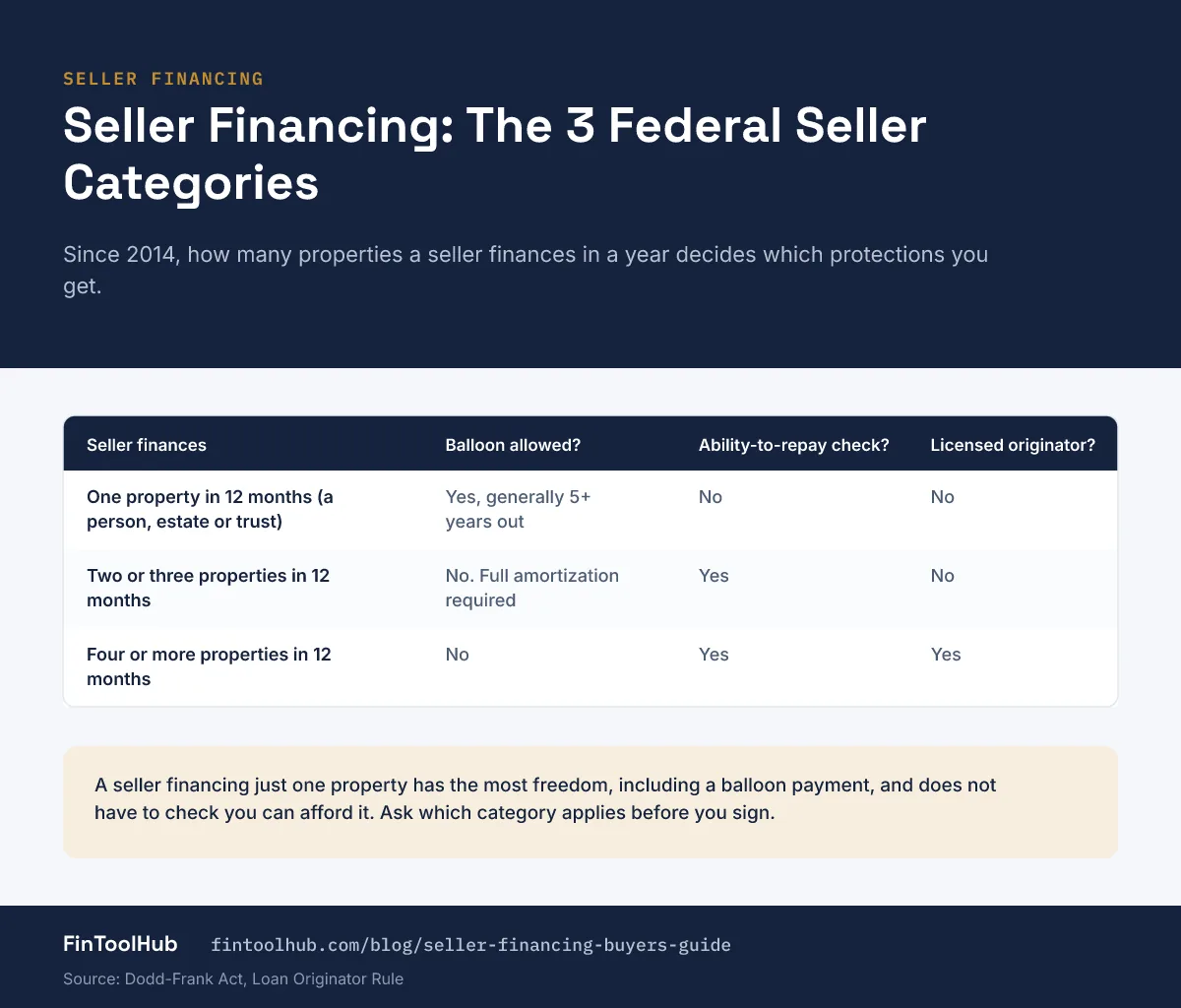
The rule most guides skip: your seller falls into one of three federal categories
Since 2014, the Dodd-Frank Act's Loan Originator Rule has applied specific requirements to sellers who finance residential property (1-4 units) sold to an individual buyer. Which category your specific seller falls into meaningfully changes what protections you get — and it's worth asking directly which one applies before you sign anything.
| Seller category | Balloon payment allowed? | Ability-to-repay check required? | Licensed originator required? |
|---|---|---|---|
| One property in 12 months — must be a natural person, estate, or trust (not an LLC or corporation) | Yes, generally 5+ years out | No | No |
| Two to three properties in 12 months | No — full amortization required | Yes | No |
| Four or more properties in 12 months, or doesn't fit the categories above | No | Yes | Yes |
The practical upshot: a seller financing just one property gets the most flexibility — including the ability to include a balloon payment — but doesn't have to verify you can actually afford the payments. A seller financing multiple properties faces stricter rules specifically designed to protect you, including a required ability-to-repay assessment and, at the higher volume tier, an actual licensed mortgage loan originator involved in structuring the deal.
Balloon payments: the single biggest thing to plan around
Many seller-financed deals are structured with monthly payments calculated on a full 30-year amortization schedule, but with the entire remaining balance due in a lump sum somewhere between 3 and 7 years. That's not a red flag by itself — it's a normal seller-financing structure — but it means you're committing to either refinance into conventional financing, sell the property, or pay off the balance in full by a specific future date, regardless of what mortgage rates or your financial situation look like when that date arrives.
- Know your balloon date before you sign, and have a realistic plan for what happens when it arrives — not just an assumption that "rates will probably be fine" or "I'll probably qualify for a refinance by then."
- Build in a buffer. If the balloon is due in 5 years, start seriously preparing your refinance path around year 3-4, not the month before it's due.
- Ask what happens if you can't pay it off on time — some sellers will negotiate an extension in advance; others won't, and the consequence of missing a balloon payment can include default and foreclosure under the note's terms.
Current market terms, so you know what's reasonable
Seller-financed interest rates commonly run higher than conventional mortgage rates — reflecting the seller's added risk of acting as the lender — with typical ranges around 6-10%, most commonly landing in the 7-9% range depending on your down payment size, credit profile, and local market conditions. Late fees are commonly structured around 5-6% of the monthly payment amount, charged after a 10-15 day grace period. Everything here is genuinely negotiable — that's one of the real advantages of seller financing over a bank — so don't treat any single number as fixed before you've actually discussed it.
Real red flags to walk away from
- No title insurance offered. This protects you against undisclosed liens, ownership disputes, or title defects — going without it on a seller-financed deal is a genuine risk, not a minor formality to skip for convenience.
- A seller who's evasive about the balloon payment or won't clearly explain what happens at maturity.
- Prepayment penalties that seem excessive relative to the deal size — reasonable terms exist here, but they should be proportionate.
- A land contract or "contract for deed" instead of a recorded deed of trust. Under a land contract, legal title typically stays with the seller until the loan is fully paid off — meaning if the seller runs into their own financial trouble, dies, or acts in bad faith before you've finished paying, your ownership position can be far weaker than it would be with a properly recorded mortgage or deed of trust that gives you title immediately, subject to the lien.
Get a real estate attorney involved
It isn't legally required in most states, but given the genuine complexity of Dodd-Frank compliance, promissory note drafting, and deed or deed-of-trust preparation, having your own attorney review the documents before you sign is strongly worth the cost — typically in the range of $1,500 to $3,500 for structuring a seller-carry deal, a small fraction of the overall transaction value. This is not the place to rely solely on the seller's paperwork or a template pulled off the internet.
Don't assume seller financing is your only option
Seller financing genuinely makes sense for some buyers — but if you have a substantial down payment and reasonably solid credit, it's worth getting a real quote from a conventional lender before assuming you need to go this route. Conventional financing typically offers lower rates, longer fixed terms without a looming balloon payment, and stronger standardized buyer protections. Seller financing is most valuable specifically when conventional financing genuinely isn't accessible to you, not simply as a default first choice.
The Dodd-Frank three-tier seller classification, the residential/individual-buyer scope limitation, balloon payment structures, and current market rate ranges verified across multiple independent 2025-2026 legal and real estate sources showing consistent detail on the regulatory framework. This is general educational information, not legal advice — a real estate attorney should review your specific transaction and confirm which Dodd-Frank category applies before you sign.
Frequently asked questions
Does seller financing require the seller to check my ability to repay?
Only sometimes - sellers financing just one property in 12 months are not required to verify your ability to repay under Dodd-Frank. Sellers financing two or more properties are required to.
Can a seller-financed deal include a balloon payment?
It depends on the seller's category. A seller financing one property in 12 months can include a balloon payment, generally at least 5 years out. Sellers financing multiple properties generally cannot.
What's the difference between a deed of trust and a land contract in seller financing?
A recorded deed of trust or mortgage gives you legal title to the property immediately, subject to the lien. A land contract (contract for deed) typically keeps legal title with the seller until the loan is fully paid off, leaving buyers in a weaker legal position.
Does Dodd-Frank apply to seller financing for a business or commercial property?
Generally no - these protections apply specifically to residential property (1-4 units) sold to an individual buyer, not to commercial property, business sales, or residential sales to an LLC or corporation.
What are typical seller financing interest rates in 2026?
Commonly 6-10%, most often landing around 7-9% - higher than conventional mortgage rates, reflecting the seller's added risk, though terms are generally negotiable.