
Loan & Finance
0% APR vs. Cash Rebate: The Math Manufacturers Hope You Skip
The two offers are almost always mutually exclusive, and the "free money" headline doesn't always survive contact with a calculator. Here's the actual break-even point, worked out in full.
Walk onto almost any new-car lot this year and you'll see the same pitch: 0% APR financing, or a cash rebate — pick one. They're framed as equally attractive, but they almost never are for a given buyer, and the manufacturer isn't going to run the numbers for you. Here's how to actually figure out which one wins.
Why you can't have both
0% APR financing isn't free money — it's the manufacturer paying the lender's interest on your behalf, out of their own marketing budget. A cash rebate is a separate incentive, also funded by the manufacturer. Since both cost the manufacturer real money, they're typically structured as mutually exclusive choices: take the 0% financing, or take the rebate and finance at whatever standard rate you qualify for. You very rarely get to stack both on the same deal.
The math, worked out on a real example
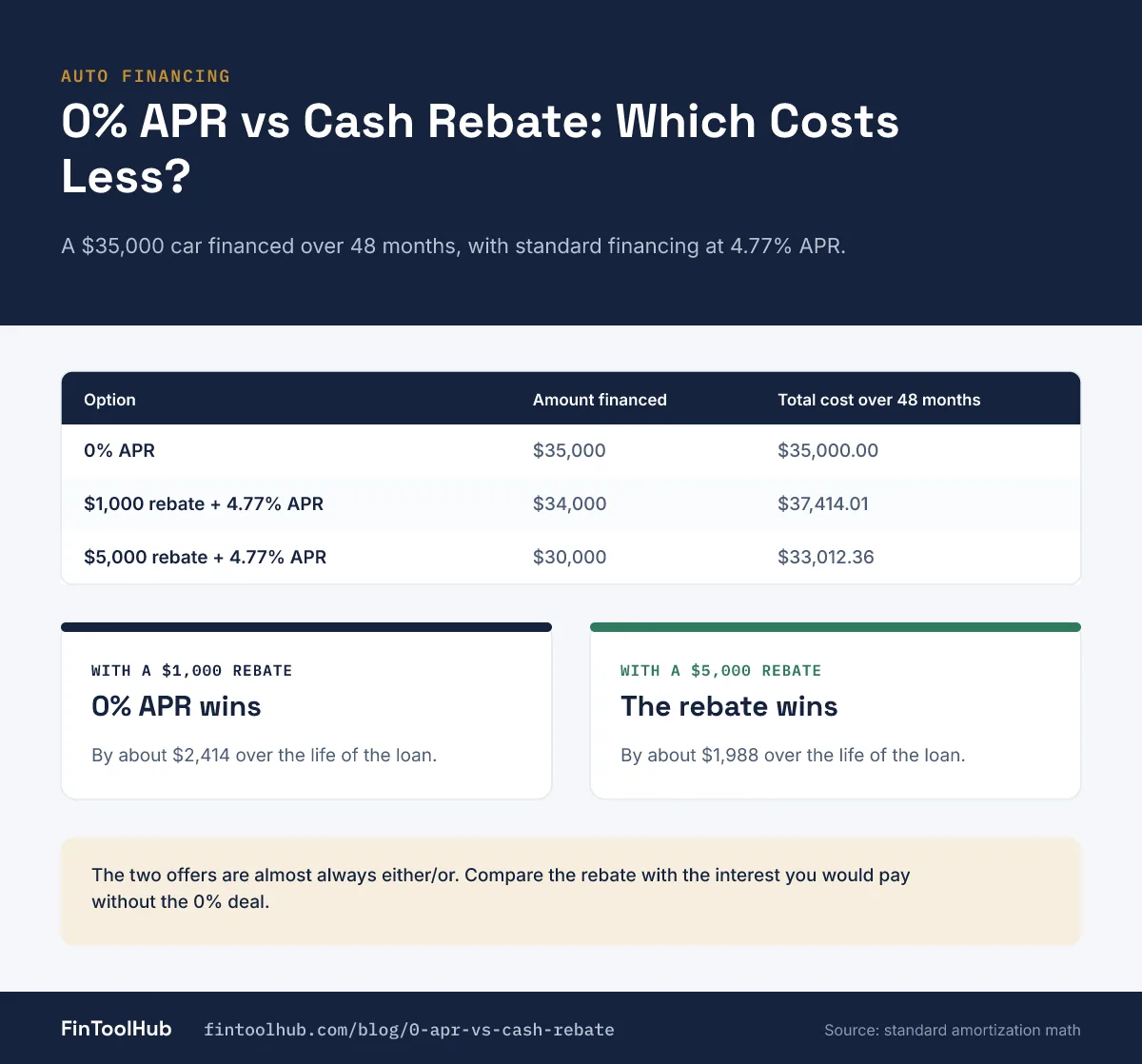
Say you're financing $35,000 over 48 months. The manufacturer offers 0% APR, or a $1,000 rebate with standard financing at 4.77% APR (a realistic rate for a well-qualified buyer). Here's what each option actually costs over the life of the loan:
| Option | Amount financed | Total cost over 48 months |
|---|---|---|
| 0% APR | $35,000 | $35,000.00 |
| $1,000 rebate + 4.77% APR | $34,000 | $37,414.01 |
On a modest rebate, 0% APR wins clearly — over $2,400 cheaper across the loan. But rebates aren't always this small. Run the same $35,000 purchase with a $5,000 rebate instead:
| Option | Amount financed | Total cost over 48 months |
|---|---|---|
| 0% APR | $35,000 | $35,000.00 |
| $5,000 rebate + 4.77% APR | $30,000 | $33,012.36 |
Same interest rate, same term — but now the rebate wins by nearly $2,000. The entire decision hinges on the size of the rebate relative to what you'd actually pay in interest without it. There's no universal answer; it depends on the specific numbers in front of you.
A useful rule of thumb
Before you compare anything, get pre-approved
The comparison above only works if you know your actual qualifying interest rate outside the dealership's promotional offer. Get pre-approved by your own bank or credit union before you visit the lot. That gives you a real number — not a guess — to compare against the manufacturer's 0% pitch. Most 0% offers also require excellent credit, typically 720+ FICO, so it's worth confirming you'd even qualify before factoring it into your decision at all.
Three things that quietly change the math
Sales tax usually applies to the pre-rebate price
0% deals often stretch the loan term to look better
To make a 0% offer's monthly payment look competitive, manufacturers frequently extend it to 72 or even 84 months. A longer term does lower the payment — but it also means you're carrying a larger balance for longer while the car depreciates. Combine a long 0% term with a small down payment, and it's entirely possible to be underwater — owing more than the car is worth — for a meaningful stretch of the loan. If you're comparing a long-term 0% offer, it's worth mapping out exactly when your equity turns positive with our Auto Loan Payoff Calculator, which shows that crossover point directly.
MSRP can differ slightly by offer
Less consistently documented, but worth watching for: some buyers report the sticker price running slightly higher on trims eligible for 0% financing compared to otherwise-identical trims eligible for the cash rebate instead. It's not universal, but it's one more reason to compare the actual out-the-door price under each scenario, not just the financing terms in isolation.
The practical takeaway
There's no financing hack here — just arithmetic. Get your own pre-approval rate first. Run both scenarios at your actual loan amount and term. If you take the rebate, apply it as a down payment to reduce what you finance, rather than treating it as separate spending money. And whichever option wins the interest math, don't let a longer 0% term talk you into carrying debt on a depreciating asset any longer than you need to.
The break-even mechanics, the sales-tax-on-pre-rebate-price rule, and the credit-score requirements for 0% offers were verified across multiple independent 2026 sources, and the worked examples above were independently validated using standard loan amortization math. This is general information, not a recommendation for your specific purchase — run your own numbers against your actual pre-approval rate and the offer in front of you.
Frequently asked questions
Can I get both 0% APR and a cash rebate?
Usually not - manufacturers typically structure these as mutually exclusive offers, since both are separately funded incentives that cost the manufacturer money.
Is 0% APR always the better deal?
No - it depends on the size of the alternative cash rebate. Smaller rebates usually lose to 0% APR, but larger rebates can outperform it, especially at longer loan terms.
Does sales tax apply before or after a cash rebate?
In most states, before - you're typically taxed on the vehicle's full pre-rebate price, slightly reducing the rebate's real-world value.
What credit score do I need for 0% APR financing?
Most 0% offers require excellent credit, typically a FICO score of 720 or higher.
Why do 0% APR offers often come with longer loan terms?
Extending the term to 72-84 months lowers the monthly payment, making the offer look more attractive - but it also extends the period during which the loan balance may exceed the car's depreciating value.