
Student Loans
The 2026 Student Loan Overhaul: SAVE Is Dead, Here's What Replaced It
The federal repayment system changed more in the past few months than in the previous decade. Here's exactly what happened, what's live right now, and the tax change buried in the fine print that could cost some borrowers thousands.

What actually happened to SAVE
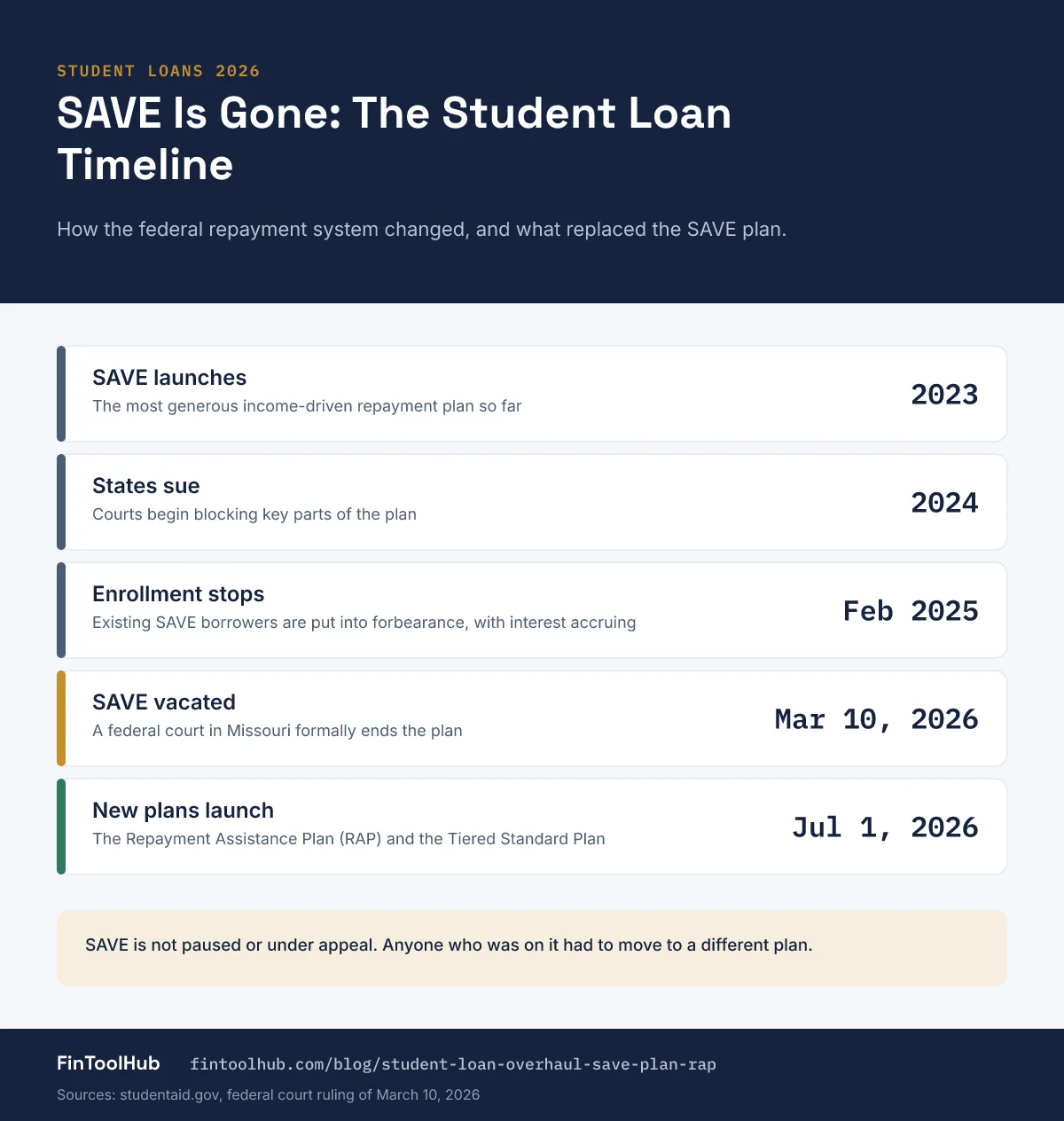
The SAVE plan — Saving on a Valuable Education — launched in 2023 as the most generous income-driven repayment option the federal government had ever offered. It didn't survive long. Multiple states sued almost immediately, arguing the Department of Education had overstepped its authority, and by mid-2024 federal courts had blocked key provisions. Millions of borrowers who'd already enrolled were placed into an interest-accruing forbearance that dragged on for nearly two years while the litigation worked through the courts.
That litigation reached its conclusion on March 10, 2026, when a federal court in the Eastern District of Missouri formally vacated the plan. SAVE isn't paused, delayed, or under further appeal — it no longer exists. Anyone who was on it had to move to a different plan.
A quick timeline
The two plans that replaced it
The OBBBA didn't just remove SAVE — it narrowed the entire menu of federal repayment options going forward. For any first federal loan disbursed on or after July 1, 2026, there are now exactly two choices.
| Plan | Type | How it works |
|---|---|---|
| Repayment Assistance Plan (RAP) | Income-driven | Payment set at 1%–10% of income on a sliding scale, no partial financial hardship requirement to qualify |
| Tiered Standard Plan | Fixed payment | Term of 10 to 25 years, set by your total balance rather than income — no forgiveness timeline built in |
The design philosophy is a genuine departure from the old system. Where the previous menu — Standard, Graduated, Extended, PAYE, ICR, IBR, and SAVE — offered borrowers a wide range of customized options, RAP and the Tiered Standard Plan trade that flexibility for simplicity. You're either on a plan that scales with your income, or a plan that scales with your balance. There's no longer a third option in between.
If you already have loans, here's what you keep
The new rules apply immediately to new borrowers, but existing borrowers get a longer runway — with an expiration date attached.
- Standard, Graduated, and Extended plans stay available as long as all of your loans were disbursed before July 1, 2026.
- PAYE and Income-Contingent Repayment (ICR) stopped accepting new enrollees on July 1, 2026, and both sunset completely by July 1, 2028. If you're on either plan, you have until that date to switch — after that, you'll be moved automatically to IBR or RAP.
- Income-Based Repayment (IBR) is the one legacy income-driven plan the OBBBA keeps permanently. It also got easier to qualify for — the old partial financial hardship requirement was removed, so any borrower with eligible loans can now enroll regardless of income level.
If you were on SAVE specifically, none of your forbearance time on that plan counted toward forgiveness under any income-driven plan, and interest continued accruing the entire time. That's a real cost some borrowers are only now discovering as they pick a new plan and see the balance they're actually starting from.
The change buried in the fine print that could cost you thousands
Forgiven student loan debt is taxable again. A provision in the American Rescue Plan Act had made student loan forgiveness tax-free — but that exemption expired on December 31, 2025, and nothing in the OBBBA extended it.
If your remaining balance is forgiven through an income-driven plan — RAP, IBR, or a legacy plan still winding down — in 2026 or later, the forgiven amount gets added to your taxable income for that year. On a large balance, that can mean an unexpected five-figure tax bill arriving in the same year your debt technically disappears.
This is easy to miss because forgiveness itself sounds like unambiguously good news, and for a decade it effectively was — the tax-free treatment made IDR forgiveness a clean, no-strings-attached benefit. That's no longer true for anyone whose forgiveness lands in 2026 or beyond under the current rules. If you're several years from your own forgiveness date, it's worth budgeting for that eventual tax bill now rather than being surprised by it later.
The one major exception: PSLF
Public Service Loan Forgiveness operates under entirely separate rules and wasn't touched by any of this. If you work full-time for a qualifying government or nonprofit employer and make 120 qualifying monthly payments, your remaining balance is still forgiven completely tax-free. The expired exemption applies to income-driven repayment forgiveness specifically — not PSLF. If you're pursuing PSLF, an income-driven plan like RAP or IBR generally produces qualifying payments; the new Tiered Standard Plan, since it isn't income-driven, does not.
What Parent PLUS borrowers need to do before it's too late
Parent PLUS loans are excluded from RAP entirely. The only income-driven option available to Parent PLUS borrowers going forward is Income-Contingent Repayment — and only after consolidating the loan first. If you're a Parent PLUS borrower who wants access to any income-driven plan, that consolidation needed to happen before July 1, 2026. Anyone who hasn't consolidated by that point is left with only non-income-driven repayment options.
What to actually do right now
- Confirm your current plan status at studentaid.gov — especially if you were on SAVE, since you may have been auto-enrolled somewhere you didn't choose.
- Check your loan disbursement dates. If any of your loans were taken out on or after July 1, 2026, you're limited to RAP or the Tiered Standard Plan for that portion of your debt, even if older loans still qualify for legacy plans.
- If you're pursuing forgiveness, model the eventual tax bill — the exemption that used to make this a non-issue is gone.
- If you're on PAYE or ICR, don't wait until 2028 to think about your next move. Understanding your options now, while you still have both the old and new systems available to compare, puts you in a much better position than being auto-switched later.
You can run your own numbers under the new fixed-payment plans with our Student Loan Payoff Calculator, which reflects the current system rather than the pre-2026 rules still floating around on a lot of other sites.
This timeline and the mechanics of RAP, the Tiered Standard Plan, IBR's permanent status, and the expired tax exemption on forgiven debt are drawn from multiple independent 2026 sources, including university financial aid offices and legal analysis of the OBBBA, cross-checked for consistency. Federal student loan policy is changing quickly — confirm your specific situation at studentaid.gov, and consider talking to a student loan counselor or tax professional before making a major repayment decision. Official sources: Federal Student Aid (studentaid.gov).
Frequently asked questions
Is the SAVE plan still available in 2026?
No. A federal court vacated the SAVE plan on March 10, 2026. It no longer exists in any form, and anyone previously enrolled was required to select a different repayment plan.
What replaced the SAVE plan?
Two new plans launched July 1, 2026: the Repayment Assistance Plan (RAP), an income-driven option with payments set between 1% and 10% of income, and the Tiered Standard Plan, a fixed-payment plan with a term based on your total loan balance rather than your income.
Is forgiven student loan debt taxable now?
Yes, for most income-driven repayment forgiveness occurring in 2026 or later — the temporary tax exemption expired December 31, 2025. Forgiven balances under RAP, IBR, or legacy income-driven plans are added to your taxable income for that year. Public Service Loan Forgiveness remains tax-free under separate, unaffected rules.
Can I still use PAYE or Income-Contingent Repayment?
If all your loans were disbursed before July 1, 2026, you can remain on PAYE or ICR until July 1, 2028, when both plans sunset completely and remaining borrowers are moved to IBR or RAP.
Which federal repayment plans still exist for new borrowers?
Only two: the Repayment Assistance Plan (RAP) and the Tiered Standard Plan. Anyone taking out their first federal student loan on or after July 1, 2026 cannot enroll in Standard, Graduated, Extended, PAYE, ICR, or IBR — those are only available to borrowers with loans from before that date.