
Tax & Paycheck
Every State Income Tax Change for 2026 (So Far)
Three states cut or restructured their income tax this year — one of them in a special session most people missed entirely. Here's exactly what changed, effective when, and which "current rate" you'll still find online is actually out of date.

State income tax rates aren't supposed to be exciting. Most years, nothing changes, and the "current rate" a site quoted five years ago is still correct today. 2026 has not been one of those years. Three states pushed through genuine, material changes to their income tax structure — and at least two of them did it in ways easy to miss if you're not specifically tracking state legislative sessions.
ARArkansas: a surprise special-session cut
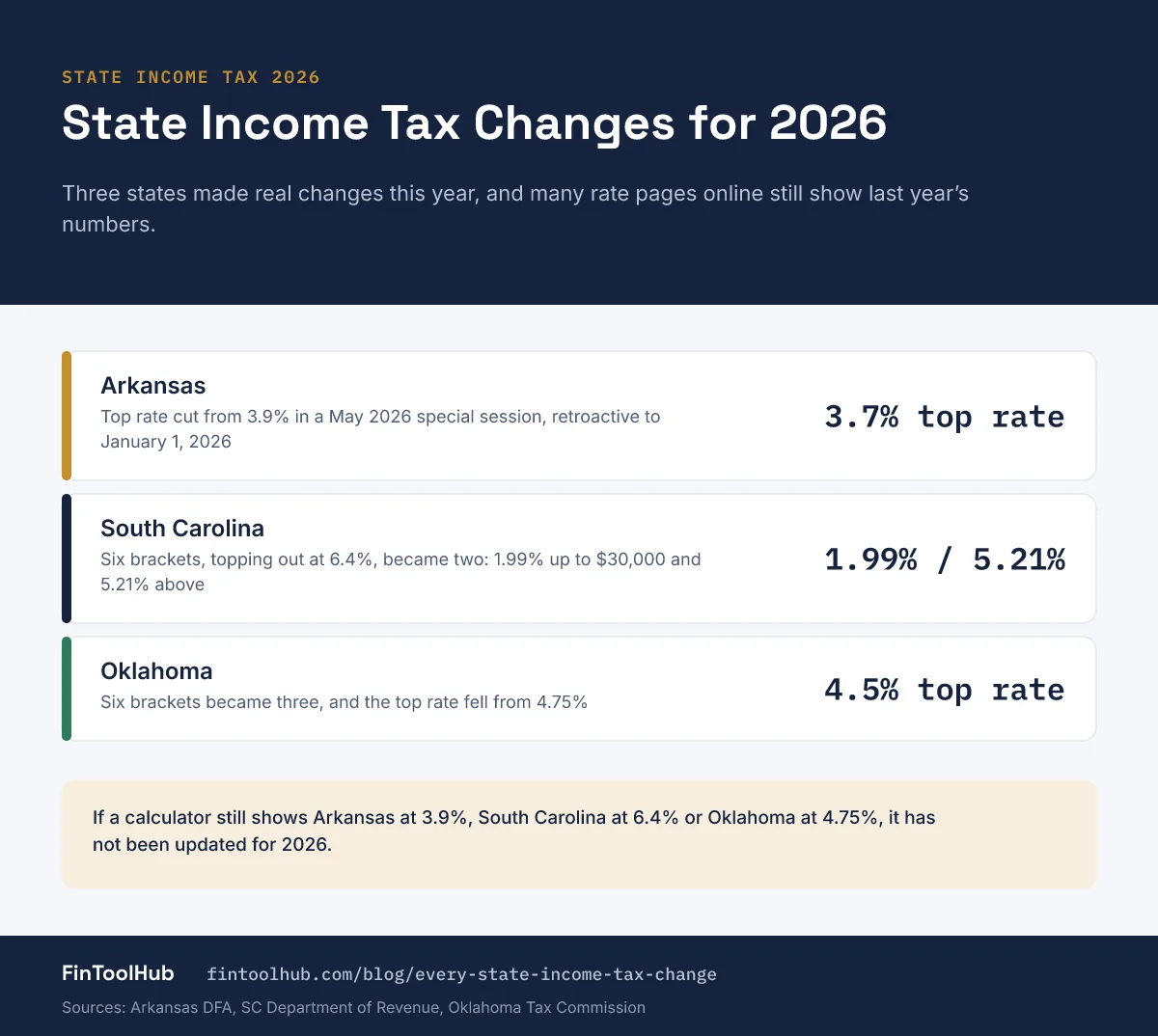
On May 6, 2026, Arkansas passed HB 1001 and SB 1 in a special legislative session, cutting the state's top individual income tax rate to 3.7% — retroactive to January 1, 2026. It's the state's fourth rate cut in four consecutive years, continuing a trend that's dropped Arkansas's top rate significantly since the mid-2020s.
| Taxable income | Rate |
|---|---|
| $0 – $5,599 | 0% |
| $5,600 – $11,199 | 2% |
| $11,200 – $15,999 | 3% |
| $16,000 – $26,399 | 3.4% |
| $26,400 – $94,700 | 3.7% |
| Above $94,700 | Separate simplified table, top rate 3.7% |
Arkansas has a genuinely unusual structure worth knowing about even beyond the new rate: taxpayers above $94,700 don't just get additional brackets stacked on top — they switch to an entirely separate, simpler two-tier table for their whole income calculation. It's one of the only states that works this way, and it can create a real "notch" right at that threshold.
SCSouth Carolina: six brackets become two
South Carolina's change is the most structurally dramatic of the three. Under H.4216 (Act 110), the state replaced its old six-bracket system — which topped out at 6.4% — with just two brackets for 2026.
| Bracket | Rate |
|---|---|
| $0 – $30,000 | 1.99% |
| Above $30,000 | 5.21% |
That's a top-rate cut of more than a full percentage point in a single reform, and it applies identically across every filing status — South Carolina doesn't run separate bracket widths for single versus joint filers the way federal brackets do. If you've seen a South Carolina calculator recently that still shows a 6.4% or 6.2% top rate, it's describing the system this reform replaced.
OKOklahoma: six brackets become three
Oklahoma passed a smaller but still meaningful reform in 2025, effective for the 2026 tax year: a consolidation from six brackets down to three, and a top-rate cut from 4.75% to 4.5%.
| Taxable income (single) | Rate |
|---|---|
| $0 – $1,000 | 0.25% |
| $1,001 – $7,200 | 2.75% |
| Above $7,200 | 4.5% |
In practice, this means most working Oklahomans' income above roughly $7,200 now falls squarely into the single top bracket — a much simpler system to estimate by hand than the old six-tier structure, even before accounting for the rate reduction itself.
Stale numbers still floating around
Rate changes create a predictable problem: old figures linger online for years after they stop being true, sometimes for reasons that have nothing to do with a current 2026 reform. Two examples worth flagging directly:
Michigan's current income tax rate is 4.05%.
That was a one-year-only reduction for 2023, triggered by a revenue formula. A court ruling determined it wasn't permanent, and the rate reverted to 4.25% starting in 2024 — confirmed directly by the Michigan Department of Treasury's own 2026 withholding guide.
New Jersey's "exit tax" rate is 8.97%.
8.97% was New Jersey's top income tax rate before 2018. The state added a "millionaire's tax" bracket that year, and the current top rate is 10.75%. It's also worth knowing the "exit tax" isn't a separate tax at all — it's a withholding prepayment that only applies to sellers who are already nonresidents at closing.
Why so many states are cutting rates at once
Arkansas, South Carolina, and Oklahoma aren't coordinating — this is a broader trend among a group of Southern and lower-tax states that have been competing for residents and business relocation over the past several years, often citing neighboring no-income-tax states (Tennessee, Texas, Florida) as competitive pressure. Whether that pressure continues to produce further cuts in 2027 and beyond will depend heavily on each state's revenue performance; several of these reforms include language tying future reductions to hitting specific revenue growth targets, rather than locking in automatic further cuts.
If you live or work in any of these states, it's worth rerunning your withholding estimate for 2026 rather than assuming last year's paycheck math still applies — the changes are real, and in Arkansas's case, retroactive to the start of the year.
Arkansas's rate cut (HB 1001/SB 1) verified against Tax Foundation's direct coverage and Thomson Reuters Tax's bracket analysis. South Carolina's reform (H.4216/Act 110) verified against Tax Foundation's state tax rankings and independent legislative analysis. Oklahoma's simplification verified against AARP's state tax guide and independent tracking sources. This is a summary for planning purposes — confirm exact figures with each state's department of revenue before filing. Official sources: Arkansas DFA: Income tax; SC Department of Revenue: Individual income tax; Oklahoma Tax Commission; Tax Foundation: State income tax rates.
Frequently asked questions
What is Arkansas's top income tax rate for 2026?
3.7%, following a special legislative session in May 2026 that cut the rate retroactive to January 1, 2026.
What is South Carolina's top income tax rate for 2026?
5.21%, following a reform (H.4216/Act 110) that collapsed the state's previous six-bracket system into just two brackets: 1.99% on the first $30,000 of taxable income, 5.21% above.
What is Oklahoma's top income tax rate for 2026?
4.5%, down from 4.75%, as part of a reform that also consolidated the state's six tax brackets into three.
Is Michigan's income tax rate 4.05% or 4.25%?
4.25% is current, confirmed by the Michigan Department of Treasury's 2026 withholding guide. The 4.05% rate applied only to the 2023 tax year, following a one-time revenue-trigger reduction that a court determined was not permanent.
Why do some sites still show New Jersey's top rate as 8.97%?
That was accurate before 2018. New Jersey added a higher "millionaire's tax" bracket that year, and the current top rate is 10.75%. Sites that haven't been updated since before that reform are showing an outdated figure.