
Debt Payoff
HELOC vs. Personal Loan vs. Balance Transfer: Which Actually Fits Your Debt?
Three genuinely different tools, not three flavors of the same thing. The right one depends less on which has the lowest advertised rate and more on your balance size, credit score, and whether you're willing to put your home on the line.

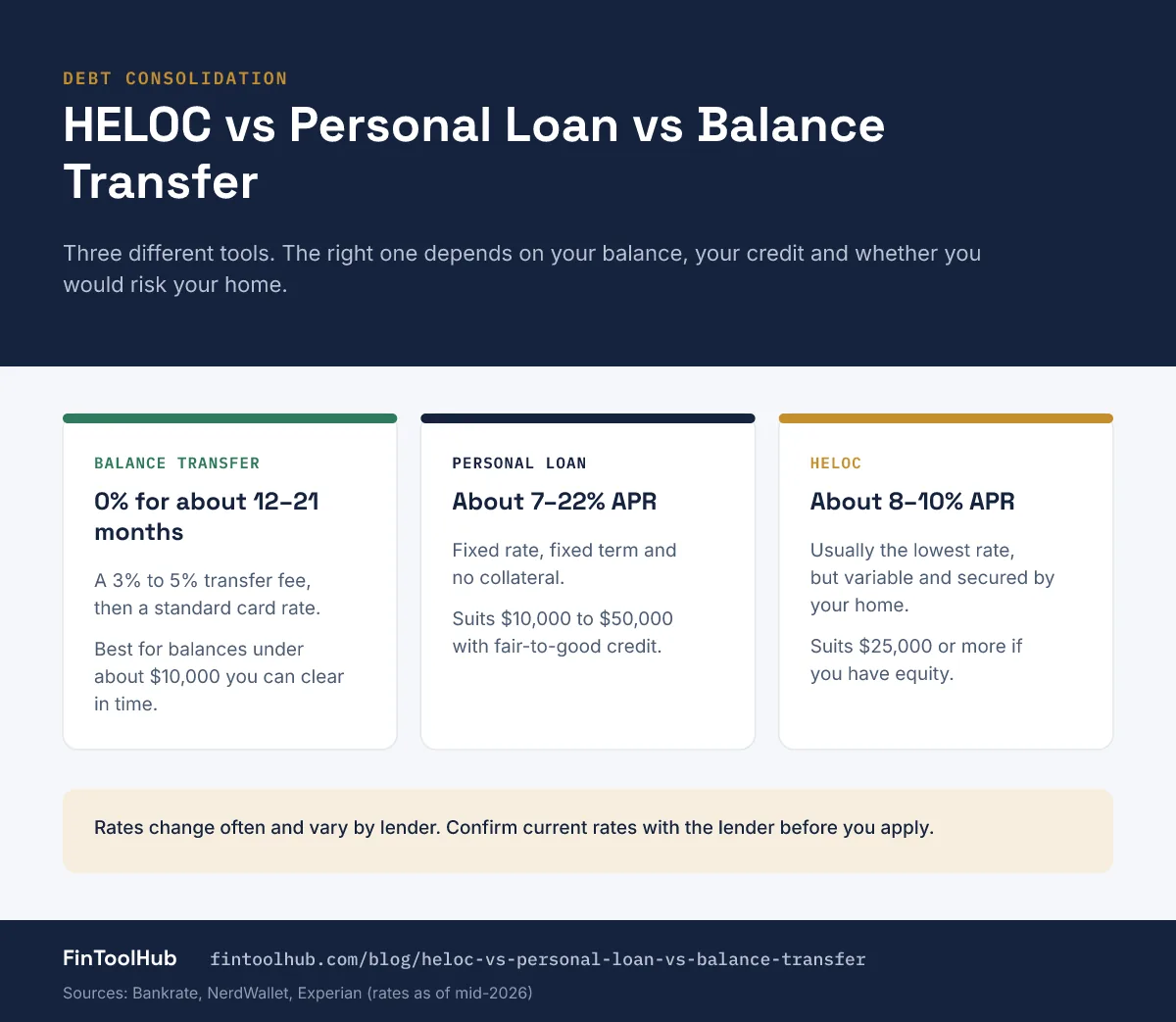
Three tools, three different jobs
Then reverts to a standard card rate. 3–5% transfer fee. Best for smaller balances you can clear fast.
Fixed rate, fixed term, unsecured. No collateral at risk. Predictable payoff date.
Usually the lowest rate of the three, secured by your home. Variable rate. Real risk if you default.
Balance transfer: cheapest, if you actually finish in time
A balance transfer card moves your existing credit card balances onto a new card carrying a promotional 0% APR — commonly 12 to 21 months, depending on the issuer. If you pay the full balance before that window closes, your total cost is just the one-time balance transfer fee, typically 3% to 5% of the amount moved. Generally requires good to excellent credit (a FICO score around 670 or higher) and works best for balances under roughly $10,000, since your new card's credit limit caps how much you can actually transfer.
The catch is the same one that applies to any 0% promotional offer: if you don't clear the balance in time, the remaining amount reverts to the card's standard APR — often north of 20% — and you lose the benefit that made this option attractive in the first place.
Personal loan: predictable, unsecured, middle-of-the-road rates
A personal loan gives you a lump sum at a fixed rate and a fixed term, used to pay off your existing debts, then repaid on a set schedule with no ambiguity about your payoff date. Rates currently average around 12–13% overall, but range widely — borrowers with excellent credit can see rates closer to 6–7%, while those with fair credit may see offers in the 22–35% range. Nothing is used as collateral, so there's no risk of losing an asset if you fall behind, though missed payments still damage your credit.
This is generally the most workable option for larger unsecured balances ($10,000–$50,000 is a common sweet spot) or for borrowers who don't have strong enough credit to qualify for the best balance transfer offers.
HELOC: the lowest rate, with real collateral risk attached
A home equity line of credit typically offers the lowest interest rate of the three — commonly in the 8% to 10% range — because it's secured by your home. It functions more like a credit card than a traditional loan: a revolving credit line you draw against as needed during a set "draw period," rather than a single lump-sum disbursement. Rates are usually variable, meaning your payment can change as broader interest rates move.
Where fees quietly erase the "better" rate
A lower headline rate doesn't automatically mean a better deal once fees enter the picture. Consider a real comparison: $10,000 in credit card debt at a 20% average rate, offered a personal loan at 11% APR — a clear improvement on paper. But one specific offer at that rate came with $1,000 in origination fees, meaning only $9,000 of the loan actually went toward paying off debt. A different offer with a slightly higher rate but no fees can end up cheaper overall, depending on how long you're carrying the balance.
a higher rate + no fees, especially on shorter terms.
Always compare total cost — interest plus fees — not the rate alone.
A simple way to decide
| Your situation | Best fit |
|---|---|
| Under $10,000, credit score 670+, confident you can pay it off in ~18 months | Balance transfer card |
| $10,000–$50,000, fair-to-good credit, want a fixed payoff date | Personal loan |
| $25,000+, own a home with meaningful equity, comfortable with the risk | HELOC |
| Any amount, but need real behavioral structure and support | Nonprofit credit counseling / debt management plan |
Whichever option you're leaning toward, run the actual numbers — including any fees — before committing. Our Debt Consolidation Calculator compares your current weighted-average rate against a new loan's total cost, fees included, so you can see whether a specific offer genuinely helps before you sign anything.
Rate ranges, fee structures, and typical credit requirements verified against multiple independent 2026 sources, including Bankrate, NerdWallet, Experian, and CBS News coverage, cross-checked for consistency as of July 2026. Rates change frequently and vary by lender — confirm current published rates directly with any lender before applying. This is general information, not financial advice. Official sources: CFPB: What is a HELOC?.
Frequently asked questions
Which is cheapest: HELOC, personal loan, or balance transfer?
It depends on your situation. A balance transfer is cheapest if you can pay off the balance within the 0% promotional period. A HELOC typically has the lowest ongoing rate but requires home equity and puts your house at risk. A personal loan sits in between, with no collateral risk.
What credit score do I need for a balance transfer card?
Generally good to excellent credit, around a 670 FICO score or higher, to qualify for the best 0% promotional offers.
Is a HELOC riskier than a personal loan for debt consolidation?
Yes, in a specific way — a HELOC is secured by your home, so defaulting can put your house at risk. A personal loan is unsecured, so a default damages your credit but doesn't threaten a specific asset.
Do balance transfer cards and personal loans charge fees?
Balance transfer cards typically charge 3-5% of the transferred amount as a one-time fee. Personal loans often charge an origination fee, commonly 1-8% of the loan amount, deducted from what you actually receive.
What happens if I don't pay off a balance transfer before the promotional period ends?
The remaining balance reverts to the card's standard interest rate, which is often well above 20% - erasing the savings the promotional period was meant to provide.