
Capital Gains Calculators
Capital Gains Tax Calculator on Sale of Property
Enter your sale price, basis, and improvements to see your real estate capital gains tax — including the Section 121 home-sale exclusion, 2026 IRS brackets, and the Net Investment Income Tax.

Home sale capital gains calculator
Works for a primary residence, second home, or land sale — just adjust the exclusion checkbox below.
Federal only — doesn't include state capital gains tax (varies 0%–13.3%+ by state), depreciation recapture on a former rental, or a Realtor's own closing statement adjustments. 2026 tax year figures per IRS Rev. Proc. 2025-32.
How this capital gains tax calculator works
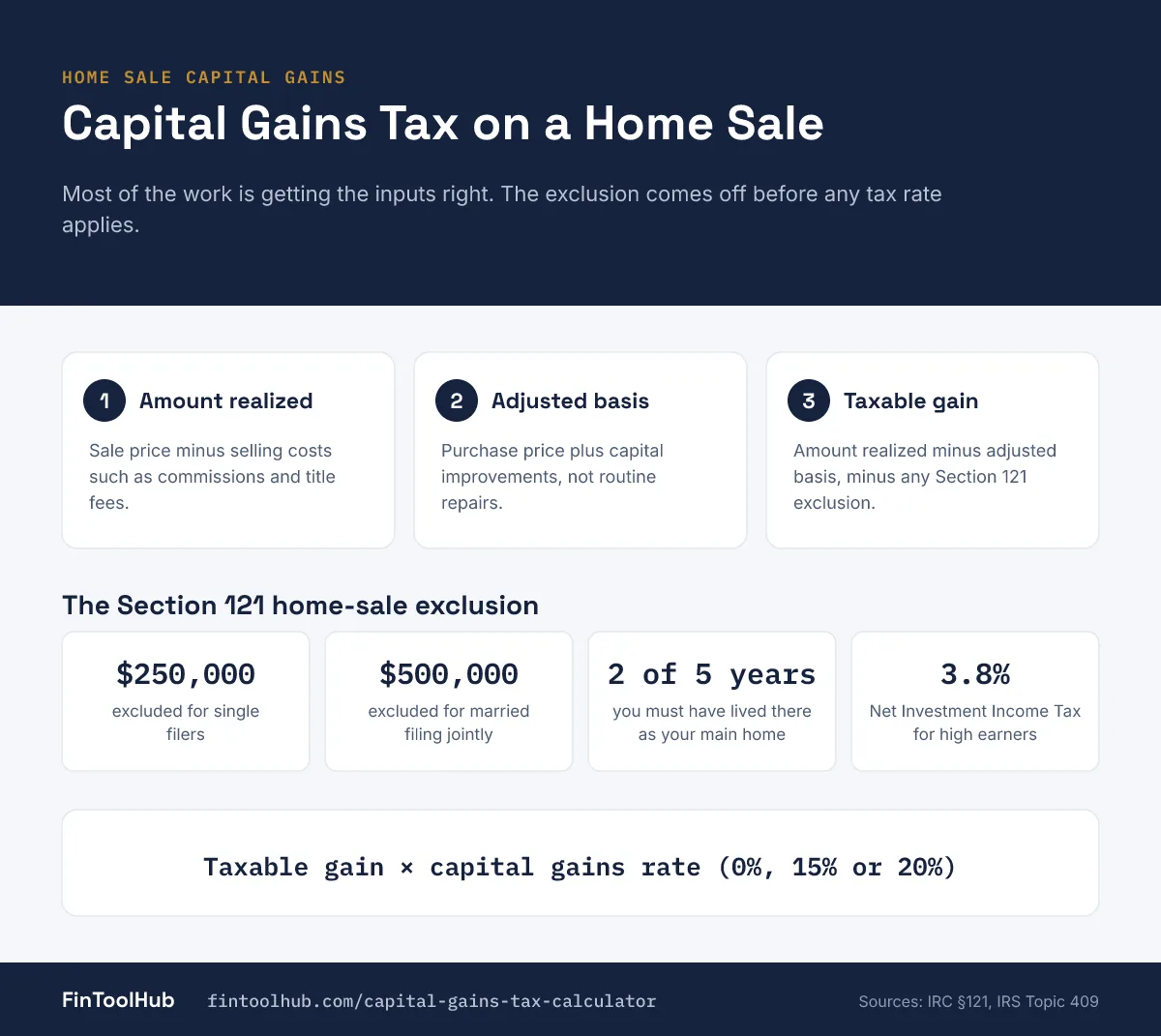
Capital gains tax on a home sale is calculated as: (sale price − selling costs − adjusted basis − any §121 exclusion) × your capital gains rate, plus 3.8% NIIT if you're a high earner. A capital gains tax calculator on sale of property, real estate capital gains tax calculator, or calculator for capital gain tax on sale of property needs four numbers to get that right: what you sold it for, what you paid in selling costs, what you originally paid, and what you spent on capital improvements along the way. The math is simple once those are right — it's getting the inputs right that trips people up, which is exactly what a calculating real estate capital gains tool should walk you through rather than assume.
Amount realized is your sale price minus selling costs (agent commissions, title fees, transfer taxes). Adjusted basis is your original purchase price plus any capital improvements — a new roof, an addition, a kitchen remodel — but not routine repairs or maintenance. Total gain is amount realized minus adjusted basis. That's the number this calculator, and any real capital gains calculator real estate tool, is really built around.
The §121 home sale exclusion (the part most calculators skip)
If the property was your primary residence for at least 2 of the last 5 years before the sale, IRC §121 lets you exclude $250,000 of gain (single or head of household) or $500,000 (married filing jointly) from tax entirely — before any tax brackets even apply. This is the single biggest factor in a capital gains on home sale calculator, home sale capital gains calculator, or capital gains tax calculator on sale of primary residence, and it's why the checkbox above matters more than almost any other input: most primary-residence sellers with typical gains owe $0 in federal capital gains tax.
Per IRS Topic No. 701, the ownership and use tests run independently and the 24 months don't need to be continuous — scattered periods within the 5-year window still count toward the total. For a married couple filing jointly, only one spouse needs to meet the ownership test, but both must independently meet the use test to claim the full $500,000 exclusion.
2026 federal capital gains tax rates
Long-term gains (property owned more than one year) are taxed at preferential 0%, 15%, or 20% rates based on your total taxable income — not at a single flat percentage. This is what a proper capital gains tax rate 2025 calculator or capital gains tax calculator 2024 search is really after; the rates below are the current 2026 figures (IRS Topic 409, Rev. Proc. 2025-32), since these thresholds move every year with inflation.
| Filing status | 0% rate up to | 15% rate up to | 20% rate above |
|---|---|---|---|
| Single | $49,450 | $545,500 | $545,500 |
| Married filing jointly | $98,900 | $613,700 | $613,700 |
| Head of household | $66,200 | $579,600 | $579,600 |
These thresholds apply to your taxable income (after deductions) — and your gain "stacks" on top of your other income to determine which bracket it lands in. Short term capital gain calculator searches are asking about a different rule entirely: property owned one year or less doesn't get these rates at all — it's taxed as ordinary income, same as our retirement tax calculator models for withdrawal income, up to 37%. That's why holding period is a required input above, not a footnote.
The Net Investment Income Tax (NIIT)
Above the capital gains rate itself, a 3.8% Net Investment Income Tax applies to taxable gains once your modified adjusted gross income exceeds $200,000 (single/HOH) or $250,000 (MFJ). Unlike the LTCG brackets, this threshold is fixed by 2013 statute (IRC §1411) and isn't adjusted for inflation — so more sellers cross it every year. It stacks on top of, not instead of, your capital gains rate.
The "over 65" capital gains exemption doesn't exist anymore
Capital gains tax over 65 calculator is one of the most common searches on this topic, and the honest answer is that the age-based exemption it's asking about was repealed by the Taxpayer Relief Act of 1997. It was replaced by the §121 exclusion above, which applies at any age based on ownership and use — not birthdate. A 70-year-old and a 30-year-old selling their primary residence use the exact same $250,000/$500,000 rule. If you're managing capital gains alongside retirement withdrawals in the same tax year, our retirement tax calculator can help you see how the two stack together.
State capital gains tax
This calculator is federal-only. Most states tax capital gains as ordinary income at their regular state rates — a mn capital gains tax calculator search, for instance, reflects Minnesota taxing gains at its regular income tax brackets (up to 9.85%), on top of the federal number above. Nine states have no broad income tax at all, so no state capital gains tax applies there; a handful of others (notably California, at up to 13.3%) tax gains more heavily than most. For the full state-by-state picture, including which states offer partial exclusions and how the highest combined rates compare, see our Capital Gains Tax by State: Complete 2026 Guide.
Federal figures verified directly against IRS Topic 409 (capital gains and losses), IRS Topic 701 (sale of your home), and IRS Publication 523 — Revenue Procedure 2025-32 (2026 inflation adjustments), IRC §121 (home sale exclusion), and §1411 (Net Investment Income Tax). This is a planning estimate, not tax advice — a CPA should confirm your actual basis, holding period, and exclusion eligibility before you file.
Frequently asked questions
Before you list, or before you file.
How is capital gains tax calculated on real estate?
Sale price minus selling costs gives you amount realized. Purchase price plus capital improvements gives you adjusted basis. The difference is your gain. If it's your primary residence and you qualify for the §121 exclusion, up to $250,000 (single) or $500,000 (MFJ) of that gain is tax-free; the rest is taxed at 0%, 15%, or 20% federally, depending on your income.
Do the 2-of-5-year ownership and use periods need to be continuous?
No. Per IRS Topic 701, the 24 months of ownership and 24 months of use just need to add up within the 5-year window before the sale — scattered periods count. The two tests are independent and can be satisfied during different 2-year stretches.
Do I still get a capital gains break at age 65?
Not because of your age specifically. The old one-time over-55 exemption was repealed in 1997 and replaced by the §121 exclusion, which applies at any age as long as you owned and used the home as your primary residence for 2 of the last 5 years.
What counts as a capital improvement I can add to my basis?
Improvements that add value or extend the property's life — a new roof, an addition, a renovated kitchen, new HVAC. Routine repairs and maintenance (painting, fixing a leak) don't count toward basis.
Is a second home or rental property taxed the same way?
No — the §121 exclusion only applies to a primary residence. Second homes, rental property, and vacant land sales are fully taxable on the gain (subject to the standard 0/15/20% long-term rates), with no exclusion available. A former rental also carries depreciation recapture, taxed separately at up to 25%.
Does this include state tax?
No, this calculator is federal only. Most states tax capital gains as ordinary income at their own rates, which vary from 0% (nine states with no income tax) to over 13% in the highest-tax states — add your state's rate to the federal number above for a full picture.