
Net Worth Calculators
Tangible Net Worth Calculator
Strip out goodwill, patents, and other intangible assets to see your tangible net worth — the number lenders actually use in loan covenants.

Calculate your tangible net worth
Works for a business balance sheet or a personal net worth statement.
Debt-to-tangible-net-worth ratio = total liabilities ÷ tangible net worth. Lower is generally stronger; many commercial loan covenants cap this ratio, but the exact threshold is set by your specific loan agreement — check yours rather than assuming a standard number.
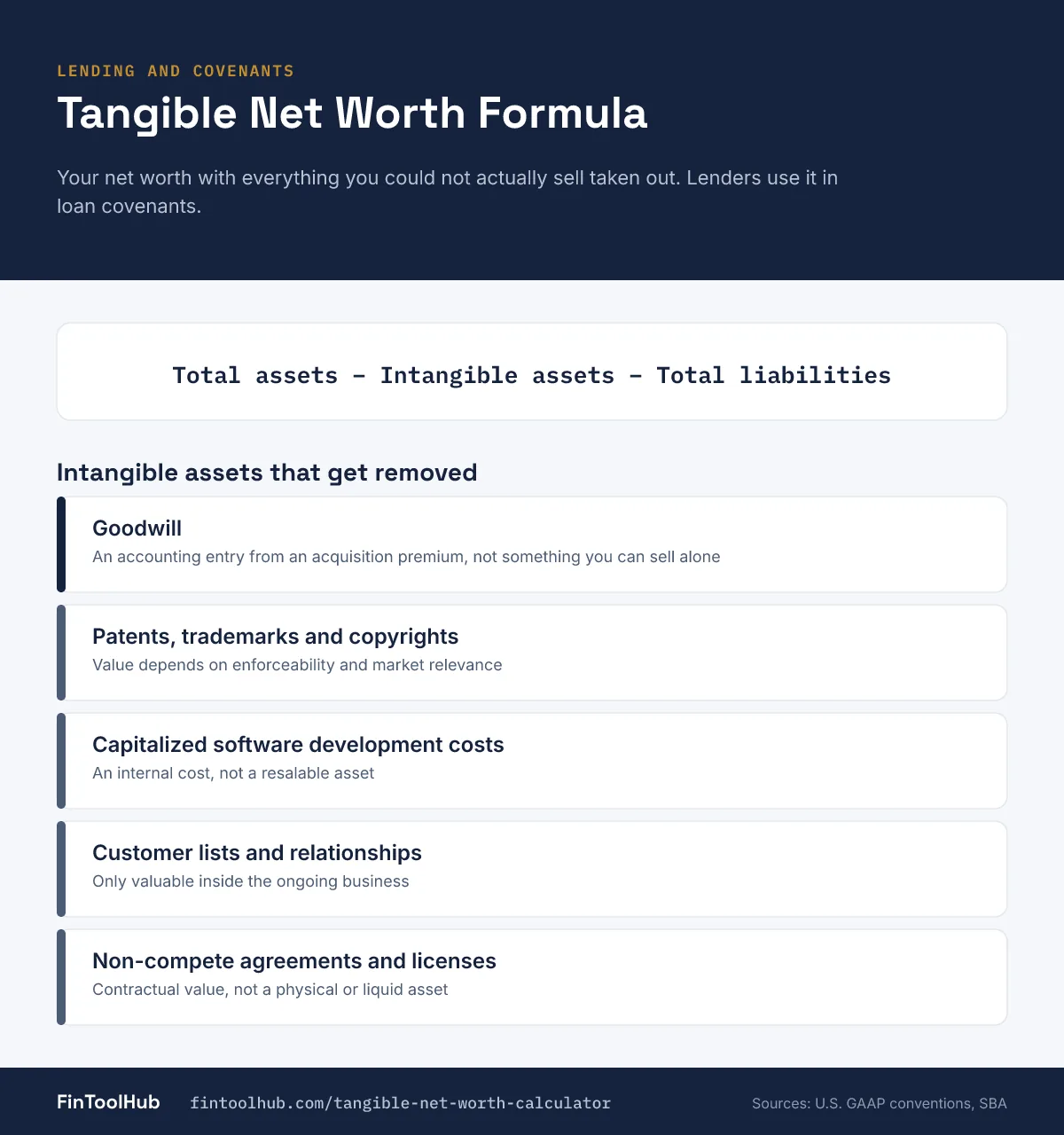
What tangible net worth calculation actually strips out
Tangible net worth is total assets minus intangible assets (like goodwill and patents) minus total liabilities — it's your regular net worth figure with anything you couldn't actually sell stripped back out first. A tangible net worth calculation starts from the same place as a regular net worth calculation — total assets minus total liabilities — and then takes one extra step: it removes intangible assets from the asset side before subtracting liabilities. The formula behind how to calculate tangible net worth is:
Equivalently: Tangible Net Worth = Standard Net Worth − Intangible Assets.
The reason this matters: two businesses (or two people) can show identical net worth on paper while having very different amounts of it backed by something a lender could actually seize and sell if things went wrong. That's exactly the gap a calculation of tangible net worth is designed to expose.
What counts as an intangible asset
This is the part that trips people up when they try how do you calculate tangible net worth for the first time — not every asset on a balance sheet is created equal. The most common intangibles to strip out:
| Intangible asset | Why it's excluded |
|---|---|
| Goodwill | An accounting entry from an acquisition premium, not a sellable asset on its own |
| Patents, trademarks, copyrights | Value depends entirely on continued enforceability and market relevance |
| Capitalized software development costs | Internal development cost, not a liquid or resalable asset |
| Customer lists / relationships | Only valuable in the context of the ongoing business, not independently |
| Non-compete agreements, licenses | Contractual value, not a physical or liquid asset |
| Deferred financing costs | An accounting deferral, not an asset with resale value |
Physical, financial, and liquid assets — cash, real estate, equipment, inventory, marketable securities, accounts receivable — stay in as tangible assets. Some lenders go further and also strip out related-party or officer receivables, since those aren't arm's-length assets either; check your specific loan agreement's definition before assuming a standard list applies.
The debt-to-tangible-net-worth ratio
A debt to tangible net worth calculation is the follow-on question most people asking about tangible net worth are actually trying to answer: Debt-to-Tangible-Net-Worth Ratio = Total Liabilities ÷ Tangible Net Worth. This ratio shows up constantly in commercial lending — bank credit agreements and bonding/surety requirements frequently set a maximum allowable ratio as a loan covenant, because it tells a lender how leveraged the business is against assets that could realistically be liquidated. There's no single universal "good" number — thresholds are set contract-by-contract and vary by industry, lender, and loan type — so always check the covenant in your specific agreement rather than assuming a rule of thumb applies.
Why the U.S. Small Business Administration uses tangible net worth
Tangible net worth isn't just a bank-covenant term — it's written directly into federal lending rules. The SBA uses it as an alternative size standard: a business that exceeds its industry's normal size limit can still qualify as "small" (and eligible for SBA financing) if its tangible net worth and average net income fall under a separate ceiling. As of the SBA's current published guidance:
| SBA program | Tangible net worth ceiling | Average net income ceiling |
|---|---|---|
| 7(a) loans | Under $15 million | Under $5 million |
| 504 / CDC loans | Under $20 million | Under $6.5 million |
Net income is averaged over the two years preceding the application, after federal income taxes. This is a ceiling for program eligibility, not a minimum — it's the opposite direction from a bank's debt-to-tangible-net-worth covenant above, so don't conflate the two when you see "tangible net worth" mentioned in an SBA context versus a bank credit agreement.
Tangible net worth for individuals vs. businesses
Tangible net worth started as, and is still most commonly used as, a business and commercial-lending metric. For an individual, most personal balance sheets simply don't carry meaningful intangible assets — a house, a car, a brokerage account, and cash in the bank are all tangible. The calculation becomes relevant to a person mainly if they own a business (where their share carries goodwill or IP), hold patents or copyrights personally, or are applying for SBA or bank financing where a lender specifically requests a tangible net worth figure as part of underwriting.
Formula and intangible-asset classifications reflect standard U.S. GAAP treatment and common commercial lending covenant definitions. SBA figures verified against sba.gov: 7(a) loan eligibility and sba.gov: 504 loan eligibility. This is a general planning estimate, not a substitute for your actual loan agreement's defined terms — those definitions control, and can vary from the general list above.
Frequently asked questions
Before you sign a covenant, or apply for financing.
What is tangible net worth?
Tangible net worth is your total assets minus intangible assets (like goodwill and patents) minus total liabilities. It's a stricter version of net worth that only counts assets a lender could realistically seize and sell.
How do you calculate tangible net worth?
Start with total assets, subtract intangible assets (goodwill, patents, trademarks, capitalized software, and similar), then subtract total liabilities. The result is your tangible net worth.
What is a good debt-to-tangible-net-worth ratio?
There's no single universal benchmark — it depends on your industry, lender, and loan agreement. Lower generally signals less leverage against liquidatable assets, but the specific maximum allowed is set by whatever covenant applies to your loan.
Is tangible net worth the same as book value?
They're closely related but not identical. Book value (or shareholders' equity) is total assets minus total liabilities. Tangible book value, like tangible net worth, further subtracts intangible assets from that figure.
Do lenders require a minimum tangible net worth?
Many commercial lenders do, especially for larger credit facilities and bonding/surety requirements — it's a common financial covenant. The specific minimum is set in your loan agreement, not by a universal standard.
Does the SBA use tangible net worth?
Yes — as an eligibility ceiling, not a minimum. Per sba.gov, businesses that exceed normal SBA size limits can still qualify for a 7(a) loan if tangible net worth is under $15 million and average net income (after federal taxes, over the prior two years) is under $5 million. For 504/CDC loans, the ceiling is $20 million tangible net worth and $6.5 million average net income.