
Capital Gains Calculators
Capital Gains Tax Calculator on Sale of Rental Property
Rental property has no §121 exclusion and adds a step your primary-residence math skips entirely: depreciation recapture. This calculator models both pieces of the tax separately.
Rental property capital gains calculator
Splits your gain into depreciation recapture (up to 25%) and standard capital gain (0/15/20%).
No §121 exclusion applies — rental property is never a primary residence for tax purposes, even if you lived there before or after renting it out. Federal only; doesn't include state tax or Form 4797/8949 preparation.
Why rental property capital gains math is different
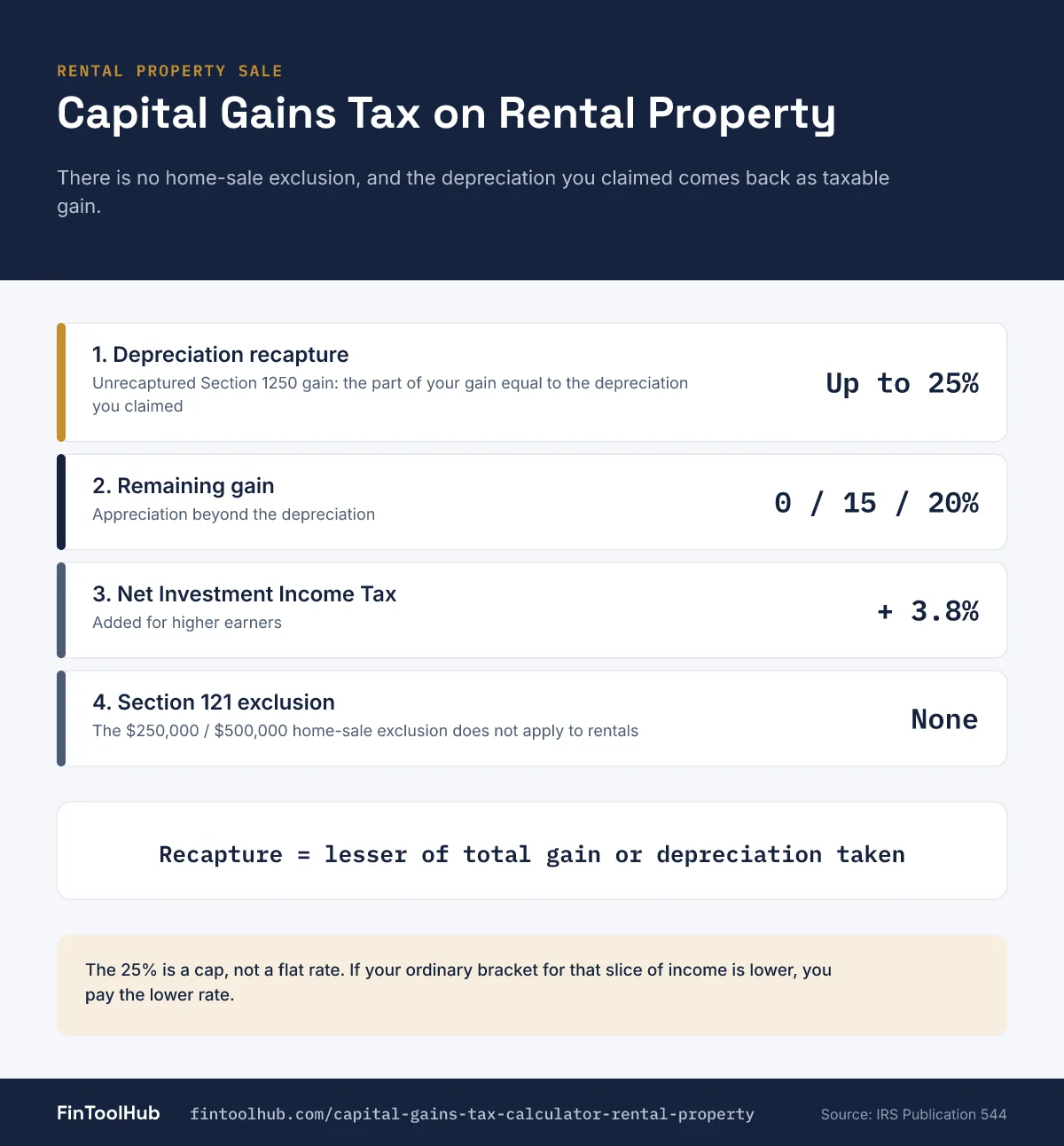
A capital gains tax calculator on sale of rental property has to do two things a primary-residence calculator doesn't: skip the §121 exclusion entirely, and split your gain into a depreciation-recapture piece (taxed up to 25%) and a standard capital gain piece (taxed at 0/15/20%). Miss the depreciation step and you'll underestimate the tax bill — often significantly, since every dollar of depreciation you claimed while renting the property reduced your basis, and that reduction comes back as taxable gain when you sell.
To calculate capital gains tax on sale of rental property or calculating capital gains tax on sale of rental property correctly, you need five numbers: sale price, selling costs, original purchase price, capital improvements, and — the piece that's easy to forget — total accumulated depreciation claimed over the years you rented it out.
The depreciation recapture step
Per IRS Publication 544, when you sell depreciated real estate at a gain, the portion of that gain equal to your accumulated depreciation is called unrecaptured Section 1250 gain, and it's taxed at a maximum rate of 25% — separate from, and generally higher than, the standard 0/15/20% long-term capital gains rates that apply to the rest of the gain.
One IRS rule that surprises people: depreciation reduces your basis under an "allowed or allowable" standard — meaning if you were entitled to claim depreciation but never actually claimed it on your tax returns, the IRS still treats your basis as if you had. Skipping depreciation doesn't avoid recapture; it just means you paid more tax along the way for nothing. If that applies to you, a CPA can help you catch up via Form 3115 before you sell, rather than losing the deduction entirely.
2026 federal rates for both pieces
| Gain component | Tax treatment |
|---|---|
| Depreciation recapture (unrecaptured §1250 gain) | Ordinary rate, capped at 25% |
| Remaining gain — Single | 0% to $49,450 · 15% to $545,500 · 20% above |
| Remaining gain — Married filing jointly | 0% to $98,900 · 15% to $613,700 · 20% above |
| Remaining gain — Head of household | 0% to $66,200 · 15% to $579,600 · 20% above |
Both pieces stack on top of your other taxable income for the year, in this order: your ordinary income first, then the depreciation recapture (up to 25%), then the remaining gain at 0/15/20%. That ordering matters — it's why a large depreciation recapture amount can push the rest of your gain into a higher bracket than it would land in on its own.
The Net Investment Income Tax, and one exception
A 3.8% Net Investment Income Tax applies on top of both pieces once your modified adjusted gross income exceeds $200,000 (single/HOH) or $250,000 (MFJ). One notable exception: if you qualify as a real estate professional under IRC §469(c)(7) and materially participate in the rental as a trade or business, the gain may not be subject to NIIT at all — a fact-specific determination the IRS scrutinizes closely, so document your hours and involvement if you're relying on it.
Short-term rentals: a simpler (worse) answer
If you held the property one year or less, none of the 25%-cap treatment applies — the entire gain, depreciation-related or not, is taxed as ordinary income at your regular marginal rate, up to 37%. There's no version of short-term ownership that benefits from the depreciation recapture cap; it only exists within the long-term capital gains framework.
If this is actually your primary residence
If the property was your primary residence for at least 2 of the last 5 years — even if you rented it out for part of that window — you may still qualify for some or all of the §121 exclusion on the non-depreciation portion of the gain, though the depreciation recapture piece is never excludable. That's a different calculation than this page models; use our Capital Gains Tax Calculator on Sale of Property for a primary-residence sale instead.
Want to defer the tax instead of paying it now?
A properly structured 1031 exchange can defer both the standard capital gains tax and the depreciation recapture tax by rolling your gain into a replacement property, rather than triggering either. Our 1031 Exchange Calculator models exactly this trade-off, including how much of your gain stays deferred versus how much becomes taxable "boot" if you don't fully reinvest.
Depreciation recapture rules verified against IRS Publication 544 (Sales and Other Dispositions of Assets) and IRC §1(h)(1)(D) (unrecaptured Section 1250 gain), §1250(b)(3) ("allowed or allowable" basis rule), and §1411 (NIIT). This is a planning estimate — actual reporting requires Form 4797 and the Unrecaptured Section 1250 Gain Worksheet in the Schedule D instructions. A CPA should confirm your actual depreciation schedule before you file.
Frequently asked questions
Before you list the property, or before you file.
How do you calculate capital gains tax on the sale of a rental property?
Find your total gain (sale price minus selling costs minus adjusted basis), then split it in two: the portion equal to your accumulated depreciation is taxed at up to 25% (unrecaptured Section 1250 gain), and the remaining gain is taxed at standard 0/15/20% long-term capital gains rates.
Does the $250,000/$500,000 home sale exclusion apply to a rental property?
No. The Section 121 exclusion only applies to a primary residence you owned and used as such for at least 2 of the last 5 years. A pure rental property doesn't qualify, and even a former primary residence loses the exclusion on its depreciation-recapture portion.
What if I never claimed depreciation on the property?
It doesn't matter — the IRS uses an "allowed or allowable" standard, meaning your basis is reduced by the depreciation you were entitled to claim whether you actually claimed it or not. You'll owe the recapture tax regardless.
Is depreciation recapture always taxed at exactly 25%?
No — 25% is a cap, not a flat rate. If your ordinary income tax bracket for that portion of income is lower than 25%, you pay the lower rate instead.
Can I avoid depreciation recapture?
A properly structured 1031 exchange can defer both the capital gains tax and the depreciation recapture tax by rolling the gain into a replacement property, rather than eliminating the tax. Selling outright triggers both.