
Investing Calculators
Capital Gains Yield Calculator
See how much of your stock's return came from price appreciation alone — plus dividend yield and total return, so you're comparing the complete picture, not just one piece of it.

Calculate capital gains yield
Enter your beginning and ending share price. Dividends and shares are optional, for total return and dollar totals.
Capital gains yield alone doesn't include dividends — that's what the total return row is for. Annualization uses a compounding formula, so short holding periods can produce extreme-looking annualized numbers; treat those as illustrative, not predictive.
How to calculate capital gains yield
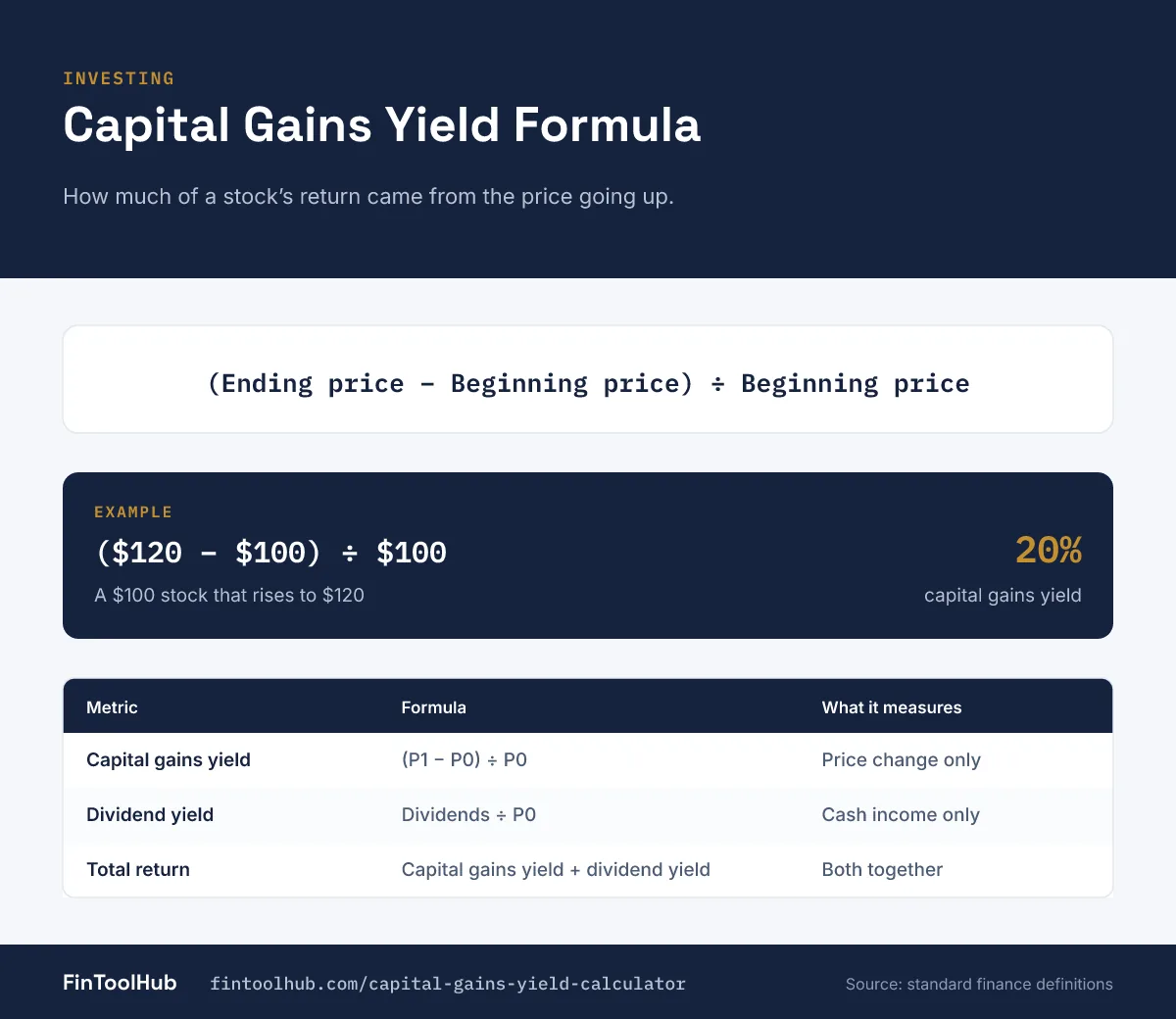
Capital gains yield = (ending price − beginning price) ÷ beginning price, expressed as a percentage. That's the entire formula behind a capital gains yield calculator, and it's the same calculation whether you're asking how to calculate capital gains yield, how do i calculate capital gains yield, or how do you calculate capital gains yield — all four phrasings land on the identical math.
where P₀ is the price you paid and P₁ is the current or sale price. A $100 stock that rises to $120 has a 20% capital gains yield: (120 − 100) ÷ 100 = 0.20.
To calculate capital gains yield by hand, you only need two numbers — your purchase price and the current or sale price. Everything else in the calculator above (dividends, shares, holding period) exists to answer the more complete question most people actually want once they've done this capital gains yield calculation: what was my total return, not just the price-appreciation slice of it?
Capital gains yield vs. dividend yield vs. total return
Capital gains yield only measures price movement — it ignores dividends entirely. That's a deliberate, narrow measurement, not an oversight, but it means CGY alone can be misleading on its own. A stock with a 0% or even negative capital gains yield can still deliver a strong positive return if its dividend yield is high enough; a stock with an impressive capital gains yield and zero dividends might actually underperform a lower-CGY dividend payer once both are measured on total return.
| Metric | Formula | What it measures |
|---|---|---|
| Capital gains yield | (P₁ − P₀) ÷ P₀ | Price appreciation only |
| Dividend yield | Dividends ÷ P₀ | Cash income only, relative to what you paid |
| Total return | Capital gains yield + dividend yield | The complete picture |
Growth stocks tend to skew heavily toward capital gains yield with little or no dividend; mature, income-focused stocks often do the opposite. Neither pattern is inherently better — it depends on what you're optimizing for — but comparing two investments on capital gains yield alone, without checking total return, is one of the most common ways to misjudge which one actually performed better.
Annualizing capital gains yield over different holding periods
A how to calculate the capital gains yield search over a period longer or shorter than exactly one year runs into a comparison problem: a 20% return over 18 months isn't directly comparable to a 20% return over 6 months. Annualizing converts any holding period into an equivalent yearly rate using a compounding formula — (1 + total return)^(12 ÷ months) − 1 — so returns across different timeframes can be compared on equal footing. Short holding periods amplify this dramatically: a strong week can annualize into a number well above 100%, which is mathematically correct but not a realistic expectation for a full year.
Capital gains yield vs. capital gains tax
These two get confused constantly because they share a name, but they answer completely different questions. Capital gains yield is a pure investment performance metric — how much a stock's price moved. It has nothing to do with what you'd owe the IRS. If you were actually looking for the tax on a sale, IRS Topic 409 covers the general rules, and our dedicated tools handle the real math: use the Capital Gains Tax Calculator on Sale of Property for a primary residence, or the Capital Gains Tax Calculator on Sale of Rental Property if depreciation recapture applies. Neither of those tools uses the word "yield" the way this page does — this one is about performance, theirs are about what you owe.
Formula verified against standard corporate finance references (CFI, Wall Street Prep) and cross-checked against multiple independent worked examples. This is a performance calculation, not investment advice or a tax calculation — capital gains yield says nothing about future returns.
Frequently asked questions
Before you compare two investments on price alone.
How do you calculate capital gains yield?
Subtract your purchase price from the current or sale price, then divide by the purchase price: (ending price − beginning price) ÷ beginning price. Multiply by 100 to express it as a percentage.
Is capital gains yield the same as total return?
No. Capital gains yield only measures price appreciation. Total return adds dividend yield on top of capital gains yield, capturing both price movement and cash income from the investment.
Can capital gains yield be negative?
Yes — if the current or sale price is lower than what you paid, capital gains yield is negative, sometimes called a capital loss. A stock can still have a positive total return despite a negative capital gains yield if its dividend yield is high enough to offset the price decline.
Is capital gains yield related to capital gains tax?
Not directly — they just share a name. Capital gains yield is an investment performance metric measuring price movement. Capital gains tax is what you owe the IRS on a profitable sale, calculated completely differently and covered by our dedicated capital gains tax calculators.
Why does the annualized return look so different from the total return?
Annualizing converts your actual holding-period return into an equivalent yearly rate using compounding, so a strong short-term return can annualize into a much larger-looking number. It's a valid comparison tool, but not a prediction that the same rate will continue for a full year.