
HSA Calculators
HSA Calculator
Check your 2026 contribution limit, see your immediate tax savings, and project your HSA's growth over time — plus fix an excess contribution if you've over-funded.

HSA contribution & growth calculator
Checks your limit, then projects your balance forward.
Tax savings shown is a simplified federal estimate on your own contribution only. Payroll (Section 125) contributions also avoid the 7.65% FICA tax; direct/after-tax contributions you deduct on Form 8889 don't — see the "triple tax advantage" section below for the full explanation.
Excess HSA contribution earnings calculator
If you over-contributed, use the IRS Net Income Attributable (NIA) formula to find what you owe.
The earnings portion is taxable as "other income," plus a 10% penalty if you're under 65 — the excess contribution itself is not re-taxed if already included in income. Withdraw both before your tax filing deadline (including extensions) to avoid the ongoing 6% excise tax.
2026 HSA contribution limits
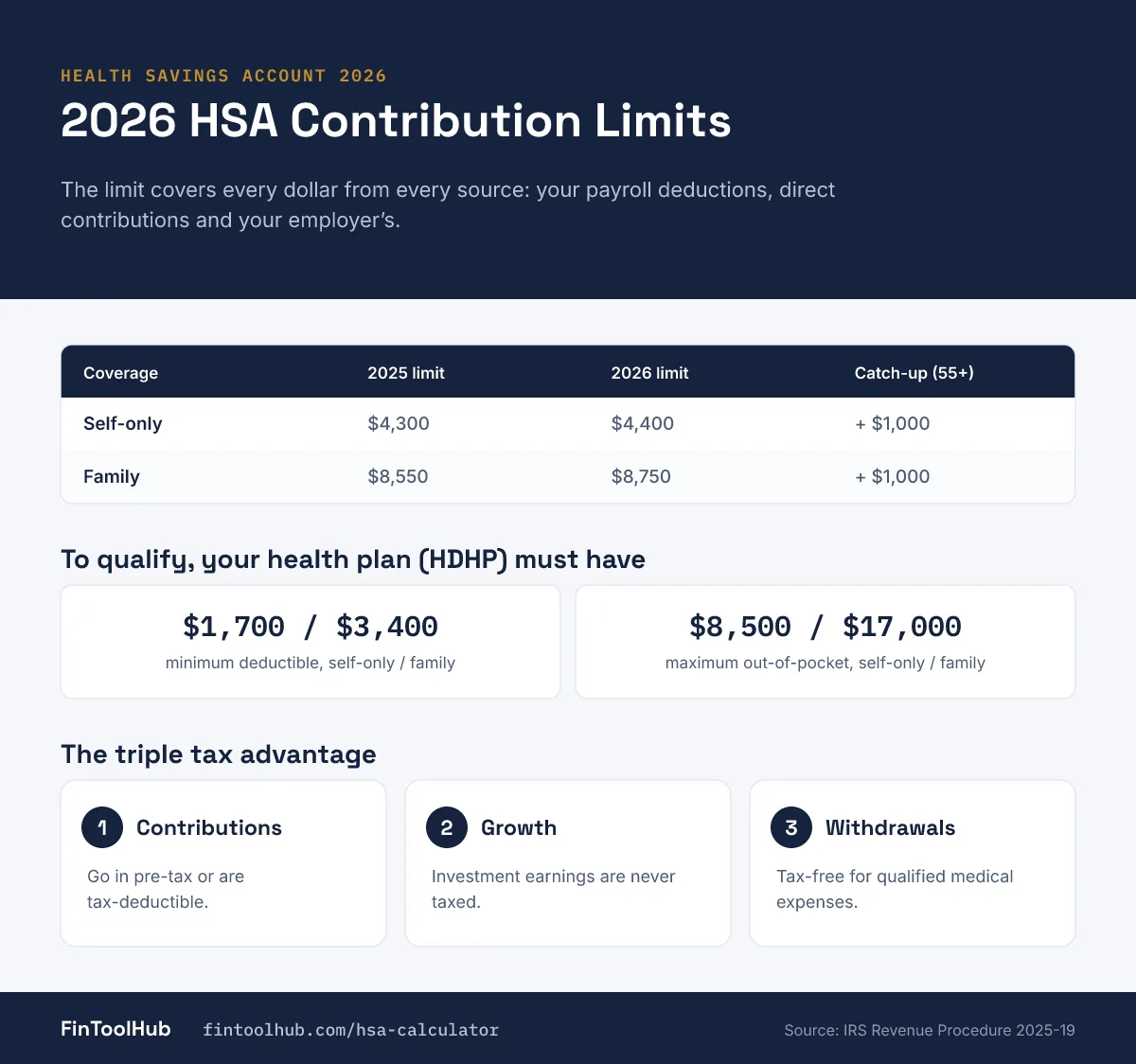
Per IRS Revenue Procedure 2025-19, the numbers behind every hsa calculator, hsa account calculator, and hsa contribution calculator search this year are:
| Coverage | 2025 limit | 2026 limit | Catch-up (55+) |
|---|---|---|---|
| Self-only | $4,300 | $4,400 | +$1,000 |
| Family | $8,550 | $8,750 | +$1,000 |
The limit covers every dollar from every source combined — your payroll deductions, direct contributions, and anything your employer kicks in. The $1,000 catch-up for age 55+ has been fixed by statute since HSAs began in 2004; it isn't inflation-adjusted like the base limits. To be HSA-eligible in 2026, your HDHP needs a minimum deductible of $1,700 self-only / $3,400 family, with an out-of-pocket maximum no higher than $8,500 / $17,000.
The triple tax advantage — and one exception worth knowing
An HSA is unique among tax-advantaged accounts: contributions go in pre-tax (or tax-deductible), growth is never taxed, and withdrawals for qualified medical expenses are never taxed either. But there's a real nuance an hsa tax deduction calculator or hsa deduction calculator search should account for — contributions made through payroll (a Section 125 cafeteria plan) skip income tax and the 7.65% FICA/payroll tax. Contributions you make directly and deduct yourself on Form 8889 reduce your income tax, but not FICA. If your employer offers payroll HSA contributions, routing money that way rather than depositing it yourself captures extra savings the deduction alone doesn't.
Using your HSA as a retirement account
An hsa calculator retirement or hsa investment calculator search usually reflects a real strategy: paying current medical bills out of pocket, investing the HSA balance instead of spending it, and letting decades of tax-free growth compound — sometimes called a "stealth IRA." After age 65, you can withdraw HSA funds for any reason without the early-withdrawal penalty; non-medical withdrawals are simply taxed as ordinary income, exactly like a traditional IRA. Before 65, non-qualified withdrawals face both income tax and a 20% penalty — a distinct calculation from what's above, covered fully by our HSA Withdrawal Penalty Calculator.
Calculating earnings on an excess contribution
The how to calculate earnings on excess hsa contributions question has a specific IRS-defined answer: the same Net Income Attributable (NIA) formula used for excess IRA contributions under Treas. Reg. §1.408-11.
You must withdraw the excess contribution and this calculated earnings amount by your tax filing deadline (including extensions) to avoid a 6% excise tax that otherwise applies every year the excess remains. The earnings portion is taxable, and if you're under 65, subject to an additional 10% penalty — but the excess contribution itself isn't taxed again if it was already included in income.
Contribution limits verified against IRS Revenue Procedure 2025-19. Excess contribution earnings formula referenced against Treas. Reg. §1.408-11, as applied to HSAs per IRS Notice 2004-2 and the instructions for Form 8889 and Form 5329. This is a planning estimate — your HSA custodian and a tax professional should confirm exact figures before you file. Official sources: IRS Rev. Proc. 2025-19; IRS Publication 969; IRS: Form 8889 instructions.
Frequently asked questions
Before you contribute, or before you correct an over-contribution.
How much can I contribute to my HSA in 2026?
$4,400 for self-only HDHP coverage or $8,750 for family coverage, plus an extra $1,000 if you're 55 or older. This limit includes all sources combined — your contributions, payroll deductions, and any employer contribution.
How do I calculate my HSA tax savings?
Multiply your own contribution by your marginal tax rate for a rough federal estimate. Payroll contributions also skip the 7.65% FICA tax; direct contributions you deduct yourself don't. Our dedicated HSA Tax Savings Calculator breaks this down fully across federal, FICA, and state taxes.
How do I calculate earnings on an excess HSA contribution?
Use the IRS Net Income Attributable (NIA) formula: excess contribution × [(adjusted closing balance − adjusted opening balance) ÷ adjusted opening balance]. Withdraw the excess plus this calculated earnings amount before your tax deadline to avoid the 6% excise tax.
Can I use my HSA like a retirement account?
Yes — many people invest their HSA balance and pay current medical costs out of pocket, letting the account compound for decades. After age 65, non-medical withdrawals are taxed as ordinary income with no penalty, similar to a traditional IRA.
What happens if I withdraw HSA funds for a non-medical expense before 65?
You'll owe ordinary income tax plus a 20% penalty on the withdrawn amount. After age 65, the 20% penalty no longer applies — you'd just owe ordinary income tax, the same as a traditional IRA withdrawal.