
Mortgage
Beyond the Basic Payoff Calculator: HELOC Acceleration, Reverse Mortgages, and Other Options
Paying extra on your mortgage isn't the only lever. Here's how HELOC-acceleration strategies and reverse mortgages actually compare — and why they're not even solving the same problem.
Two tools, two completely different goals
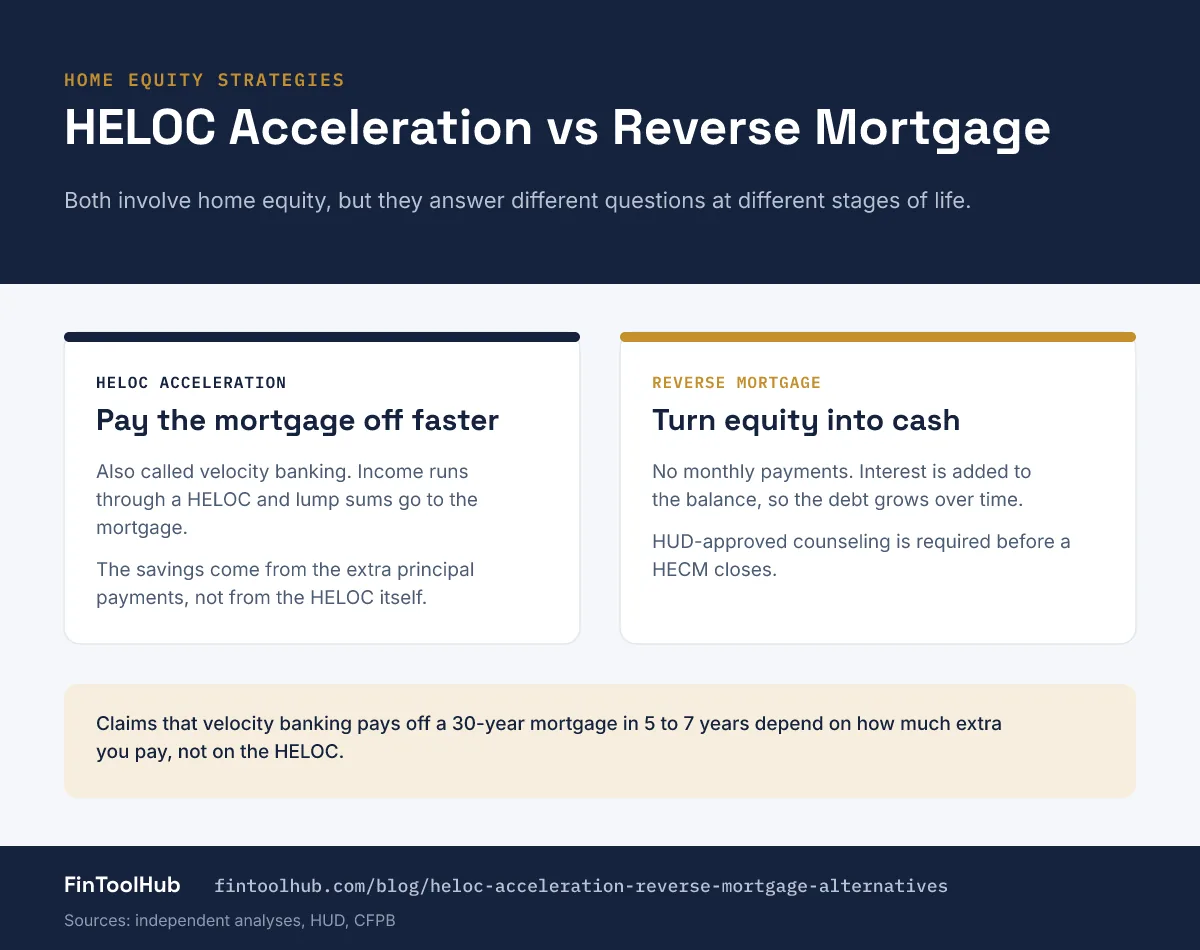
Before comparing anything, it's worth being clear about what each of these actually does. HELOC acceleration (also called "velocity banking") is a strategy for paying off your existing mortgage faster. A reverse mortgage does the opposite — it converts home equity into cash, growing your debt over time rather than shrinking it. They get mentioned in the same breath because both involve home equity, but they answer different questions for different people at different life stages.
HELOC acceleration ("velocity banking"): what it claims
The pitch, popularized heavily on social media and YouTube: route your paycheck directly into a HELOC instead of a checking account, pay your living expenses from the HELOC, and periodically make large lump-sum "chunk payments" toward your mortgage principal with the surplus. Because a HELOC charges interest on your average daily balance rather than a fixed monthly amount, proponents claim this "hub account" approach can pay off a 30-year mortgage in 5–7 years and save tens or even hundreds of thousands in interest.
What's actually happening underneath the strategy
Independent analysis of the mechanic — not just promotional material — converges on one consistent finding: the interest savings come from making extra principal payments, not from any special property of the HELOC itself. A HELOC can genuinely reduce interest cost versus a standard amortized mortgage when you route income through it, because of how daily-balance interest works — but that's a real, if modest, mechanical effect, not a loophole that multiplies your money. The bulk of the advertised savings is just the well-established effect of extra principal payments, which you can achieve directly, without a HELOC, a variable rate, or the added complexity.
There's also a real behavioral risk worth naming honestly: using a HELOC as your primary transaction account — the account your entire paycheck flows through — requires near-perfect discipline. A missed step, an unexpected expense, or a HELOC line reduction (lenders can and sometimes do reduce home equity lines when home values or credit conditions shift) can leave the strategy in worse shape than a simple extra-payment plan ever would.
Where a HELOC genuinely does help
There's a real, well-established use for a HELOC that's different from the mortgage-acceleration pitch: consolidating higher-rate consumer debt — credit cards, for instance — at a HELOC's typically lower rate, freeing up cash flow that can then go toward the mortgage. That's a straightforward interest-rate arbitrage with a clear mechanism, not a behavioral trick dressed up as one.
Verdict: not a scam, frequently oversold
Velocity banking isn't fraudulent — the underlying cash-flow mechanics are real and can produce a marginal interest advantage under the right rate conditions. But the dramatic "pay off your house in 5 years" claims mostly describe what disciplined extra principal payments already do on their own, without a variable-rate HELOC layered in. If the appeal is the psychological structure of using a "hub account," that's a legitimate personal preference — just don't mistake it for a special financial advantage the HELOC itself is providing.
Reverse mortgages: a completely different tool
A Home Equity Conversion Mortgage (HECM) — the federally insured reverse mortgage almost everyone means when they say "reverse mortgage" — lets homeowners 62 and older convert home equity into cash without a monthly mortgage payment. Instead of you paying the lender, the lender pays you: as a lump sum, a line of credit, monthly payments, or some combination. The loan balance grows over time as unpaid interest and mortgage insurance are added to it, and repayment is deferred until you sell, move out permanently, or pass away.
| 2026 HECM detail | Figure |
|---|---|
| Minimum age (youngest borrower/eligible spouse) | 62 |
| National lending limit (HUD Mortgagee Letter 2025-22) | $1,249,125 |
| Typical upfront costs | 4–6% of home value |
| First-year disbursement cap | 60% of principal limit (some exceptions apply) |
| Average proceeds accessed (FY2025) | ~$178,000 |
Because it's a non-recourse loan backed by FHA insurance, neither you nor your heirs will ever owe more than the home's value when it's repaid — even if the loan balance eventually exceeds it. That protection is real and meaningfully reduces the downside risk compared to a typical loan.
Mandatory HUD-approved counseling (generally required before closing) exists specifically to walk through this tradeoff before you commit — it's not a formality to skip past.
Other options worth knowing about
- Mortgage recasting — pay a lump sum toward principal and ask your lender to re-amortize your existing loan at the same rate and term, lowering your required monthly payment without a full refinance. Not all lenders offer it, and it usually carries a small flat fee, but it avoids refinancing costs and rate resets entirely.
- Refinancing to a shorter term — if you qualify for a good rate, moving from a 30-year to a 15-year mortgage structurally accelerates payoff and typically locks in a lower rate, without depending on your own month-to-month discipline the way an extra-payment plan does.
- A straightforward extra-payment plan — the least complicated option, and per the analysis above, the thing velocity banking is actually accomplishing underneath its own mechanics anyway.
HELOC acceleration analysis reflects consistent findings across multiple independent financial reviews of the strategy's mechanics. HECM figures verified against HUD Mortgagee Letter 2025-22 (2026 lending limit) and the National Reverse Mortgage Lenders Association's reported average proceeds figure. This is educational information, not personalized financial advice — a HUD-approved counselor is required before any HECM closing, and a fee-only financial planner can help evaluate whether either strategy fits your specific situation. Official sources: CFPB: Reverse mortgage loans; CFPB: What is a HELOC?.
Frequently asked questions
Before you open a HELOC or apply for a reverse mortgage.
Does HELOC acceleration (velocity banking) actually save money?
The savings largely come from making extra principal payments — something you can do directly without a HELOC. The HELOC itself adds a modest mechanical advantage under the right conditions, but also adds variable-rate risk and complexity that a direct extra-payment plan doesn't carry.
Is velocity banking a scam?
No — the underlying cash-flow mechanics are real. It's more accurate to call it frequently oversold: the dramatic payoff-time claims mostly describe what disciplined extra payments already achieve, not a special advantage unique to the HELOC structure.
Who actually qualifies for a reverse mortgage?
The youngest borrower (or eligible non-borrowing spouse) must be at least 62, the home must be your primary residence, you generally need significant equity, and you must complete HUD-approved counseling and pass a financial assessment confirming you can cover property taxes, insurance, and maintenance.
Can you lose your home with a reverse mortgage?
Yes, if you fall behind on property taxes, homeowners insurance, or required home maintenance — these obligations don't go away with a HECM, and defaulting on them can trigger foreclosure even though there's no monthly mortgage payment.
Is a reverse mortgage the opposite of paying off your mortgage faster?
In terms of your loan balance, yes — a reverse mortgage's balance grows over time as interest and insurance accrue, rather than shrinking with each payment. It's a tool for accessing retirement income from home equity, not a payoff-acceleration strategy.