
Travel & Tax
How to Get Your VAT Tax Refund When Traveling: A Global Blue Walkthrough
Shopping abroad? Here's how VAT refunds actually work, what Global Blue takes as a fee, and how to avoid missing the deadline at the airport.
What a VAT refund actually is
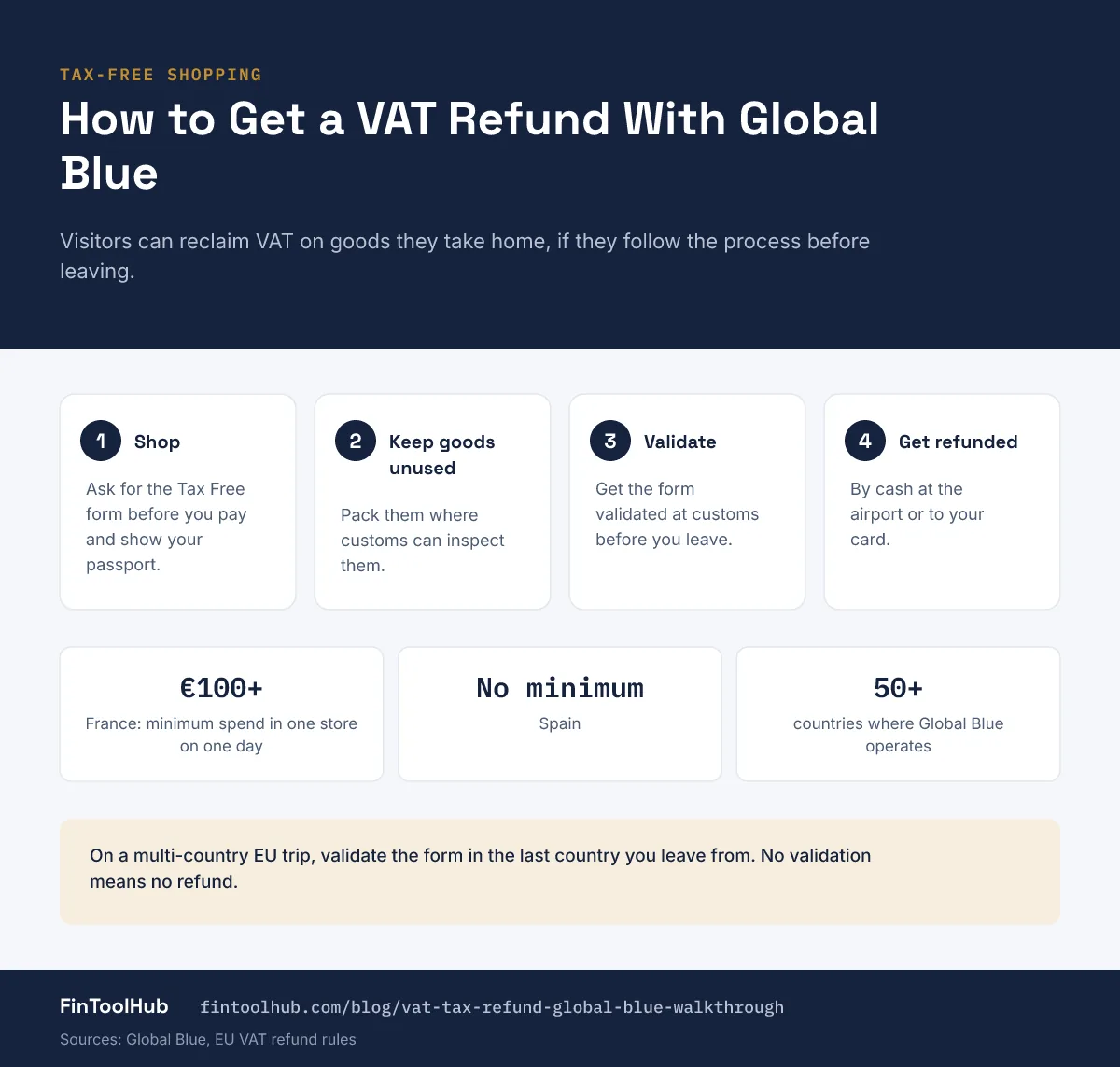
Most countries outside the US build a Value Added Tax (VAT) — typically 15% to 27% — directly into the sticker price of goods. Non-resident visitors who buy goods for personal export (not services, hotels, or meals — physical items you're taking home) can generally reclaim that VAT, provided they meet a minimum purchase threshold that varies significantly by country. France requires more than €100 spent in a single store on a single day; Spain has no minimum at all. Global Blue is the largest company handling this process worldwide, operating in 50+ countries — if you've shopped somewhere with a "Tax Free" sign in the window, there's a good chance their logo was on your paperwork.
The walkthrough: how the process actually works
- Shop at a participating store. Tell the salesperson you want to use the Tax Free / Global Blue option before you pay, and show your passport — many stores now scan it directly to generate the form.
- Keep the goods unused and accessible. Customs can ask to physically inspect the items, so pack them somewhere reachable, not buried in checked luggage, and don't use or unpack them before you leave.
- Validate the form before you leave the country (or the EU/Schengen area). This is done at an airport, port, or border customs point — often a digital kiosk (PABLO in France, DIVA in Spain) or a staffed desk. No validation stamp means no refund, full stop.
- Choose your refund method. Cash at an airport kiosk, credit card (typically several weeks to post), or in some countries, a fully digital process from start to finish.
There's also a purchase-to-export window — commonly around three months from the purchase date — after which the form typically can't be validated, even if you still have the goods and receipt.
What Global Blue actually keeps
This is the part that surprises most first-time users: the VAT rate printed on your receipt is not what lands back in your account. Global Blue's fee is commonly reported in the range of roughly 15% to 40% of the VAT amount itself (not the purchase price), with real user reports from France describing a specific breakdown: on a 20% VAT amount, Global Blue took approximately 28% as commission, then a further currency conversion fee (commonly 3–8% if you choose a refund in your home currency rather than local currency) plus a small fixed handling charge, before conversion at Global Blue's own exchange rate rather than the market rate.
None of this makes Global Blue disreputable — it's a legitimate, widely used service, and for many travelers it's the only option a given store supports. But going in expecting the full VAT rate back, rather than roughly half to two-thirds of it after fees, is where most of the disappointment comes from.
Cash vs. card refund: a real tradeoff
Cash at the airport is instant, which matters if you want the money before you fly. It also tends to carry its own handling fee on top of the base commission. A credit card refund usually avoids the cash-handling fee but takes weeks to actually post, and you're trusting the process to complete correctly after you've already left the country with no easy way to follow up in person.
Are there lower-fee alternatives?
Yes — a newer generation of digital VAT refund apps has entered the market specifically to undercut Global Blue and its longtime competitor Planet on commission, with some reporting effective fees closer to 15% of the VAT amount rather than 30–40%. The tradeoff is store coverage: these apps only work at retailers in their own network, which is currently much smaller than the decades-old reach of the two established players. For a single large purchase at a major retailer, it's worth asking at checkout whether more than one refund option is available before defaulting to whichever form the salesperson hands you first.
A practical checklist
- Confirm the store's minimum purchase threshold before you start shopping — thresholds vary by country and don't combine across stores.
- Keep every receipt and Tax Free form together, and photograph the stamped form immediately after validation — it's your only proof if the physical copy is lost in the mail.
- Arrive at the airport with extra time specifically for customs validation, especially if you're checking bags that contain the purchased goods.
- Validate in your last country before leaving the region, not your purchase country, on multi-country trips.
- Decide in advance whether speed (cash) or a marginally better net amount (card, no cash-handling fee) matters more to you.
Process details verified against Global Blue's publicly described shopper process and multiple independent VAT refund guides. Fee figures reflect commonly reported ranges from consumer reviews and traveler reports, since exact commission schedules are not consistently published by refund operators — treat specific percentages as illustrative, and confirm current fees at the point of purchase. This is general travel information, not tax or legal advice. Official sources: Your Europe (EU): VAT when shopping; Global Blue.
Frequently asked questions
Before your next trip abroad.
How much of my VAT will I actually get back?
Less than the full VAT rate — commonly reported estimates suggest an effective refund closer to 12-14% of your purchase price when the nominal VAT rate is 20%, after the refund operator's commission and any currency conversion fees are deducted.
What happens if I forget to get my form stamped at customs?
Generally, no stamp means no refund. Validation at customs before you leave the country (or the EU/Schengen region on a multi-country trip) is a hard requirement, not a formality you can skip or complete later.
Do I need to show the actual items I bought at customs?
You might — customs officers can ask to inspect the purchased goods to confirm they're unused and being exported, so keep them accessible rather than packed away in checked luggage.
Is cash or credit card better for a VAT refund?
Cash is faster but often carries its own handling fee on top of the base commission. Credit card refunds usually avoid that specific fee but take several weeks to post, with less ability to follow up once you've left the country.
Are there cheaper alternatives to Global Blue?
Yes — newer digital VAT refund apps often charge lower commissions, but they only work at retailers in their own network, which is smaller than Global Blue's decades-old reach. Worth asking at checkout whether an alternative is available before defaulting to the first form offered.