
Capital Gains
Capital Gains Tax on Inherited or Gifted Property — And What Changes If You Live Abroad
Inherited property gets a "stepped-up basis" that can erase most of your capital gains tax. Gifted property doesn't. That one difference — plus a few cross-border rules — determines whether you owe a little or a lot.
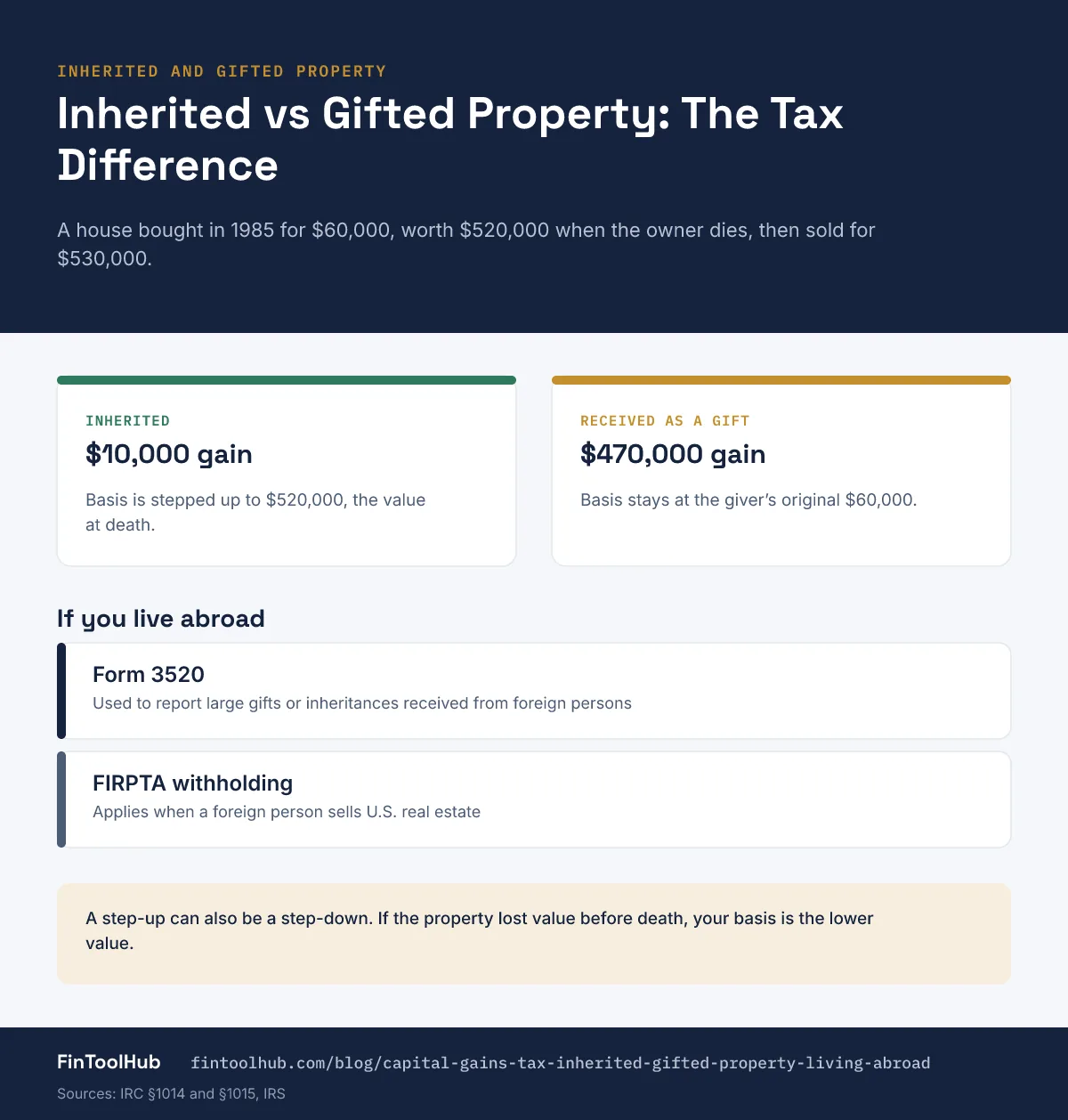
The single distinction that decides your tax bill
Inherited property gets its basis reset to fair market value on the date of death. Gifted property keeps the original owner's basis. That's the entire difference between owing very little capital gains tax and owing a lot, on the exact same property, transferred to the exact same person. Everything else in this article builds on that one rule.
Inherited property: the stepped-up basis
Under IRC §1014, when you inherit property, your cost basis becomes the property's fair market value on the date of the original owner's death — not what they originally paid for it. If the estate elects it (and it reduces the estate's value), an alternate valuation date six months later can be used instead. Either way, decades of appreciation that happened before you inherited the property essentially disappear from your future tax bill.
This is called a "step-up," but it can also be a "step-down" — if the property lost value before death, your basis is reduced to the lower fair market value, which can eliminate a loss the original owner would have been able to claim.
Gifted property: carryover basis (and a trap for losses)
Property you receive as a gift during the giver's lifetime works completely differently under IRC §1015: you generally inherit the giver's basis, not a fresh fair-market-value number. If your parent bought that same $60,000 house in 1985 and gifted it to you while still alive when it was worth $520,000, your basis is still $60,000 — the original purchase price plus any improvements they made. Sell it for $530,000, and your taxable gain is $470,000, not $10,000.
Same property, two very different outcomes
| Scenario | Your basis | Taxable gain on a $530,000 sale |
|---|---|---|
| Inherited (original cost $60,000, FMV at death $520,000) | $520,000 | $10,000 |
| Gifted during owner's lifetime (same $60,000 original cost) | $60,000 | $470,000 |
This is exactly why estate planning attorneys often advise holding highly appreciated property until death rather than gifting it early — the tax outcome for the eventual recipient can differ by hundreds of thousands of dollars on an identical asset. Once you know your actual basis, our Capital Gains Tax Calculator can run the rest of the numbers, including the §121 exclusion if the property becomes your primary residence, and current federal rates.
What changes if the property is abroad
If you're a US citizen or resident and you inherit or receive a gift of property located outside the US, one thing surprises almost everyone: the inheritance or gift itself is not taxable income to you under IRC §102, regardless of size. What you do have is a reporting obligation, not a tax bill — and the two get confused constantly.
Form 3520 must be filed if you receive more than $100,000 in aggregate during the year from a nonresident alien individual or foreign estate, or more than $20,573 (2026) from a foreign corporation or partnership. It's an informational return only — filing it doesn't create a tax bill by itself. But the penalty for not filing when required is real: 5% of the gift's value per month it's unreported, capped at 25% total.
Separately — and this is the part people forget — once you eventually sell that inherited or gifted foreign property, the gain is taxable on your US return like any other capital gain, because US citizens and residents are taxed on worldwide income. If you also pay capital gains tax to the country where the property is located, the Foreign Tax Credit generally lets you offset US tax with what you already paid abroad, so you're not fully taxed twice — though the mechanics depend on the specific tax treaty, if one applies.
What changes if you're a foreign seller of US property
The reverse scenario — a nonresident alien selling US real property, even property they inherited or received as a gift — runs into a completely different set of rules, centered on the Foreign Investment in Real Property Tax Act (FIRPTA).
- 15% withholding by default on the gross amount realized (the sale price), withheld by the buyer at closing — not the seller's actual tax liability, just a deposit against it.
- Reduced to 10% if the amount realized is $300,001–$1,000,000 and an individual buyer intends to use the property as a personal residence.
- Reduced to 0% (no withholding) if the amount realized is $300,000 or less, under the same residence-intent condition.
FIRPTA withholding applies even when the property changes hands as a gift or through an estate, not just a sale for cash — a detail that catches families off guard when transferring US property to non-citizen relatives. The seller reconciles the actual tax owed by filing Form 1040-NR; if the 15% withheld exceeds the real tax on the gain, the difference comes back as a refund, though often not quickly.
A practical checklist
- Determine whether the property was inherited (stepped-up basis) or gifted during the owner's lifetime (carryover basis) — this decides your starting basis.
- If gifted and currently worth less than the giver's basis, note the dual-basis rule before assuming you can claim a loss.
- If the property is or was located abroad, check whether you crossed the Form 3520 reporting threshold — even though no income tax is owed on the receipt itself.
- If you're a nonresident alien selling US property, expect FIRPTA withholding at closing regardless of your actual gain, and plan to file a US return to reconcile it.
- Run the actual capital gains number once your basis is confirmed — our Capital Gains Tax Calculator and Rental Property Capital Gains Calculator cover the primary-residence and depreciation-recapture scenarios respectively.
Basis rules verified against IRC §1014 (inherited property) and §1015 (gifted property). Foreign gift/inheritance reporting verified against IRS.gov: Gifts from Foreign Person and the Form 3520 instructions. FIRPTA withholding verified against IRS.gov: FIRPTA Withholding. This is educational information, not tax or legal advice — cross-border estate and gift situations should be reviewed by a CPA or tax attorney familiar with the specific countries involved, since treaties can change these results.
Frequently asked questions
Before you sell what you inherited or were given.
Do I pay capital gains tax on inherited property?
Only on appreciation that happens after you inherit it. Your basis is reset to the property's fair market value on the date of death, so gain is calculated from that value forward, not from what the original owner paid decades earlier.
Is gifted property taxed the same way as inherited property?
No. Gifted property carries over the giver's original basis rather than resetting to fair market value, which typically means a much larger taxable gain when you eventually sell, compared to the same property inherited instead.
Do I owe US tax on an inheritance from a relative living abroad?
No income tax is owed on the inheritance itself. You may need to report it on Form 3520 if it exceeds $100,000 (from an individual or estate) or $20,573 in 2026 (from a foreign corporation or partnership) — but that's a reporting requirement, not a tax bill.
What happens if I don't report a large foreign inheritance?
The penalty for failing to file Form 3520 when required is 5% of the gift's or bequest's value per month it goes unreported, up to a maximum of 25% — even though the underlying transfer itself was never taxable income.
What is FIRPTA and does it apply to inherited property?
FIRPTA requires a buyer to withhold 15% of the sale price (sometimes 10% or 0% for lower-value residential purchases) when a foreign person sells US real property. It applies to inherited or gifted property transfers as well, not just cash sales, whenever the seller is a nonresident alien for US tax purposes.