
Tax & Paycheck
Sales Tax, Vehicle Tax, and Transfer Tax by State: The Complete Guide
Three different transaction taxes, three different rulebooks, and almost no state uses the same rate for all three. Here's how each one actually works — and which states are the real outliers.
Three taxes, not one
"Sales tax," "vehicle tax," and "transfer tax" get used almost interchangeably in everyday conversation, but they're three legally distinct taxes, often with completely different rates, exemptions, and even different states choosing to levy them at all. A state with no general sales tax can still charge a hefty real estate transfer tax. A state with a high sales tax can exempt vehicle trade-ins entirely. There's no shortcut — each one needs its own explanation.
Sales tax by state
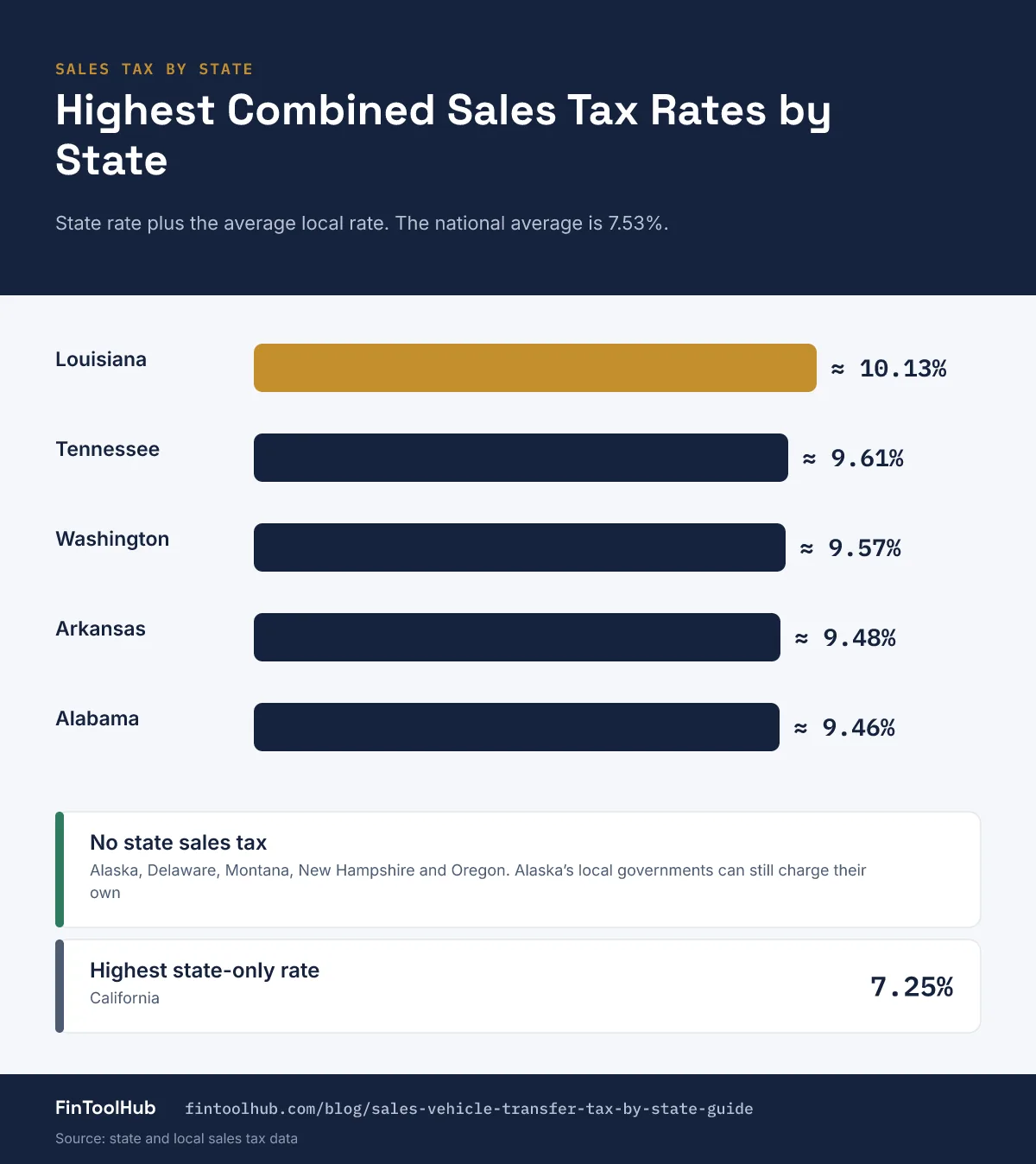
Every state sales tax bill has up to two layers: a statewide rate set by the legislature, and local rates added by cities, counties, and special districts on top. What you actually pay at checkout is the combined rate — and it varies enormously by state.
| Category | States / rate |
|---|---|
| No state sales tax | Alaska, Delaware, Montana, New Hampshire, Oregon |
| Highest combined (state + avg. local) | Louisiana ~10.13%, Tennessee ~9.61%, Washington ~9.57%, Arkansas ~9.48%, Alabama ~9.46% |
| Highest state-only rate | California, 7.25% |
| National average (population-weighted, combined) | 7.53% |
Of the five "no sales tax" states, four are genuinely tax-free at every level: Delaware, Montana, New Hampshire, and Oregon. Alaska is the exception — the state itself charges nothing, but local municipalities are free to impose their own sales taxes, and many do, with some areas reaching 7%+.
One mechanic worth knowing if you shop or sell across state lines: states use either destination-based sourcing (tax is based on the buyer's location — used by most states, including California, New York, and Florida) or origin-based sourcing (tax is based on the seller's location — used by Texas, Pennsylvania, Ohio, and Virginia, among others). This matters most for online and mail-order purchases.
Vehicle sales tax by state
Vehicle purchases generally follow a state's general sales tax rules, with a few state-specific twists that matter more for cars than for everyday purchases:
- Trade-in credit varies. Most states only tax the difference between the new car's price and your trade-in value — buy a $30,000 car and trade in a $10,000 vehicle, and you're taxed on $20,000, not $30,000. A handful of states tax the full purchase price regardless of trade-in, which meaningfully changes the math on a trade-heavy deal. Confirm your specific state's rule before assuming the discount applies.
- The five sales-tax-free states generally don't tax vehicle purchases either — which is part of why "Montana LLC" vehicle registration is a widely discussed (and increasingly scrutinized) strategy: some out-of-state buyers of high-value vehicles or RVs register them through a Montana-based LLC to access Montana's lack of sales tax, even though they don't live there. Several states have tightened enforcement against residents using this structure to avoid their home state's tax, and it carries real legal and insurance complications — this is worth professional advice, not a DIY move.
- Some states tax vehicles annually, not just at purchase. A handful of states (Virginia and Connecticut among them) levy an ongoing personal property tax on vehicles you own, separate from the one-time sales tax paid at purchase — an ongoing cost many new residents don't expect.
Real estate transfer tax by state
A transfer tax (also called a deed tax, conveyance tax, documentary stamp tax, or realty transfer tax depending on the state) is charged when real property changes hands — typically a percentage of the sale price, paid at closing. Unlike sales tax, there's no consistent rule for who pays it: state law sometimes specifies buyer or seller, and in many places it's negotiated or split by local custom.
| Category | Detail |
|---|---|
| Highest fixed rate | Delaware, 2.5% (state + county combined) |
| Highest progressive rate | Washington State, up to 3% on higher-value sales |
| Lowest rate among states that charge it | Alabama, Georgia, Illinois, Kentucky, South Dakota — around 0.1% |
| States with no state-level transfer tax | Roughly 13–16 states, depending on source — commonly cited: Alaska, Arizona, Colorado, Idaho, Indiana, Kansas, Louisiana, Mississippi, Missouri, Montana, New Mexico, North Dakota, Oregon, Texas, Utah, Wyoming |
New York City and New York State layer a tiered "mansion tax" on top of the standard transfer tax for homes sold above $1 million, with the rate climbing further above $2 million — a good example of how transfer tax structures can get considerably more complex in high-value markets than the base state rate suggests.
If you're structuring a sale — including an owner-financed one — our Seller Financing Calculator and Capital Gains Tax Calculator can help with the two numbers that typically matter more than transfer tax itself: the financing payment and the capital gains tax on the sale.
This is a living guide
State and local rates change constantly — more often than most people realize, sometimes multiple times a year at the local level. Rather than freeze a single "final" number for every state in this article, we're building dedicated calculators for each of these tax types, starting with the ones already live below, with more state-specific tools rolling out over time.
Sales tax figures sourced to Tax Foundation, State and Local Sales Tax Rates (2026, midyear update). Transfer tax figures sourced to PropertyShark's 2026 real estate transfer tax survey. Rates and exemptions change frequently — always confirm current figures with your state's Department of Revenue before a transaction. This is educational information, not tax advice.
Frequently asked questions
Before you assume one rate applies to everything.
What states have no sales tax?
Alaska, Delaware, Montana, New Hampshire, and Oregon. Of these, only Delaware, Montana, New Hampshire, and Oregon are tax-free at every level — Alaska allows local municipalities to charge their own sales tax.
Is vehicle sales tax the same as general sales tax?
Usually based on the same state rate, but with state-specific rules around trade-in credits, and in a few states, an additional ongoing personal property tax on vehicles that general sales tax doesn't have.
Which state has the highest real estate transfer tax?
Delaware has the highest fixed rate at 2.5%. Washington State's progressive rate can reach as high as 3% on higher-value sales.
Do all states charge a real estate transfer tax?
No — a significant number of states (commonly cited as 13 to 16, depending on the source) charge no state-level transfer tax, though counties or cities within those states can sometimes still impose their own.
Who pays the transfer tax, the buyer or the seller?
It depends on the state and sometimes the specific city — some states assign it by law, others leave it to local custom or negotiation between buyer and seller, and a few jurisdictions split it between both parties by a set formula.