
Debt & Savings
Dave Ramsey's Debt Snowball and Emergency Fund Rule: Do They Actually Work?
The math behind paying off your smallest debt first, and why a $1,000 starter emergency fund might be too small in 2026 — evaluated against the actual research, not just the pitch.
Two separate claims, two separate questions
Dave Ramsey's "7 Baby Steps" bundle a lot of financial advice together, but two specific pieces get argued about constantly: Baby Step 2, the debt snowball (pay your smallest balance first, regardless of interest rate), and Baby Step 1, the $1,000 starter emergency fund. They're different claims that deserve different evidence — one is a behavioral question, the other is closer to a purchasing-power question. Here's what the actual research and current data say about each.
The debt snowball: what the spreadsheet says
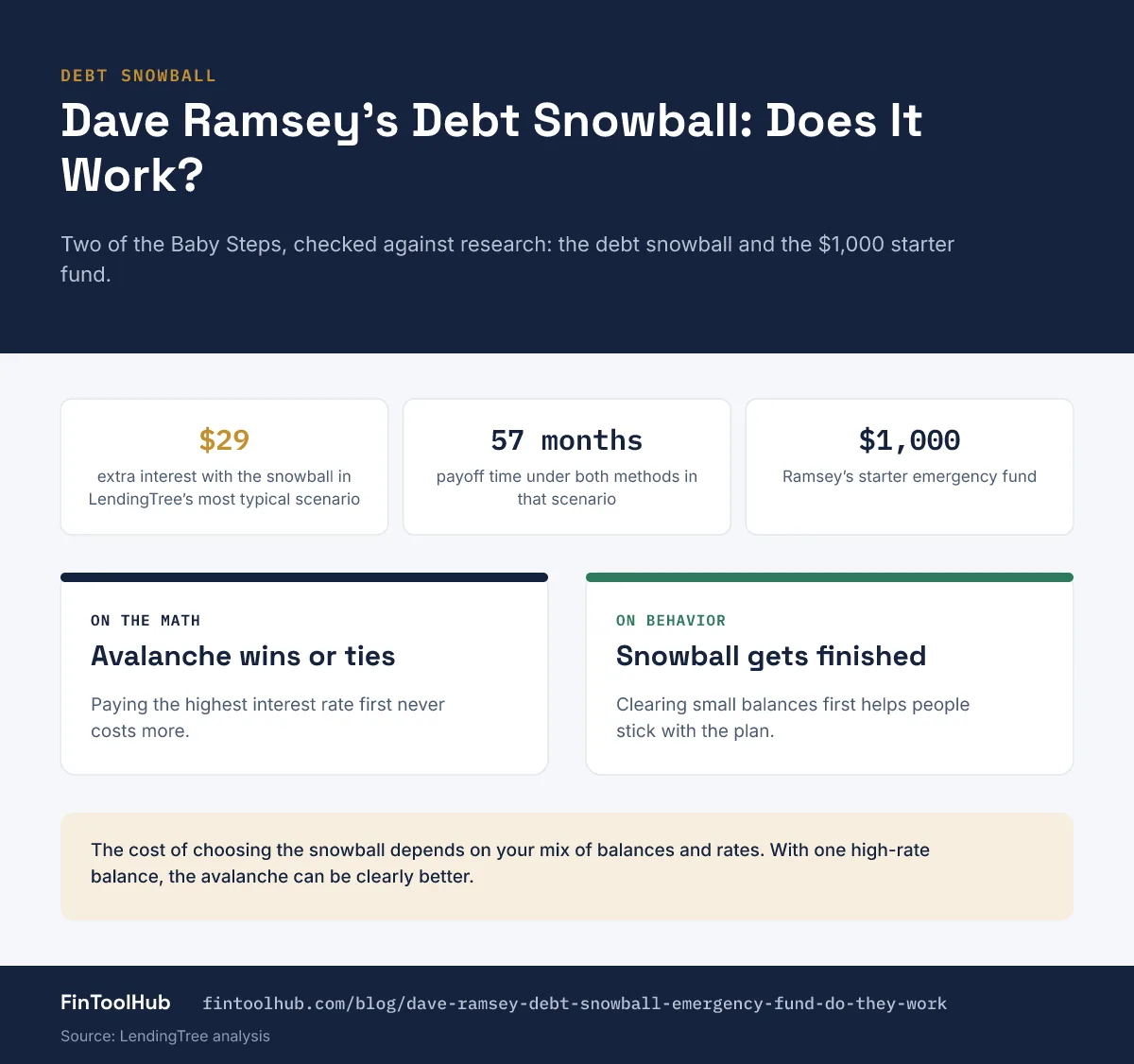
On pure math, the debt snowball never beats the debt avalanche (highest interest rate first) — avalanche is mathematically optimal or, at worst, tied. That's not in dispute. What's less well known is how much the snowball actually costs you in a typical situation. LendingTree modeled several realistic consumer debt loads and found the gap is often much smaller than people assume — in their most representative scenario (average credit card, personal loan, auto loan, and student loan balances combined), the two methods differed by just $29 in total interest, over an identical 57-month payoff timeline.
That's not universal — LendingTree also found scenarios where a high-rate balance made avalanche clearly better by a meaningful margin. The honest takeaway: the size of the "cost" of choosing snowball over avalanche depends entirely on your specific mix of balances and rates, and for many typical households, it's smaller than the intensity of the online debate around it would suggest.
The debt snowball: what the behavioral research says
The snowball's real case isn't mathematical — it's behavioral, and there's genuine peer-reviewed research behind it, not just anecdote. A study published in the Journal of Consumer Research (Kettle, Trudel, Blanchard, and Häubl, 2016) found that people who concentrated payments on individual accounts — closing them out one at a time — were more likely to eliminate their total debt than people who spread payments proportionally across all their balances. A separate paper in the Journal of Marketing Research (Gal and McShane, 2012) reached a related conclusion: consumers who tackled smaller debts first showed stronger follow-through.
Put plainly: a mathematically perfect plan you abandon after four months loses to an imperfect plan you actually finish. The snowball's early "wins" — a fully closed account, not just a lower balance — appear to genuinely help some people stay consistent long enough to finish, which is worth more than a modest interest savings if the alternative is quitting halfway through.
Verdict: the snowball is a legitimate behavioral tool, not a math trick
It's fair to call the debt snowball mathematically suboptimal. It's not fair to call it irrational — there's real published research behind the idea that completing individual accounts drives follow-through better than optimizing for the smallest total interest bill. Whether it's right for you depends on whether you're the kind of saver who needs visible milestones to stay motivated, or someone who'll stick with a plan regardless of how the wins are sequenced.
The $1,000 emergency fund: what Ramsey says it's actually for
Ramsey has faced renewed criticism recently — including from his own audience — over whether $1,000 still means anything after more than three decades of inflation since the figure was first popularized in the early 1990s. His response, stated directly and repeatedly in recent public commentary, is that the number was never intended to function as a real safety net. He's described it as a deliberately small buffer meant to prevent a minor setback from becoming new debt while someone works through the debt snowball — explicitly calling it part of a behavior-modification program, not a comprehensive emergency fund. The full 3–6 months of expenses arrives later, as Baby Step 3, only after all non-mortgage debt is gone.
Critics counter that "never meant to be enough" doesn't fully answer the inflation question — commentators have pegged the 2026 inflation-adjusted equivalent of the original figure somewhere between roughly $1,800 and $2,000, depending on the base year used, and argue that a genuinely common repair (a water heater, an alternator) can now exceed $1,000 on its own, undermining the "small buffer" framing.
The $1,000 emergency fund: what the current data says
Whatever the "right" number is, the data on why any buffer beats none is not in dispute. Bankrate's research has found that 59% of Americans don't have enough savings to cover a $1,000 emergency expense at all, and separately, that roughly one in three U.S. adults had to dip into emergency savings in the past year. On the more comprehensive 3–6 month target, Bankrate's most recent Annual Emergency Savings Report found that while 85% of respondents believe they need at least three months of expenses to feel secure, 63% believe they actually need more than that — up to six months, aligning with Ramsey's own Baby Step 3 target rather than his Step 1 figure.
Verdict: defensible as a first step, genuinely too small as a real safety net
Ramsey's own framing — that Step 1 is a psychological milestone, not a finished emergency fund — holds up as a description of intent. Where the criticism lands is on communication: a figure frozen for over 30 years while typical repair and replacement costs have risen substantially is a real, measurable gap, not just an inflation-adjustment nitpick. Our Emergency Fund Calculator uses essential monthly expenses rather than a fixed dollar figure — for many households, even a 1-month cushion is a larger, more individually accurate number than $1,000, while still functioning as the same kind of early, motivating milestone Ramsey is describing.
Behavioral debt-payoff research: Kettle, K.L., Trudel, R., Blanchard, S.J., & Häubl, G. (2016), "Repayment Concentration and Consumer Motivation to Get Out of Debt," Journal of Consumer Research, 43(3); Gal, D. & McShane, B. (2012), Journal of Marketing Research. Payoff-cost comparison: LendingTree's debt avalanche vs. debt snowball study. Emergency savings data: Bankrate's Annual Emergency Savings Report and CFPB emergency savings research. This is an evaluation of publicly available advice and research, not a personal endorsement or criticism of any individual — and not personalized financial advice.
Frequently asked questions
Before you pick a plan and stick with it.
Is the debt snowball actually worse than the debt avalanche?
Mathematically, yes — avalanche is optimal or tied on total interest paid. But the gap is often smaller than expected for typical consumer debt loads, and peer-reviewed research shows snowball users are more likely to actually finish paying off their debt, which can matter more than the interest difference.
Is there real research behind the debt snowball's behavioral advantage?
Yes — studies published in the Journal of Consumer Research (2016) and Journal of Marketing Research (2012) both found that concentrating payments on individual accounts, rather than spreading them proportionally, was associated with a higher likelihood of eliminating total debt.
Why does Dave Ramsey still recommend only $1,000 for a starter emergency fund?
He has said publicly that the figure was never meant to be a complete safety net — it's designed as a small, deliberately uncomfortable buffer to maintain momentum during debt payoff, with the full 3-6 month emergency fund coming later as a separate step.
Is $1,000 enough for an emergency fund in 2026?
As a complete safety net, most financial researchers would say no — critics estimate the inflation-adjusted equivalent is closer to $1,800-$2,000. As a first psychological milestone before building a fuller fund, the case for a small starting target still has support, even if the specific number is debated.
What matters more: the exact method, or actually starting?
The research consistently points to consistency over optimization — both the debt payoff and emergency savings research show that people who start and stick with an imperfect plan outperform those who wait for or abandon a "perfect" one.