
Home Insurance
How Is Home Insurance Actually Calculated? Replacement Cost, Contents, and the 80% Rule
Your premium isn't based on what you paid for your house. Here's what insurers actually calculate — and why underinsuring by even 20% can cost you the whole claim, not just part of it.
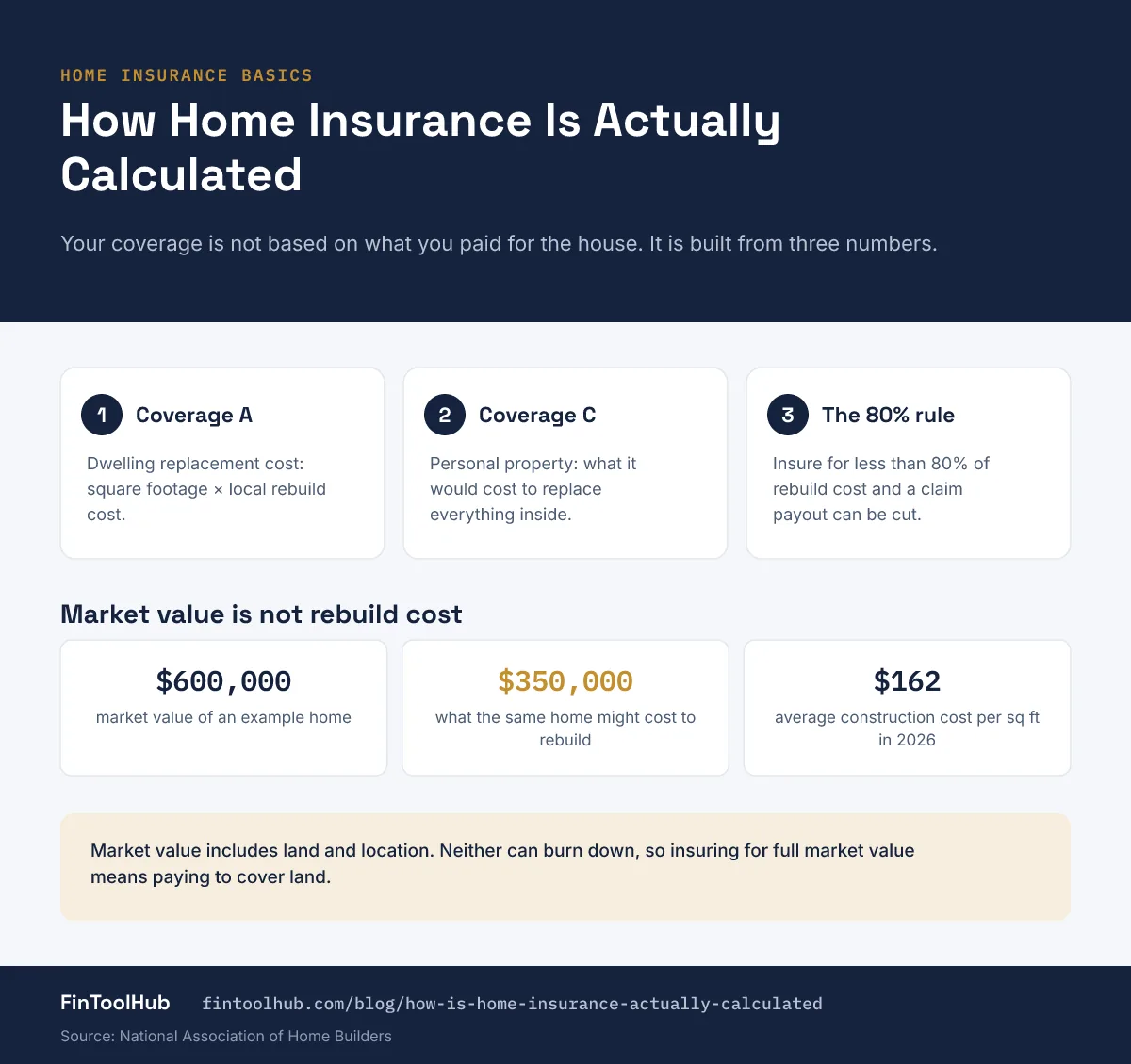
Two calculations, not one
Ask most homeowners how their insurance coverage amount was set, and they'll guess it's tied to their purchase price or their home's current market value. It isn't. A homeowners policy is actually built from two separate calculations that have nothing to do with what you paid: dwelling replacement cost (Coverage A — what it costs to rebuild the structure) and personal property value (Coverage C — what it costs to replace everything inside it). A third number, the 80% rule, determines what happens to your payout if either of those first two numbers turns out to be wrong.
Get any one of the three wrong, and the gap doesn't show up until the worst possible moment — when you're filing a claim after a fire, storm, or theft.
How dwelling replacement cost is calculated
Replacement cost is your home's square footage multiplied by the local cost per square foot to rebuild, adjusted for construction quality and features. Per the National Association of Home Builders, the 2026 national average construction cost is about $162 per square foot — but that average hides a wide range, from roughly $100 to $250+ depending on region and finish level, with some high-cost states running well above $300.
Insurers layer in a few adjustments on top of the base square-footage math: number of stories, roofline complexity, foundation type, and interior finish quality (economy, standard, premium, or luxury-grade materials) all move the number, sometimes significantly. Our Home Insurance Replacement Cost Calculator walks through each of these adjustments and gives you a working estimate in a couple of minutes.
The 80% rule: why "close enough" isn't
Most standard homeowners policies require you to insure your home to at least 80% of its full replacement cost. Fall below that line, and your insurer doesn't just refuse to pay for the shortfall — they proportionally reduce every claim payout, including partial losses, not just total losses. The formula:
Worked example: replacement cost is $200,000, so the 80% threshold is $160,000. Insured for only $150,000 and you file a $50,000 partial-loss claim? The insurer pays 93.75% of it — $46,875 — and you cover the remaining $3,125 out of pocket, even though the damage itself was nowhere near a total loss.
That mechanic is exactly why "underinsuring by 20%" is such a costly mistake — it doesn't cost you 20% of your payout. Depending on how far below the threshold you are, it can meaningfully shrink every claim you ever file on the policy, for as long as the gap exists.
This isn't theoretical — real claims data backs it up
Researchers at the University of Colorado Boulder analyzed thousands of policyholders who filed claims after the 2021 Marshall Fire near Boulder and found 74% were underinsured — more than a third fell short by 25% or more of what they actually needed to rebuild. A separate analysis of California wildfire claims found average coverage of roughly $591,000 against an actual average rebuild cost of about $757,000, largely because post-disaster material and labor prices spiked well above pre-fire estimates. Rebuild costs tend to jump precisely in the moment you need coverage most — everyone in a disaster-hit area needs the same contractors and materials at the same time, which is exactly why "extended" or "guaranteed" replacement cost riders (often 10–25% above your stated limit) exist as a buffer.
How contents (Coverage C) is calculated — and where it gets tricky
Personal property coverage is usually set automatically as a percentage of your dwelling coverage — commonly 50% to 70%, though some insurers default lower (30–50%) and a few go as high as 75%. That default is a starting point, not a guarantee it matches what you actually own; a real inventory, added up category by category, is the only way to know for sure.
One detail that catches people off guard: unlike dwelling coverage, which typically defaults to full replacement cost, personal property coverage commonly defaults to actual cash value (ACV) instead — meaning your payout factors in depreciation. A six-year-old sofa is reimbursed at what a six-year-old sofa is worth, not what a new one costs. Replacement cost coverage for contents is usually available as an upgrade, worth asking about.
Our Home Contents Insurance Calculator builds a category-by-category inventory and checks it against both your actual coverage limit and those sub-limits specifically.
What actually sets your premium
Replacement cost and contents value are the foundation — a bigger, more expensive-to-rebuild home costs more to insure, all else equal — but they're not the whole premium calculation. Insurers layer on genuine risk-based pricing factors on top:
- Location risk — wildfire, hurricane, flood, and hail exposure, plus local crime rates and proximity to fire protection resources.
- Construction details — your roof's age and material, the home's age, and the materials used in construction all affect both risk and rebuild cost.
- Claims history — both your personal claims history and the property's own claims history can move your rate.
- Credit-based insurance score — used in most states as a rating factor, though a handful of states prohibit or restrict this practice.
- Your chosen deductible and coverage limits — a higher deductible lowers your premium; added endorsements (extended replacement cost, scheduled valuables) raise it.
- Discounts — bundling with auto insurance, security systems, and a claims-free history are the most common levers you control directly.
In other words: replacement cost and contents value set the ceiling of what you'd need to be paid out in a total loss. Everything above is what determines what you pay to secure that ceiling.
A quick way to check your own numbers
- Run your square footage and local rebuild cost through the Replacement Cost Calculator and compare the result to your policy's Coverage A limit.
- Build a rough category inventory in the Home Contents Insurance Calculator and check it against your Coverage C limit — and specifically against jewelry/valuables sub-limits.
- If either number reveals a real gap, call your agent before your next renewal, not after a claim.
And if a gap does exist between what you're insured for and what you'd actually need, an emergency fund is the practical backstop for the portion a coinsurance penalty or a sub-limit wouldn't cover — worth having regardless of how well-insured you are.
National average construction cost sourced to the National Association of Home Builders (2026). Underinsurance research: University of Colorado Boulder's analysis of Marshall Fire claims data, as reported by NerdWallet. This is educational information, not insurance advice — confirm your specific coverage needs with your insurer or a licensed appraiser.
Frequently asked questions
Before your policy renews.
Is home insurance based on what I paid for my house?
No. It's based on replacement cost — what it would cost to rebuild the structure today — which is often very different from your purchase price or current market value, since market value includes land and neighborhood factors that don't need to be insured.
What is the 80% rule in home insurance?
Most policies require you to insure your home to at least 80% of its replacement cost. Fall below that threshold, and your insurer proportionally reduces every claim payout, including partial losses — not just total losses.
How is personal property (contents) coverage calculated?
Usually as a default percentage of your dwelling coverage — commonly 50-70% — though that default may not match what you actually own. A real inventory, category by category, is the only way to know for sure, and certain categories like jewelry carry their own separate sub-limits regardless of your total contents coverage.
Why did my premium go up even though my coverage didn't change?
Premiums respond to more than your coverage amount — local rebuild costs, your claims history, your credit-based insurance score (where used), and broader risk factors like regional wildfire or storm activity can all shift your rate even with an unchanged policy.
How do I know if I'm underinsured?
Compare your dwelling coverage limit to a current replacement cost estimate, and compare your personal property limit to an actual inventory of your belongings. A meaningful gap in either direction is worth raising with your agent before you need to file a claim.