
Loan & Finance Calculators
Roof Financing Calculator
Compare monthly payments across personal loans, HELOCs, contractor 0% promos, and FHA Title I loans — plus a real check on what a missed 0% promo deadline actually costs.

Calculate your roof financing payment
Pick a financing type to auto-fill a typical rate, then adjust to your actual quote.
Principal & interest only. Typical rates as of 2026: personal loans ~8–24% APR, HELOC/home equity ~7–10% APR, FHA Title I ~7–9% APR, contractor promos often 0% for 12–24 months. Confirm your actual quote — these are planning defaults, not an offer.
Deferred-interest risk check
If you're using a "0% promo," this is the number that matters most — what happens if you don't pay it off in time.
This is how genuine "deferred interest" plans work: miss the deadline by even $1, and interest is charged retroactively on the original loan amount from day one — not just on what's left. Always confirm with the lender whether your promo is "deferred" (retroactive) or "waived" (you only owe interest going forward) before you sign.
What a roof actually costs, and what financing changes
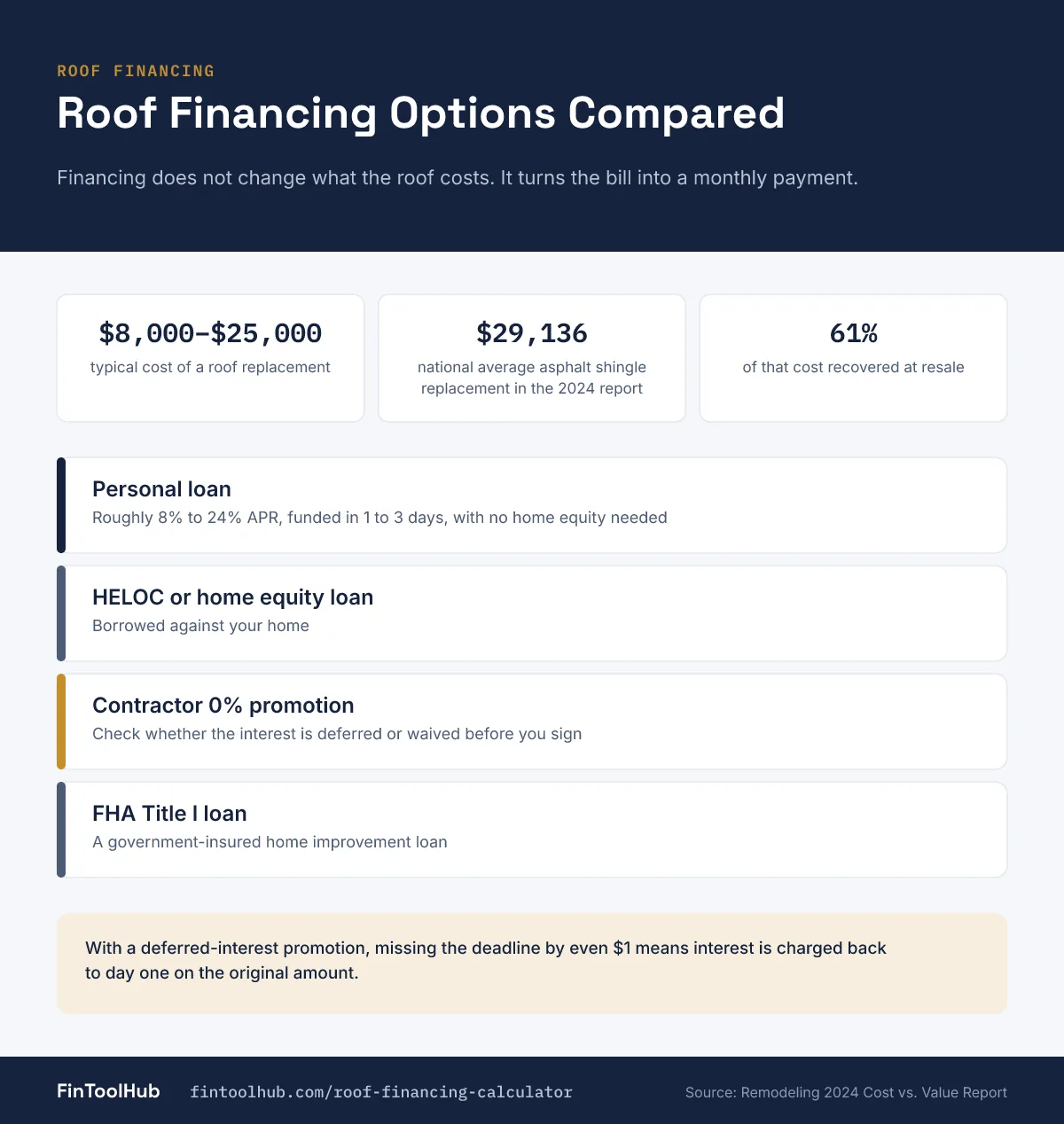
Most roof replacements run $8,000 to $25,000, with the average financed project landing around $12,000–$16,000. The Remodeling 2024 Cost vs. Value Report puts the national average asphalt shingle roof replacement at $29,136, recovering about 61% of that cost at resale — a useful benchmark, though your actual number depends heavily on roof size, material, pitch, and local labor costs. A roof financing calculator or roof finance calculator doesn't change that total cost; it turns a number most households don't have sitting in checking into a monthly payment you can actually budget against.
Comparing your financing options
| Option | Typical rate | Funding speed | Best for |
|---|---|---|---|
| Personal loan | ~8–24% APR | 1–3 days | Speed, no home equity needed |
| HELOC / home equity loan | ~7–10% APR | 2–6 weeks | Lowest long-term rate, if you have equity |
| Contractor 0% promo | 0% during promo, 18–29% after | Minutes to approve | Cheapest option only if paid off in time |
| FHA Title I | ~7–9% APR | 1–3 weeks | Limited equity, credit scores as low as 580 |
FHA Title I is worth knowing about specifically because it's federally backed (administered by HUD) and doesn't require home equity for loans up to $25,000 on a single-family primary residence — loans under $7,500 don't even need an appraisal. It fills a real gap for recent buyers or anyone in a market where home values haven't risen much.
The deferred-interest trap, with real numbers
A 0% APR contractor promo is genuinely free money — if you pay off the entire balance before the promotional period ends. If you don't, most of these plans use a "deferred interest" structure, not a "waived interest" one, and the difference is expensive: deferred interest is calculated on your original loan amount, for the entire promotional period, at the regular APR — not just on whatever balance happens to be left.
Before signing any 0% promo, ask the lender directly: is this deferred interest or waived interest? A waived-interest plan only charges interest on the remaining balance going forward from the deadline — a real difference in a worst-case scenario, and worth getting in writing.
Is roof financing interest tax deductible?
It depends entirely on how you financed it. HELOC and home equity loan interest can be deductible when the funds are used to substantially improve the home securing the loan — a roof replacement typically qualifies, subject to the usual mortgage interest deduction limits, so confirm with a tax professional. Personal loan interest is generally not deductible. One thing worth knowing directly: the federal Section 25C Energy Efficient Home Improvement Credit expired December 31, 2025 — roof work completed in 2026 is not eligible for that federal credit, regardless of materials used, unless bundled with qualifying energy efficiency upgrades under a separate program.
Roof replacement cost benchmark sourced to the Remodeling 2024 Cost vs. Value Report. Deferred-interest mechanics and FHA Title I program details cross-verified against multiple independent 2026 roof-financing guides and HUD program descriptions. This is a planning estimate — actual rates, terms, and promotional structures depend on your lender and credit profile.
Frequently asked questions
Before you sign a financing agreement with your roofer.
What's the best way to finance a new roof?
It depends on your priorities: a HELOC or home equity loan typically offers the lowest rate if you have equity, a personal loan is fastest if you need funds quickly with no equity, and a contractor 0% promo is cheapest only if you're confident you can pay it off within the promotional period.
What is deferred interest, and why does it matter?
On a deferred-interest promotional plan, if any balance remains when the promo period ends, interest is charged retroactively on the entire original loan amount for the full promotional period — not just on the remaining balance. This can add thousands of dollars in interest from missing a deadline by a small amount.
How do I know if my 0% offer is deferred or waived interest?
Ask the lender directly and get it in writing. A waived-interest plan only charges interest going forward from the deadline if a balance remains; a deferred-interest plan charges it retroactively on the original amount. The terms sound similar but the financial outcome is very different.
What is an FHA Title I loan?
A federally backed home improvement loan administered by HUD, available for up to $25,000 on a single-family primary residence with no home equity requirement. Loans under $7,500 don't require an appraisal, and the program accepts credit scores as low as 580.
Is interest on a roof loan tax deductible?
HELOC and home equity loan interest can be deductible when used for a substantial home improvement like a roof replacement, subject to standard mortgage interest deduction rules — confirm with a tax professional. Personal loan interest is generally not deductible.