
Loan & Finance Calculators
Modular Home Financing Calculator
Modular homes usually qualify for a standard mortgage. Manufactured homes not on owned land usually don't — they need a chattel loan instead, at a different rate and term entirely.

Calculate your modular or manufactured home payment
Pick your situation below — the suggested rate and term adjust automatically.
Real property — generally eligible for a standard mortgage (conventional, FHA, VA, or USDA).
Principal & interest only — doesn't include property tax, insurance, site prep, or utility hookup costs, which can be significant for a new modular or manufactured home installation.
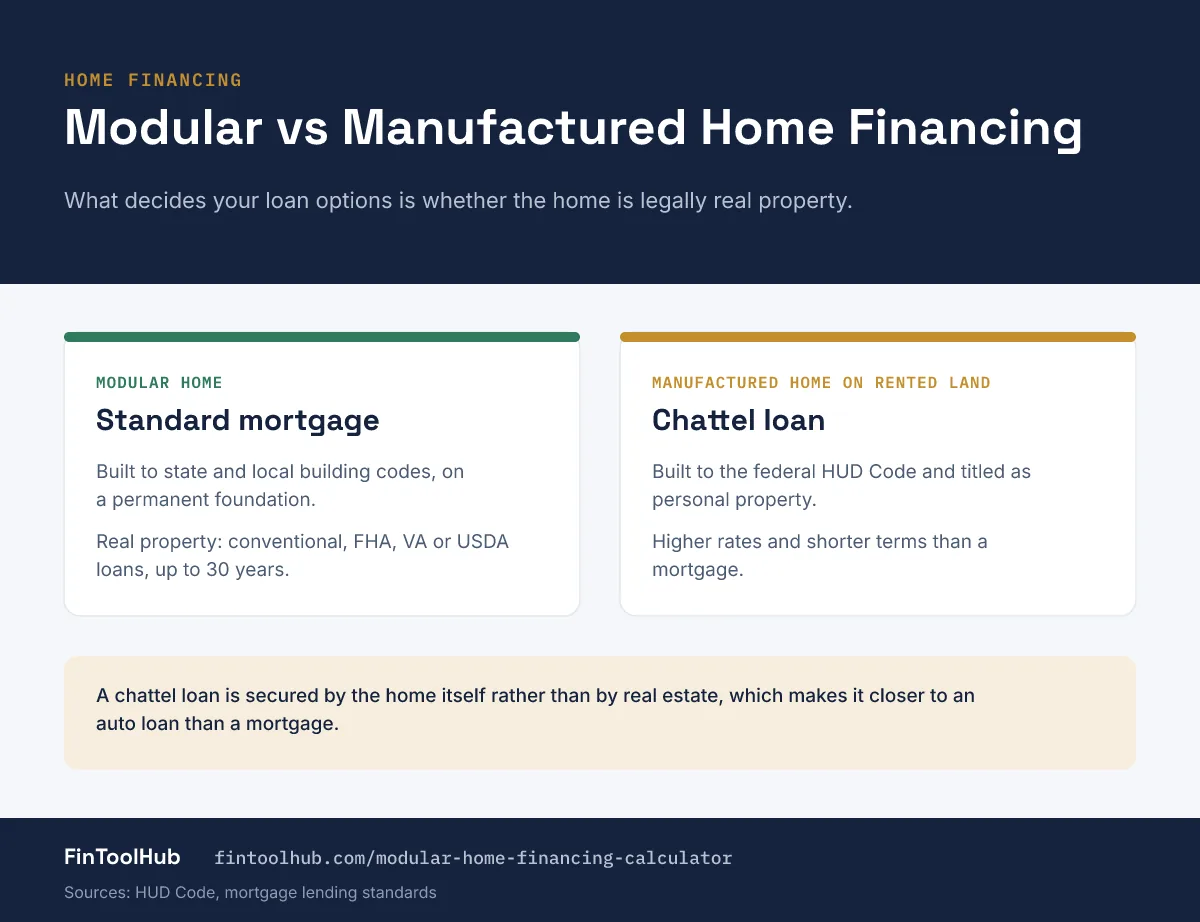
The distinction that decides your financing options
A modular home financing calculator, modular home finance calculator, or a search for financing a modular home calculator usually assumes a straightforward mortgage — and that assumption is generally correct, for a specific reason: modular homes are built to the same state and local building codes as a site-built house, permanently affixed to a foundation on land, and legally classified as real property. That classification is what makes them eligible for the same financing as any other house: conventional loans, FHA, VA, or USDA mortgages, all with standard rates and terms up to 30 years.
Why manufactured homes not on owned land need a different loan entirely
If a manufactured home isn't permanently affixed to land you own, it's typically titled as personal property — legally closer to a vehicle than a house. Lenders finance that situation with a chattel loan: the home itself (not real estate) secures the loan, similar in structure to an auto loan. Chattel loans generally carry higher interest rates and shorter terms than a mortgage, because personal property is considered a riskier, less liquid form of collateral than real estate.
| Factor | Modular (real property) | Manufactured, not on owned land (chattel) |
|---|---|---|
| Loan type | Standard mortgage | Chattel loan |
| Typical term | Up to 30 years | Often 15–23 years |
| Typical rate | Comparable to a standard mortgage rate | Generally higher than a mortgage rate |
| Collateral | The home and the land together | The home only |
Government-backed programs worth knowing about
FHA offers two distinct programs relevant here: Title II insures standard mortgages for manufactured or modular homes classified as real property, on the same terms as any FHA mortgage. Title I is different — a HUD-backed loan specifically designed for manufactured homes and lots, including situations where the home isn't classified as real property, generally with more flexible terms than a private chattel loan. VA and USDA loan programs can also apply to a qualifying manufactured or modular home purchase on owned land, following largely the same eligibility rules as their standard mortgage programs.
What to confirm before you finance
- Foundation type — a permanent foundation is generally required for real-property classification and standard mortgage eligibility.
- Land ownership — owning the land the home sits on is typically necessary for mortgage financing; land-lease communities usually mean chattel financing instead.
- Local titling rules — some states allow converting a manufactured home's title from personal property to real property once it's permanently affixed to owned land, which can open up mortgage financing that wouldn't otherwise apply.
This page reflects standard HUD/FHA program structure (Title I vs. Title II) and general real-property-vs-chattel financing distinctions used across the manufactured and modular housing industry. Rates, terms, and program eligibility change and vary by lender and state — confirm current figures with a lender before relying on this estimate. A live search wasn't available for this specific build; verify current rates independently.
Frequently asked questions
Before you apply for modular or manufactured home financing.
Can I get a regular mortgage for a modular home?
Generally yes. Modular homes are built to local building codes and classified as real property once installed on a permanent foundation, making them eligible for conventional, FHA, VA, or USDA mortgages just like a site-built house.
What's the difference between a modular home and a manufactured home for financing purposes?
Modular homes follow local building codes and are typically real property, eligible for standard mortgages. Manufactured homes follow the federal HUD Code and, if not on owned land with a permanent foundation, are often titled as personal property, requiring a chattel loan instead.
What is a chattel loan?
A loan secured by the home itself as personal property, rather than by real estate — similar in structure to a vehicle loan. Chattel loans are common for manufactured homes on rented land, and generally carry higher rates and shorter terms than a standard mortgage.
What's the difference between FHA Title I and Title II for manufactured homes?
Title II insures standard mortgages for manufactured or modular homes classified as real property. Title I is a separate HUD program specifically for manufactured homes and lots, including situations where the home isn't classified as real property.
Can I convert a manufactured home from personal property to real property?
In many states, yes — if the home is permanently affixed to land you own and meets your state's requirements for retitling, which can open up standard mortgage financing that wouldn't otherwise be available. Requirements vary significantly by state.